

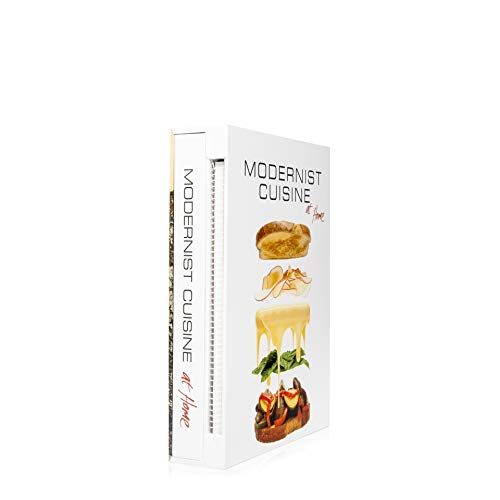
Modernist cuisine at home
Introduction
Nova: Imagine you are one of the wealthiest people on the planet. You were the Chief Technology Officer at Microsoft, you have a PhD from Princeton, and you have worked with Stephen Hawking. What do you do with your spare time? If you are Nathan Myhrvold, you decide to write a cookbook. But not just any cookbook. You write a twenty-four-hundred-page, six-volume behemoth called Modernist Cuisine that costs six hundred dollars and weighs nearly fifty pounds.
Atlas: Fifty pounds? That is not a cookbook, Nova. That is a gym membership. Who is actually cooking from a book that requires a forklift to move?
Nova: Exactly! And that is why we are talking about its younger, slightly more approachable sibling today: Modernist Cuisine at Home. It is still a massive, stunning piece of work, but it was designed to bring the laboratory techniques of the world's best restaurants into a regular kitchen. It is the book that convinced home cooks that they needed a jewelry scale and a pressure cooker to make the perfect grilled cheese.
Atlas: A jewelry scale for a sandwich? This sounds like the most over-engineered approach to dinner I have ever heard of. Is it actually about making better food, or is it just science for the sake of science?
Nova: That is the big question, isn't it? Today, we are diving into the world of Nathan Myhrvold and his team at The Cooking Lab. We are going to look at how they literally cut ovens in half to see how heat moves, why your mac and cheese has been a lie, and how this book changed the way we think about the chemistry of a home-cooked meal.
Key Insight 1
The Science of the Plate
Nova: To understand Modernist Cuisine at Home, you first have to understand the photography. It is probably the most famous part of the book. They didn't just take pictures of food; they used water jets and lasers to cut pots, pans, and even a Weber grill perfectly in half.
Atlas: Wait, they actually sliced the equipment? Why not just use Photoshop? It seems like a lot of effort to destroy a perfectly good grill.
Nova: Because Myhrvold wanted to show the physics of cooking in real-time. When you see a cross-section of a pot of boiling broccoli, you can see exactly how the steam bubbles form at the bottom and how the heat is transferred through the water. It turns cooking from a mystery into a visual map of thermodynamics.
Atlas: Thermodynamics and broccoli. I am starting to see why he was a CTO. But does seeing a bubble form actually help me cook better? Or is it just eye candy?
Nova: It is both. The book argues that if you understand heat transfer, you stop following recipes blindly. For example, they explain that air is a terrible conductor of heat compared to water or oil. That is why you can stick your hand in a four-hundred-degree oven for a few seconds without getting burned, but if you touch four-hundred-degree oil, you are going to the hospital instantly.
Atlas: Okay, that makes sense. So the book is trying to teach us the 'why' behind the 'how.' But I noticed you mentioned a jewelry scale earlier. How precise are we talking here?
Nova: Extremely. One of the core tenets of the Modernist approach is that volume is the enemy of consistency. A cup of flour can weigh significantly different amounts depending on how tightly you pack it. Modernist Cuisine at Home insists on grams. If you want the perfect texture for a sauce, you aren't adding a 'pinch' of something; you are adding exactly zero-point-five percent of the total weight in a specific stabilizer.
Atlas: That feels very clinical. Does it take the soul out of cooking? I like the idea of 'seasoning to taste' and feeling the dough.
Nova: Myhrvold would argue that 'soul' is often just a cover for 'inconsistency.' By being precise, you can achieve the 'soulful' result every single time. They spent years and millions of dollars in a lab testing these variables so you don't have to guess. They are basically giving you the cheat codes to the kitchen.
Key Insight 2
The Secret Ingredients
Nova: Let's talk about the most famous recipe in the book: the Silky Smooth Macaroni and Cheese. This is the one that usually converts the skeptics.
Atlas: How revolutionary can mac and cheese be? You melt cheese, you add noodles. Done.
Nova: But think about what happens when you try to melt high-quality cheddar. It gets oily, it separates, or it gets grainy because the proteins clump together. Traditional recipes use a roux—flour and butter—to keep it together, but that masks the flavor of the cheese.
Atlas: True, roux-based sauces can taste a bit like paste if you aren't careful. So what is the Modernist secret?
Nova: Sodium citrate. It is a type of salt that acts as an emulsifier. In the book, they show you how to dissolve a tiny amount of sodium citrate in water or milk, and then you just whisk in the cheese. The result is a sauce that is as smooth as Velveeta but tastes like the most expensive, aged Gruyère you can find.
Atlas: Sodium citrate? That sounds like something I’d find in a chemistry set, not a pantry. Is it safe? And where do you even get it?
Nova: It is perfectly safe—it is actually what gives club soda its slightly salty taste. And while you couldn't find it at a grocery store when the book first came out, you can get it on Amazon for ten dollars now. This is the 'Modernist' part of the title. They use hydrocolloids and salts to manipulate the structure of food.
Atlas: It feels like we are hacking the food. Are there other 'hacks' like that in the book?
Nova: Tons. They use things like xanthan gum to thicken sauces without changing the flavor profile. They use malic acid to give things a tartness that isn't as 'citrusy' as lemon juice. The book even teaches you how to make 'constructed' eggs where you cook the yolk and the white separately to their perfect, individual temperatures and then put them back together.
Atlas: That sounds like a lot of work for an egg. But I guess if you want the ultimate version of a dish, you have to be willing to go the extra mile. Is the whole book like this? Just chemicals and lab equipment?
Nova: Not at all. A lot of it is about using common tools in uncommon ways. For instance, they are obsessed with the pressure cooker. Most people think of it as a tool for grandma's pot roast, but Myhrvold calls it one of the most important tools in the modern kitchen.
Key Insight 3
The Power Tools
Nova: Why do you think a pressure cooker is so important to a guy who has every laser and centrifuge imaginable?
Atlas: I am guessing speed? It cooks things faster because of the pressure, right?
Nova: Speed is part of it, but the real magic is the temperature. In a normal pot, water boils at two-hundred-and-twelve degrees Fahrenheit. No matter how high you turn the flame, the water stays at that temperature. But in a pressure cooker, you can get the water up to two-hundred-and-fifty degrees.
Atlas: And that extra thirty-eight degrees makes a big difference?
Nova: It is huge for the Maillard reaction—that is the chemical reaction that creates those deep, savory, browned flavors. Usually, you don't get much browning in a wet environment like a soup. But in a pressure cooker, you can actually brown the vegetables and meat while they are submerged. It makes a chicken stock in ninety minutes that tastes like it simmered for twelve hours.
Atlas: Okay, I can get behind that. Better flavor in less time is a win. What about sous vide? I know that is a big part of the Modernist brand.
Nova: It is the cornerstone. Modernist Cuisine at Home was one of the first major books to really push sous vide for the home cook. They explain that if you want a steak medium-rare, which is about one-hundred-and-thirty degrees, why would you put it in a five-hundred-degree pan? You are essentially trying to catch it at the exact millisecond before it overcooks.
Atlas: It is like trying to stop a car at exactly sixty miles per hour by slamming on the brakes right at the finish line.
Nova: Exactly! Sous vide is like cruise control. You set the water to one-hundred-and-thirty degrees, drop the steak in, and it can never, ever get hotter than that. You can leave it in for an hour or four hours, and it will be perfectly edge-to-edge pink every single time.
Atlas: I have to admit, that takes the stress out of cooking expensive meat. But I’ve heard people complain that sous vide meat looks... well, gray and unappetizing when it comes out of the bag.
Nova: And that is where the 'Modernist' technique comes back in. The book teaches you that the 'cook' and the 'sear' are two different processes. You use the water to get the internal temperature perfect, and then you use a blowtorch or a screaming hot cast-iron pan for thirty seconds just to get that crust. It is about separating the variables.
Key Insight 4
The Modernist Mindset
Nova: One of the most interesting sections of the book isn't about a recipe at all—it is about food safety. Myhrvold is a bit of a rebel when it comes to government guidelines.
Atlas: A rebel? Is he telling people to eat raw chicken?
Nova: Not quite, but he points out that the FDA guidelines are often simplified to the point of being misleading. For example, the FDA says you have to cook chicken to one-hundred-and-sixty-five degrees to be safe. But Myhrvold explains that food safety is a function of both temperature and time.
Atlas: So you can cook it lower if you hold it there longer?
Nova: Precisely. If you hold chicken at one-hundred-and-forty-five degrees for about nine minutes, it is just as safe as hitting one-hundred-and-sixty-five for one second. But at one-hundred-and-forty-five, the chicken is incredibly juicy, whereas at one-hundred-and-sixty-five, the fibers have tightened up and pushed out all the moisture.
Atlas: That is a game-changer. But it also sounds like you need a lot of gadgets to do this safely. You need the immersion circulator for the sous vide, the pressure cooker, the digital thermometers... is this book just for rich people with big kitchens?
Nova: That was the main criticism. When it first came out, the equipment list felt elitist. But look at where we are now, over a decade later. You can buy a sous vide machine for fifty dollars at a big-box store. Pressure cookers like the Instant Pot are in millions of homes. Myhrvold didn't just write a book for the elite; he predicted the direction the entire industry was moving.
Atlas: So he was the scout, going out into the wilderness of high-end lab cooking and bringing back the maps for the rest of us.
Nova: That is a great way to put it. He even includes a 'Kitchen Manual' with the book—a spiral-bound, waterproof version of the recipes that you can actually keep on your counter without worrying about getting grease on the beautiful photography in the main volume.
Atlas: That is actually very practical. It shows they know how messy a real kitchen is, even if they are using lasers in theirs.
Conclusion
Nova: Modernist Cuisine at Home is more than just a collection of recipes. It is a manifesto for a new way of thinking about what we eat. It challenges the idea that cooking is an art based solely on intuition and replaces it with the idea that cooking is a craft based on understanding.
Atlas: I came into this thinking it was just about fancy gadgets and 'science-y' food, but it sounds like it is really about empowerment. If you know how the molecules are behaving, you are the boss of the kitchen, not the recipe.
Nova: Exactly. Whether you are using sodium citrate to make the world's best mac and cheese or just using a scale to weigh your flour for a pizza crust, you are applying the principles of the Modernist movement. You are looking for the 'why' behind the 'how.'
Atlas: It makes me want to go out and buy a pressure cooker and some weird salts. At the very least, I’ll never look at a boiling pot of water the same way again.
Nova: And that is the goal. To see the magic in the physics of the everyday. If you want to dive deeper, the book is a visual masterpiece that belongs on any food lover's shelf—even if you never buy a centrifuge.
Atlas: Just make sure your shelf is reinforced. Fifty pounds is no joke.
Nova: Luckily, the 'At Home' version is much lighter! Thank you for joining us on this deep dive into the lab. This is Aibrary. Congratulations on your growth!