

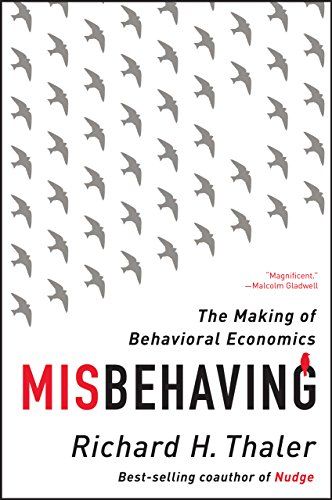
Misbehaving
Introduction: Why We Are All Bad at Money
Introduction: Why We Are All Bad at Money
Nova: Welcome to the show! Today, we are diving into a book that fundamentally changed how we view our own decisions: Richard Thaler's "Misbehaving: The Making of Behavioral Economics."
Nova: : Wait, "Misbehaving"? Are we talking about a self-help guide for toddlers? Because I feel like I need one every time I look at my credit card statement.
Nova: Close! But the misbehavior Thaler is talking about isn't accidental; it's systematic. He argues that for decades, mainstream economics was built on the foundation of the 'Econ'—a perfectly rational, self-interested agent who never makes a mistake.
Nova: : Ah, the mythical creature! The Econ who always maximizes utility, never procrastinates, and perfectly calculates opportunity costs in real-time. I’ve met plenty of people who they are Econs, but they are definitely not.
Nova: Exactly. Thaler’s whole career, chronicled hilariously in this book, was about proving that real humans—the ones who buy lottery tickets, hoard old junk, and spend their bonuses immediately—are the ones who actually run the world. This book is the origin story of behavioral economics.
Nova: : So, it’s the story of how a group of economists decided to stop reading textbooks and start looking at actual people? Why was that such a struggle for the establishment?
Nova: That’s Chapter One. It was a battle to bring academic theory back down to earth. Let's explore the war against the Econs.
The War Against Perfect Rationality
The Battle for Realism: Challenging the 'Econs'
Nova: Thaler’s book paints a picture of the economics profession in the 70s and 80s as incredibly specialized and narrow. They had these beautiful, elegant mathematical models, but they didn't describe reality.
Nova: : It sounds like they preferred the beauty of the math over the messiness of human nature. What was the central flaw in the Econ model that Thaler kept pointing out?
Nova: The Econ assumes three things: perfect self-control, pure selfishness, and perfect information processing. Thaler showed that humans fail on all three counts. We procrastinate, we care deeply about fairness, and we suffer from cognitive biases.
Nova: : I remember reading about the endowment effect early on. That seems like a perfect example of irrationality that Econs couldn't handle. Can you break that down for us?
Nova: Absolutely. The endowment effect is one of the earliest anomalies Thaler studied. It’s the finding that once you own something, you value it significantly more than you would have if you didn't own it. Think about trying to sell a used car or even a coffee mug.
Nova: : Right! I have a chipped mug from a conference five years ago. If someone offered me five dollars for it, I’d scoff. But if I were at a store, I wouldn't pay more than two dollars for the exact same mug. That’s the endowment effect in action, right?
Nova: Precisely. The Econ model says your willingness to pay should equal your willingness to accept compensation, because the mug’s objective utility hasn't changed. But for humans, ownership creates an artificial sense of value. Thaler’s early work was filled with these simple, observable violations of standard theory.
Nova: : And I bet the traditional economists hated that. It’s like telling a master carpenter their perfect dovetail joint is useless because the wood keeps warping in the real world.
Nova: That’s a great analogy. Thaler describes the resistance as intense. He was often told, "If people are irrational, they will be driven out of the market by rational actors." But Thaler’s counter was, "Well, look around. The irrational ones are still here, and they’re running the show!"
Nova: : So, the core of the book is this narrative of a scientific underdog story—the behavioralists fighting the neoclassical giants?
Nova: It is. And it’s a story about how science progresses—by finding the anomalies that the current theory can't explain. Thaler and his colleagues weren't trying to destroy economics; they were trying to make it more accurate, more.
Nova: : It sounds like they were trying to replace the perfect, sterile lab environment with the actual, messy human marketplace.
Why You Can't Mix Your Rent Money with Your Fun Money
The Psychology of Your Wallet: Mental Accounting
Nova: Let's move into one of the most relatable concepts Thaler developed: Mental Accounting. This is where the Econs really start sweating.
Nova: : Mental Accounting. That sounds like something you do when you're trying to balance your checkbook, but failing miserably.
Nova: It is, but it’s deeper than that. Mental accounting is the set of cognitive operations people use to organize, evaluate, and keep track of financial activities. The key word is. We don't treat all money as fungible, which is what standard economics demands.
Nova: : So, if I get a $1,000 tax refund, an Econ says I should look at that $1,000 as one big pool of wealth to allocate optimally. What does a real human do?
Nova: A real human, according to Thaler, puts that $1,000 into a specific mental bucket. Maybe $500 goes into the 'Vacation Fund' bucket, $300 goes into the 'Pay Down Credit Card Debt' bucket, and $200 goes into the 'Guilt-Free Splurge' bucket.
Nova: : And the problem is that the 'Guilt-Free Splurge' bucket often gets raided first, while the 'Debt' bucket sits untouched, even if the debt has a higher interest rate than the vacation fund is earning. It’s illogical, but completely human.
Nova: Exactly. You might be paying 20% interest on a credit card, but you feel morally obligated to spend that tax refund money on a new gadget because it’s earmarked as 'fun money.' Thaler showed that these mental labels dictate behavior, overriding pure economic logic.
Nova: : That explains why I feel better about buying an expensive dinner if I use cash I withdrew specifically for that purpose, versus using my regular debit card where the money just vanishes from the general checking account.
Nova: That’s the power of the label! Another fascinating area Thaler explores is. Econs don't care about fairness; they only care about maximizing their own outcome. But humans will often reject a profitable deal if they perceive it as unfair.
Nova: : I remember reading about experiments where people would rather lose money than accept a low offer. It’s the ultimate economic self-sabotage, all in the name of principle.
Nova: Thaler documented studies showing people refusing a $100 offer if they knew the proposer was keeping $1,000 for themselves, even though $100 is objectively better than $0. We are willing to pay a price—our own utility—to punish unfairness. That’s not an Econ; that’s a human being with a moral compass.
From Theory to Policy
Choice Architecture in Action: The Nudge Revolution
Nova: After establishing we misbehave, Thaler and his collaborator Cass Sunstein took the next logical step: If we can’t stop misbehaving, can we design the environment to make our misbehavior less costly, or even beneficial?
Nova: : This is where the famous 'Nudge' comes in, right? It’s the practical payoff of the whole behavioral economics movement.
Nova: It is. A nudge is any aspect of the choice architecture that alters people's behavior in a predictable way without forbidding any options or significantly changing their economic incentives. It’s about presentation, not coercion.
Nova: : Give me the classic example. The one that made policymakers sit up and take notice.
Nova: The gold standard is retirement savings. Traditional economics suggested offering a 401 plan and hoping people sign up. But humans suffer from inertia and procrastination—a self-control problem.
Nova: : So, the nudge solution is automatic enrollment. Instead of having to actively opt-in, you are automatically enrolled unless you actively opt-out.
Nova: Precisely. Thaler notes that when companies switched from opt-in to opt-out for retirement plans, participation rates skyrocketed, sometimes from 50% to over 90%. The default setting, the choice architecture, did the heavy lifting.
Nova: : That’s brilliant because it respects freedom of choice—the Econ ideal—while leveraging human laziness—the human reality. You can still say no, but you have to to say no.
Nova: And it’s not just about retirement. Thaler discusses how nudges are used in health—like putting healthier food at eye level in a cafeteria—or in energy consumption. It’s about making the path of least resistance the path toward the best outcome.
Nova: : It sounds like Thaler gave governments and corporations a new, softer tool. Instead of heavy-handed taxes or regulations, they can use subtle design to improve welfare.
Nova: That’s the goal. Thaler argues that since we always have a choice architect—whether it’s a government setting a default or a grocery store arranging its shelves—we should ensure that architect is benevolent. The book makes a powerful case that economics should be a force for good, capitalizing on our predictable flaws to help us achieve our own long-term goals.
Conclusion: The Legacy of Being Human
Conclusion: The Legacy of Being Human
Nova: So, what’s the ultimate takeaway from Thaler’s journey in "Misbehaving"? It’s that the pursuit of perfect, abstract models came at the cost of understanding actual human beings.
Nova: : And the legacy is that we finally have a framework—Behavioral Economics—that accepts our limitations: our poor self-control, our tendency to categorize money into silly buckets, and our need for fairness.
Nova: The key action item for listeners is to recognize their own mental accounts and defaults. Are you spending from your 'fun money' bucket while ignoring high-interest debt? Are you relying on a default setting in your life that doesn't serve your future self?
Nova: : It forces you to be an active architect of your own environment, rather than a passive participant in the default settings others have chosen for you. It’s about recognizing that we are not Econs; we are flawed, emotional, and sometimes wonderfully predictable humans.
Nova: And that predictability is the key. It allows us to design systems—whether for saving, health, or happiness—that work our nature, not against it. Thaler didn't just write a book; he helped build a whole new branch of social science by insisting we look in the mirror.
Nova: : A necessary, and apparently very entertaining, correction to the world of high finance. I feel much better about my own misbehavior now that I know it’s scientifically validated.
Nova: That’s the spirit! Thank you for joining us on this deep dive into the wonderfully messy world of human decision-making. This is Aibrary. Congratulations on your growth!