

The Commander's Comeback: Regaining Control with Mini Habits
Golden Hook & Introduction
SECTION
Prof. Eleanor Hart: You have big goals. You're a natural leader, you see the path forward... but when it comes to the day-to-day, you feel tired, overwhelmed, and stuck. You're not alone. What if the secret to regaining control isn't to aim higher, but to aim so ridiculously small that you can't possibly fail?
chuqinglai: That’s a really provocative question, Eleanor. It feels completely counter-intuitive, especially when you're driven to achieve.
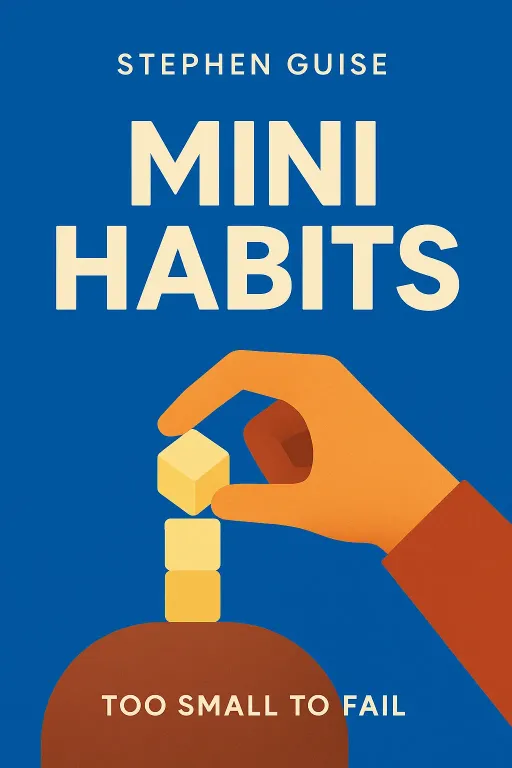
Prof. Eleanor Hart: Exactly. And that's the paradox we're exploring today through the lens of Stephen Guise's brilliant book, "Mini Habits." I'm your host, Professor Eleanor Hart, and I'm here with chuqinglai, an aspiring product manager and a natural commander-type leader who, like many of us, has felt that frustrating gap between ambition and action. Welcome, chuqinglai.
chuqinglai: Thanks for having me, Eleanor. That gap you mentioned… it’s a very real feeling. You have this vision, but the daily execution feels like wading through mud. You end up feeling powerless.
Prof. Eleanor Hart: Perfectly said. Well, today we're going to find a way out of that mud. We'll tackle this from two angles. First, we'll dismantle the myth of motivation and show why willpower is your real superpower when used correctly. Then, we'll become neuroscientists for a day, looking at how these tiny habits cleverly hack our brains to create change without the usual fight.
Deep Dive into Core Topic 1: The Motivation Trap vs. The Willpower Muscle
SECTION
Prof. Eleanor Hart: So, chuqinglai, let's start with something we all know: the New Year's resolution. That huge burst of motivation on January 1st... where does it usually go by February 1st?
chuqinglai: It’s usually gone, along with the gym membership card I bought. You feel this incredible energy to change everything, but it's a feeling, and feelings are fickle. They don't survive a cold, rainy Tuesday morning.
Prof. Eleanor Hart: Precisely. Guise argues that our culture is obsessed with motivation, but it's the most unreliable strategy for change because it's based on emotion. When you feel great, you can do anything. When you feel tired or stressed, motivation vanishes. And this is where the core story of "Mini Habits" begins. It’s called the "One Push-up Challenge."
chuqinglai: I'm intrigued. One push-up sounds... well, a bit pathetic.
Prof. Eleanor Hart: That's exactly what the author, Stephen Guise, thought! Picture this: It's late 2012. He's been trying to get fit for a decade, with the usual cycle of starting and stopping. He knows he do a 30-minute workout, but the thought is exhausting. He feels lazy, unmotivated, and the mental resistance is like a physical wall.
chuqinglai: I know that wall very well. It's the "I'll do it later" wall, which really means "I'll do it never."
Prof. Eleanor Hart: Exactly. So, in a moment of desperation, he thinks, "What's the opposite of a 30-minute workout?" And this absurd idea pops into his head: one single push-up. His first thought was, "How pathetic! One push-up isn't going to help anything." But then a second thought followed: it was so ridiculously easy, he couldn't do it. So he got on the floor and did one push-up.
chuqinglai: Okay, so he did one. Then what?
Prof. Eleanor Hart: This is the magic. After he did one, he thought, "Well, I'm already down here... maybe I'll do a few more." He ended up doing several. Then he thought, "I'll do one pull-up." And that turned into more. By breaking the workout into a series of tiny, non-intimidating micro-goals, he ended up doing a full 20-minute workout plus a 10-minute ab video. He had tricked himself into starting.
chuqinglai: That's fascinating. It's the 'activation energy' problem from chemistry, but for human behavior. The biggest hurdle is just starting the reaction. By making the initial step almost zero-effort, he bypassed the resistance entirely.
Prof. Eleanor Hart: You've hit on the key insight. The one push-up didn't motivation; it it. Action came first. This flips the entire personal development script on its head. We're taught to wait for motivation to strike before we act. Guise proves that if you act first, even in a tiny way, motivation often follows as a byproduct.
chuqinglai: That makes so much sense from a product management perspective. We're always trying to reduce friction for users to get them to take that first click or sign up. This is just applying that same principle to yourself. You're reducing your own internal friction to zero.
Prof. Eleanor Hart: It’s the ultimate user-experience design for your own brain. And this leads us directly to the 'why' it works. It's not just a psychological trick; it's a brilliant piece of neurological engineering.
Deep Dive into Core Topic 2: Hacking Your Inner CEO: Training the Habit Machine
SECTION
Prof. Eleanor Hart: The reason that 'one push-up' trick works so well isn't just a mind game, it's about understanding the two key players in your brain. Guise simplifies it beautifully. Think of your brain as having two parts: the conscious part, your prefrontal cortex, which he calls the "Smart Manager," and the subconscious part, the basal ganglia, which is the "Stupid Repeater."
chuqinglai: A Smart Manager and a Stupid Repeater. I like it. It sounds like a corporate structure.
Prof. Eleanor Hart: It's the perfect analogy for you! Your Smart Manager—the CEO—is you. It sets goals, it wants to get that promotion, learn a new skill, be healthier. It understands long-term benefits. But, it has a major weakness: it gets tired very easily. This is what scientists call willpower depletion or ego depletion. Every decision, every act of resistance, drains its battery.
chuqinglai: That completely explains why after a long day of classes and complex project planning, the idea of working on my English presentation skills feels impossible. My 'Smart Manager' has no energy left, even though it knows the presentation is important for my career.
Prof. Eleanor Hart: Exactly. And when the Smart Manager is tired, who takes over? The Stupid Repeater. The basal ganglia is your brain's habit center. It doesn't care about your long-term goals. It's a pattern-matching machine that loves efficiency and hates change. Its job is to automate everything to save energy. So when you're tired, it just runs the old, easy programs: scroll through your phone, watch another episode, avoid the difficult task.
chuqinglai: So a big, ambitious goal like "I'm going to work out for an hour every day" is a direct threat to the Stupid Repeater. It sees this massive new pattern and immediately resists.
Prof. Eleanor Hart: It sounds the alarm! It's too much change, too much effort. But a mini habit—one push-up, reading one page, writing 50 words—is different. It's a "low-willpower Trojan horse." It's so small and insignificant that the Stupid Repeater doesn't even notice it. It's not a threat. You're not trying to force a huge new policy on the factory floor; you're just sneaking in one tiny, new piece of code.
chuqinglai: So you're not launching a full-scale invasion of your old habits. You're sending in a single, disguised scout. As a PM, that's like running a tiny A/B test on yourself. The cost of failure is zero, but the potential for learning and scaling is huge. But that brings up the critical question: how do you ensure that 'scout' doesn't just stay a scout? How does one push-up become a real, consistent workout habit?
Prof. Eleanor Hart: Great question. It happens in two ways. First, as we saw with the push-up story, you often get "bonus reps." The act of starting makes continuing easier. But second, and more importantly, the habit is built on, not. Even on the days you feel awful and only do the bare minimum—one push-up—you've still marked a win. You've still reinforced the neural pathway for that new behavior. You've kept the chain of success unbroken.
chuqinglai: So the daily win, no matter how small, is what trains the Stupid Repeater. It starts to see this new action as part of the daily pattern. The resistance lowers over time, not because you're forcing it, but because you're gently persuading it.
Prof. Eleanor Hart: You've got it. You're teaching your brain, "This is who we are now. We're the kind of person who does at least one push-up a day." And once that identity takes hold, the behavior becomes automatic. It becomes easier to do it than not to do it.
Synthesis & Takeaways
SECTION
Prof. Eleanor Hart: So, let's bring it all together. We've seen that by ditching unreliable motivation for small, strategic uses of willpower, and by understanding how to work our brain's habit-making machinery instead of against it, we can break that cycle of inaction and feeling powerless.
chuqinglai: This feels... genuinely manageable. It's not about a massive life overhaul tomorrow. It's about winning one small, guaranteed victory today. It reframes success from this giant, intimidating mountain into a single, easy first step. It gives you back a sense of control.
Prof. Eleanor Hart: That's the perfect way to put it. It's about regaining that sense of control, that self-efficacy. So, chuqinglai, for our listeners who are feeling that same sense of being stuck—maybe they want to improve their leadership skills, practice self-care, or just feel more in command of their day—what's one 'stupid small' step they could take, starting today?
chuqinglai: I think it's about applying this to your specific goal. If you want to improve your presentation skills, don't set a goal to 'practice my whole presentation.' The mini habit could be 'open the PowerPoint and write one slide title.' That's it. If you want to practice self-care, don't commit to 'meditate for 30 minutes.' Your mini habit could be 'sit down and take one single, deep breath.'
Prof. Eleanor Hart: Beautiful. It's about making that first step so easy, so non-negotiable, that you simply can't fail. And in that small, daily victory, you find the power to build something truly big. Chuqinglai, thank you for bringing your sharp insights to this.
chuqinglai: Thank you, Eleanor. This has been incredibly clarifying. It feels like I've been given a key to a door I thought was permanently locked.









