

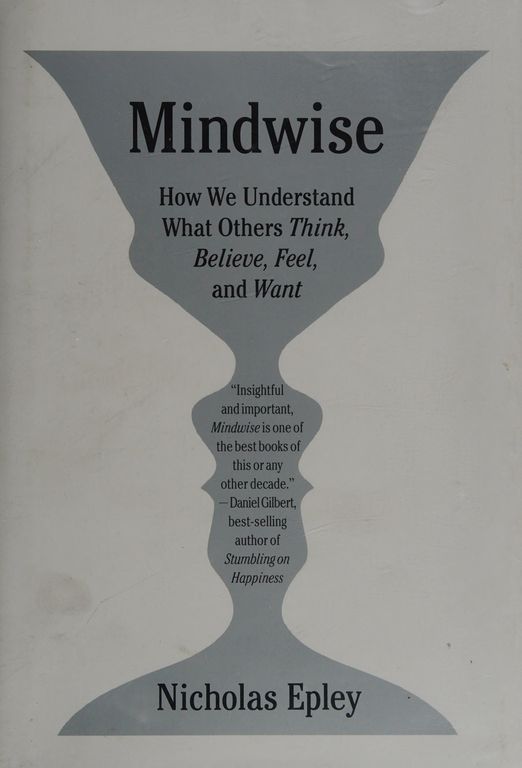
Mindwise
How We Understand What Others Think, Believe, Feel, and Want
Introduction
Nova: You are a mind reader. You do it dozens of times every single day — guessing what your boss really thinks of your presentation, sensing whether your partner is actually fine or secretly furious, intuiting why that stranger on the subway just scowled at you. Nicholas Epley, a behavioral scientist at the University of Chicago, argues this is our sixth sense — and it might be the most important social tool we have. But here's the twist: we are spectacularly bad at it.
Nova: That's from his book Mindwise, and I have to say, it's one of those rare psychology books that makes you realize just how often you walk around absolutely certain you understand someone — and you're dead wrong.
Nova: Think about that. You have conversations in your head about what other people are thinking. You make decisions based on those imagined thoughts. And yet, Epley's research shows that strangers reading each other are accurate only about 20 percent of the time. Close friends and spouses? They get it right about 35 percent of the time. That means even with the person you love most, you're wrong nearly two out of three times.
Nova: So today we're unpacking Mindwise — what our sixth sense actually is, why it fails so predictably, and the one deceptively simple strategy Epley says can transform how you connect with everyone around you. I'm Nova, and welcome to Aibrary.
The Illusion of Insight
Our Overconfident Sixth Sense
Nova: Let's start with the core claim of Mindwise. Epley says we are born mind readers — not in a supernatural way, but in the sense that we constantly infer what others think, believe, feel, and want. This ability is what allows us to build relationships, cooperate in teams, navigate office politics, and form entire societies. It's always on, operating so smoothly that, as philosopher Jerry Fodor put it, commonsense psychology works so well it disappears.
Nova: Right. And the problem, Epley argues, is that this sense comes with a massive overconfidence problem. We think we're much better at reading minds than we actually are. He cites a meta-analysis on deception detection: across hundreds of studies, the average person can tell when someone is lying about 54 percent of the time. A coin flip gets you 50 percent. So all that intuition you have about who's lying? It's barely better than random chance.
Nova: Exactly. And it gets more sobering. Epley describes experiments where people predicted how their romantic partners would answer questions about their attitudes — things like whether they preferred paying in cash or how they felt about family debt. Strangers had essentially no accuracy. Close friends and spouses did better, but still missed the mark around 65 percent of the time. And here's the thing: the longer people were married, the more confident they became about knowing their spouse's mind — but their actual accuracy did not improve. The illusion of insight grew; the insight itself did not.
Nova: That's fascinating and kind of terrifying. So familiarity breeds confidence, not understanding.
Nova: Precisely. And this overconfidence has real consequences. Epley opens the book with a deeply personal story. He traveled to Ethiopia with his wife to adopt two children, and he met the children's biological father. He desperately wanted to know what that man was thinking and feeling as he handed over his children. And Epley realized, in that raw moment, just how impenetrable another person's mind truly is. You can guess, you can infer, but you can never really know unless they tell you. And most of the time, we don't ask — because we think we already know.
Nova: So the first big takeaway is humility. You don't know what's going on in someone else's head nearly as well as you think you do.
Naive Realism and the Two Ego-Traps
Strangers to Ourselves
Nova: Here's another uncomfortable truth from the book: we are not just bad at reading others — we're bad at reading ourselves. Epley cites psychologist Timothy Wilson's idea that we are strangers to ourselves. We think introspection gives us direct access to why we feel what we feel, but in reality, our conscious mind is only seeing the finished products of our brain's processing. The actual triggers, the unconscious associations, the contextual nudges — we're blind to all of it.
Nova: So when I say I'm in a bad mood because of traffic, I might actually be in a bad mood because of something else entirely, and I'm just constructing a plausible story after the fact?
Nova: That's exactly it. Epley says introspection is blind to construction. Your brain spins a compelling narrative about why you think and feel things, and you believe that narrative completely — even when it's wrong. He uses the planning fallacy as an example: ask yourself when you'll finish a project, and you'll give an optimistic estimate. But you'll almost certainly be late. You have access to your intentions but not to all the obstacles and delays your brain conveniently overlooks.
Nova: This connects to what Epley calls naive realism — the intuitive sense that we see the world as it actually is, rather than as it appears from our own perspective. He quotes George Carlin: have you ever noticed that everyone driving slower than you is an idiot, and anyone driving faster is a maniac? That's naive realism in action. You think your perception is objective truth, and anyone who disagrees must be biased.
Nova: And this is where Epley introduces his two egocentric traps — the neck problem and the lens problem. What are those?
Nova: The neck problem is about attention. Two people can look at the same situation but notice completely different things — like necks pointing in different directions. The lens problem is deeper: even when you're looking at the same thing, your beliefs, attitudes, and knowledge color how you interpret it. And the really tricky part, Epley says, is that you look through your lens rather than at it — so you don't even realize your perception is being shaped. You simply conclude the other person is wrong.
Nova: So the neck problem is easier to fix — you can ask someone what they're paying attention to. But the lens problem? That's much harder, because you can't see your own biases.
Nova: Right. And Epley's research suggests this is why so many conflicts feel intractable. Each side genuinely believes they're seeing things clearly and the other side is deluded. The phrase he uses is I'm right, and you're biased. That sentiment, he says, comes straight from naive realism — and it's at the center of almost any difference of opinion.
Dehumanization and Anthropomorphism
When Minds Disappear and When They Don't Exist
Nova: Now let's get into one of the most striking parts of Mindwise: the idea that our sixth sense has an on-off switch, and we don't always toggle it correctly. Sometimes we fail to see a mind where one clearly exists — that's dehumanization. Other times we see a mind where none exists — that's anthropomorphism. Both are errors, and both reveal how this mental machinery works.
Nova: Give me an example of dehumanization from the book.
Nova: Epley tells a brutal story about a man named Walter Vance who had a heart attack while shopping at a Target on Black Friday. He collapsed in the aisle, and shoppers literally stepped over him to grab discounted coffee pots. They weren't monsters — they were just in a context where their mind-reading ability was disengaged. The crowd, the frenzy, the focus on products — it creates what Epley calls psychological distance. And when you feel distant from someone, you stop seeing the full human mind. This is the same mechanism that allows people to dehumanize entire groups — enemies in war, political opponents, even employees, who bosses often assume are motivated only by money when in reality they care deeply about meaning and autonomy.
Nova: And there's a great champagne story that illustrates the absurdity of this.
Nova: Yes. When the French began making champagne for the British market, they discovered the British preferred it much drier than the French did. The French found this version unpalatable and named it brut sauvage — basically, savage brute. Who but an unsophisticated savage could enjoy such a thing? The joke was on the French: brut is now the most popular champagne style in the world. Dehumanizing the other side's taste didn't make them right; it just made them blind.
Nova: On the flip side, when do we see minds where none exist?
Nova: Epley says three things trigger anthropomorphism: when something looks like it has a mind, when its behavior can be explained by having a mind, and when we're lonely and craving connection. That's why people plead with their cars on cold mornings, why office workers post signs near copiers reading don't let the copier know you're in a hurry — it smells fear, and why studies show that making people feel lonely in a lab temporarily increases their belief in God. We reach for minds because minds make sense of the unexplainable.
Nova: So both errors — missing minds and inventing them — come from the same underlying need to make the world comprehensible.
Nova: Exactly. And Epley's point is that awareness of these triggers is half the battle. Once you know that distance disengages your sixth sense, you can deliberately re-engage it. Once you know that a computer isn't actually out to get you, you can laugh at your own mental shortcut.
Perspective Taking vs. Perspective Getting
The Big Pivot
Nova: This brings us to what I think is the most practical and counterintuitive insight in the entire book. Epley takes direct aim at one of the most cherished pieces of advice in the world: put yourself in someone else's shoes. Dale Carnegie recommended it. Barack Obama recommended it. It sounds so wise. And Epley's research shows it does not work — and can actually make things worse.
Nova: Wait, perspective taking makes you less accurate?
Nova: In some cases, yes. Epley and his collaborators ran 25 experiments testing whether being instructed to adopt another person's perspective increased interpersonal insight. Across the board, perspective taking did not improve accuracy. In one experiment, couples who were told to carefully adopt their partner's perspective before predicting their attitudes actually became slightly less accurate than couples who just guessed. In another study, negotiators dealing with a simulated overfishing crisis who were told to take the other side's perspective ended up more distrustful and more selfish — they collapsed the fishery faster than the control group.
Nova: Why? What's going wrong?
Nova: Because perspective taking relies on whatever is already in your head. If your mental model of the other person is wrong — if you're filling in the gaps with stereotypes, or projecting your own feelings, or missing crucial context — then carefully imagining their perspective just amplifies your error. You're not accessing their mind; you're accessing your own simulation of their mind, which is distorted by your lens.
Nova: So what does Epley recommend instead?
Nova: Perspective getting. Instead of trying to imagine what someone thinks, you ask them. You listen. You get their perspective directly. And Epley has a stunning real-world example: the repeal of don't ask, don't tell in the U. S. military. In 2010, 1,167 retired military officers signed an open letter opposing repeal, arguing from their past experience that it would destroy morale. Meanwhile, the Pentagon took the perspective-getting route: they surveyed 115,052 active-duty soldiers and 44,266 of their spouses. Seventy percent said repeal would have no effect or a positive effect. Sixty-nine percent said they'd already worked with a gay service member, and 92 percent of those said it had no negative impact or a positive one. When the repeal actually happened in 2011, the military's own follow-up study called it a non-event. The retired officers, for all their experience, were wrong. The soldiers themselves, when asked, were right.
Nova: That's a powerful illustration. But what about situations where people won't tell you the truth?
Nova: Epley addresses this head-on. The main reason people lie, he says, is to avoid punishment. If you want honest perspective, you have to create a context where truth-telling feels safe. He describes a household policy he and his wife developed: complete immunity for honesty, combined with a cooling-off period before difficult conversations. He also says that interrogators often discover they themselves are the main barrier to truth-telling — when suspects fear the interrogator, they clam up. When they feel heard rather than judged, they open up.
Nova: So the rule of thumb from the book: if you're guessing about someone else's perspective, you're probably wrong. Just ask.
Nova: That's it. Simple, but genuinely transformative. The slow work of getting someone's perspective — through conversation, through surveys, through face-to-face interaction — is how you understand them accurately. As Epley puts it, companies truly understand their customers when they get their perspective directly, not when executives guess about them in the boardroom.
Conclusion
Nova: So let's pull this together. Mindwise is ultimately a book about intellectual humility — about recognizing that the minds of others are not open books to us, no matter how confident we feel. Epley's research shows we're wrong about strangers four out of five times and wrong about loved ones two out of three times. We don't even understand our own minds as well as we think, thanks to the invisible construction happening beneath conscious awareness.
Nova: We're trapped by naive realism, convinced our view is objective and anyone who disagrees is biased. We dehumanize people when we feel distant from them and anthropomorphize gadgets when we're lonely or confused. And the solution we've been taught — perspective taking — often backfires because it just amplifies our existing misconceptions.
Nova: But the hopeful message is that the fix is within reach. Perspective getting. Asking. Listening. Creating safety for honest answers. It's not flashy advice, but it's backed by rigorous evidence. The Pentagon got it right with 115,000 surveys. The retired generals got it wrong with their confident imaginations.
Nova: Epley closes the book by quoting Marcel Proust: The stellar universe is not so difficult of comprehension as the real actions of other people. But he also offers a path forward. Be less certain about what you think others are thinking. Engage your sixth sense deliberately — especially with people who seem distant or different from you. And when you really want to know what's on someone's mind, shut up and listen. As the old medical maxim goes: the patient is trying to tell you what's wrong. You just have to let them.
Nova: This is Aibrary. Congratulations on your growth!