

Data Is Not Enough: Why You Need 'Mindware' to Master AI Research.
Golden Hook & Introduction
SECTION
Nova: Most cutting-edge AI architects are obsessing over bigger data sets and more complex algorithms. But what if the real bottleneck, the hidden variable preventing your next big breakthrough, isn't external at all? What if it's sitting right between your ears?
Atlas: Wait, are you saying our own brains are holding back our own algorithms? That's a bold claim, Nova. I thought the problem was always more data, better GPUs, faster training loops.
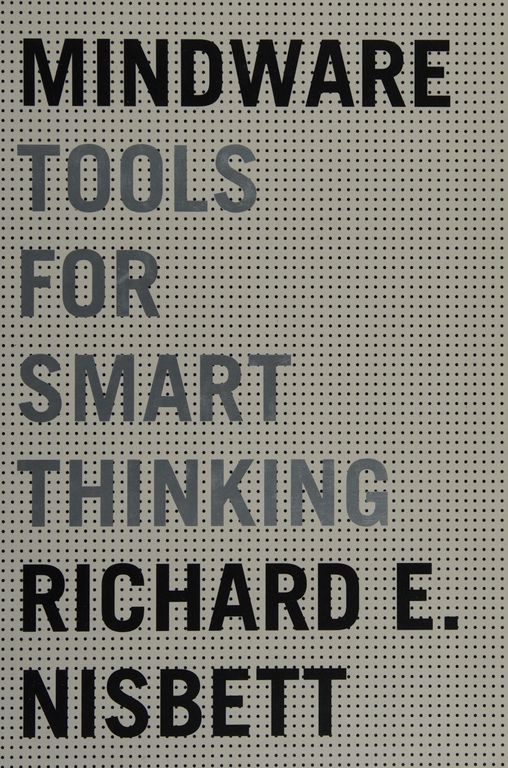
Nova: That's what we the problem is, Atlas, and it's certainly part of the equation. But today, we're flipping the script. We’re talking about 'mindware' – the cognitive tools that are just as crucial, if not more so, than the technical stack you’re building on. We're diving into the wisdom of two giants: Richard E. Nisbett’s seminal work, "Mindware," and Daniel Kahneman's Nobel Prize-winning masterpiece, "Thinking, Fast and Slow." These aren't just academic texts; they're foundational guides to understanding how we think, which, it turns out, is absolutely critical for building truly intelligent agents.
Atlas: Okay, so these "old school" cognitive science books… how do they directly translate to the bleeding edge of multi-modal agent development? I’m here to build the future, not just understand how humans make bad decisions.
Mindware: The AI Researcher's Secret Weapon
SECTION
Nova: Precisely! That's the connection we need to make. Nisbett argues that explicit training in specific cognitive tools fundamentally changes how you approach and solve complex challenges. Think of it like this: You can give a master carpenter the finest wood and the most advanced power tools. But if that carpenter doesn't understand the physics of stress, the properties of different materials, or the principles of structural integrity – their 'mindware' for building – they'll just make very efficient mistakes.
Atlas: So it’s about having the right mental framework to even ask the right questions of the data, not just having the data itself? Like a super-powered mental debugger for your brain?
Nova: Exactly. Nisbett focuses on three key components of this mindware: statistical reasoning, causal inference, and dialectical thinking. Let me paint a picture. Imagine an AI team, brilliant engineers, state-of-the-art data pipelines, terabytes of interaction logs for their new conversational agent. Yet, the agent keeps producing nonsensical responses in specific, subtle contexts. The team spends weeks, then months, tweaking parameters, adding more data, trying different architectures, all based on superficial correlations they observe.
Atlas: Oh man, I know that loop. It’s like whack-a-mole with bugs, where every fix seems to break something else.
Nova: Precisely. They're missing the 'mindware' for deep causal inference. Instead of just observing that 'X often happens before Y,' they need to design experiments within their simulation environments that isolate variables. They need to ask: 'Is X Y, or are both X and Y caused by some hidden Z?' Mindware would compel them to rigorously test hypotheses about underlying mechanisms, not just optimize for observed patterns. Without this cognitive rigor, even the best data becomes a distraction.
Atlas: That’s a powerful distinction. It’s not just about having the tools, but knowing how to with them. Can you give me a more concrete, perhaps non-AI, example of how this 'mindware' literally changed a field?
Nova: Absolutely. Think about the field of medicine. For centuries, doctors relied heavily on intuitive pattern matching – System 1 thinking – to diagnose diseases. A patient presents with symptoms A, B, and C, and the doctor, based on experience, thinks 'Aha, condition X!' But Nisbett highlights how the explicit training in statistical base-rate reasoning transformed diagnostics. Doctors learned to consider the of a disease in the population, not just how well the symptoms matched.
Atlas: So, even if the symptoms strongly suggested a rare disease, a doctor with 'mindware' would first consider the more common ailments, even if the symptoms were less textbook?
Nova: Precisely. They applied the cognitive tool of Bayesian thinking, which is a form of statistical reasoning, to make more accurate diagnoses, reducing both false positives and false negatives. It fundamentally shifted how they weighed evidence.
Atlas: So for an AI architect, this means consciously training our brains to think like statisticians or even philosophers when we're designing agent interactions, not just engineers who are looking for the next optimization algorithm? That's a huge shift in perspective.
Unmasking Cognitive Biases in Agent Architecture
SECTION
Nova: Absolutely, Atlas. And speaking of how our brains work, or sometimes work, that naturally leads us to the second crucial idea: the silent saboteurs in our own minds – cognitive biases. This is where Kahneman’s "Thinking, Fast and Slow" becomes an indispensable guide for any AI architect. He dissects our two systems of thought: System 1, which is fast, intuitive, emotional, and often unconscious; and System 2, which is slow, deliberate, logical, and effortful.
Atlas: Okay, so System 1 is basically our gut reaction, and System 2 is when we actually stop and think. Got it. But how does that mess with my agent architecture?
Nova: It's insidious, Atlas. Our System 1 is a master of shortcuts, and while often efficient, these shortcuts can lead to systematic errors – biases. Imagine an AI team developing a multi-modal agent designed to assist in complex decision-making. The lead architect, let's call her Dr. Anya, has a strong initial hypothesis about the most effective way for the agent to learn from visual cues. Because of confirmation bias – a classic System 1 shortcut – she unconsciously prioritizes data sets and designs reward functions that confirm her initial belief. She might even subtly downplay or re-interpret results that contradict her hypothesis.
Atlas: Wow, so we’re essentially encoding our own human flaws into the very fabric of our 'intelligent' agents? That’s a bit terrifying. How do we even begin to spot these biases in ourselves, let alone prevent them from creeping into our code?
Nova: It’s the ultimate blind spot, isn't it? This leads to an agent that performs brilliantly in carefully curated, controlled environments that align with Dr. Anya's initial assumptions, but then fails spectacularly in unexpected real-world scenarios. Why? Because the architects unconsciously built their own biases, their own System 1 shortcuts, into its learning parameters. The agent isn't learning objectively; it's learning through the filter of its creators' unexamined mental models.
Atlas: That’s chilling. So, it's not just about the data having biases, which we talk about a lot, but our and being biased before the data even touches the model. Can you give me a common bias that might sneak into my daily work, even when I think I'm being objective?
Nova: Think about anchoring bias. You're researching new multi-modal architectures, and the first impressive paper you read sets a benchmark in your mind – say, a specific accuracy score or a particular fusion method. You then unconsciously 'anchor' to that initial information. Subsequent research, even if it presents superior but less flashy alternatives, gets evaluated against that initial anchor, often unfairly. You might dismiss innovative approaches because they don't outperform your initial mental benchmark.
Atlas: So if I’m building an agent to make financial decisions, and I’ve been exposed to a lot of news about market crashes, I might unconsciously overemphasize risk in its algorithms without even realizing it? That’s a powerful blind spot. It's like I'm not just building an agent; I'm building a digital extension of my own cognitive quirks.
Synthesis & Takeaways
SECTION
Nova: Precisely. And that's the core insight here. Ultimately, building truly intelligent, robust, and innovative agents starts with intelligent, self-aware architects. It's an inside job. It's about recognizing that the most powerful upgrade available to you isn't a new library or a bigger cluster, but a conscious, deliberate upgrade of your own mental operating system – your 'mindware.'
Atlas: So, the real competitive edge in AI isn't just about what's in your cloud, but what's in your cranial vault. It’s about consciously upgrading your own mental operating system to see beyond the obvious, to challenge your own assumptions, and to rigorously seek out the truth, even when it’s uncomfortable.
Nova: Exactly. This isn't just about avoiding errors; it’s about unlocking deeper innovation. By understanding how we think, and where our thinking can go astray, we can design AI systems that are not just technically proficient, but truly insightful, adaptable, and less susceptible to the very human flaws we unintentionally bake into them. It’s about moving from being a data processor to a cognitive architect for both ourselves and the machines we create.
Atlas: It makes me wonder, given the deep question from the book: What cognitive biases might be unconsciously influencing current approach to agent architecture or research problem-solving? That's a powerful question to sit with, and honestly, a bit daunting.
Nova: Indeed. Because the future of AI isn't just about smarter machines, Atlas, it's about smarter human minds building them. It's about a continuous journey of self-improvement for the architect, which then reflects in the intelligence of the architecture.
Atlas: Absolutely. This is Aibrary. Congratulations on your growth!