

Beyond the Algorithm: Cultivating Intuition and Presence in a Data-Driven World
Golden Hook & Introduction
SECTION
Nova: Atlas, five words to describe your ideal mental state when tackling a complex problem. Go.
Atlas: Focused, curious, challenged, effortless, deeply satisfying.
Nova: Oh, you just gave away our whole episode! Because that, my friend, is precisely what we're aiming for today. We're diving into how to cultivate intuition and presence in a world absolutely swimming in data.
Atlas: I like that! It's like finding your superpower in the middle of a spreadsheet.
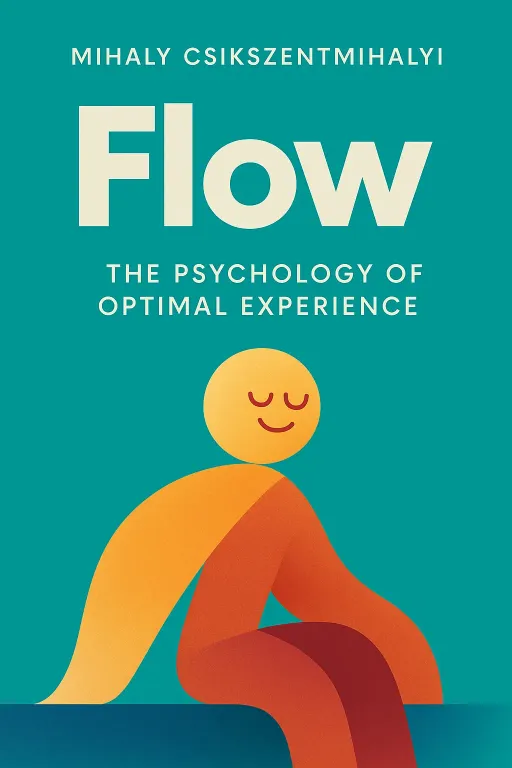
Nova: Exactly. And we're drawing heavily from two foundational works here: Mihaly Csikszentmihalyi's "Flow: The Psychology of Optimal Experience" and Carol Dweck's "Mindset: The New Psychology of Success." Csikszentmihalyi, a Hungarian-American psychologist, spent decades researching what makes people truly happy and creative. He famously coined the term 'flow' after observing artists so engrossed in their work they'd forget food, water, even sleep. His work is a cornerstone of positive psychology.
Atlas: And Dweck’s research on mindsets totally revolutionized how we think about learning and achievement. It feels like these two books, when combined, offer a really powerful playbook.
The Unseen Edge: Flow and Growth Mindset
SECTION
Nova: They absolutely do. Let's start with Flow. Csikszentmihalyi describes it as this state of optimal experience where you're completely immersed in an activity. You're fully involved, energized focus, deep enjoyment. Time seems to disappear. The characteristics are clear goals, immediate feedback, and, crucially, a balance between the challenge of the task and your skills.
Atlas: But wait, for someone who processes vast information and seeks strategic advantage, isn't 'losing yourself' a bit counter-intuitive? How does that translate to high-stakes decision-making? You still need to be analytical, right?
Nova: That's a great question, and it's where the magic truly happens. Flow isn't about losing control; it's about gaining a different kind of control, where conscious thought recedes, and action becomes fluid. Think of an experienced surgeon in the middle of a complex operation. The data, the patient's vitals, the scans—all of that information is critical. But in the most intense moments, the surgeon isn't consciously analyzing each data point. Their hands move with an almost intuitive grace, responding to immediate feedback from the tissue, the instruments. They're in a flow state.
Atlas: Wow, that's incredible. So it's like the ultimate form of focused intensity, where the 'data' becomes integrated into the 'doing.' The information is there, but the execution is almost subconscious, driven by deep skill and immediate feedback, leading to superior outcomes that no algorithm could dictate in real-time.
Nova: Exactly. The human element, the intuition, the presence—that's the unseen edge. And this is where Dweck’s work on mindset comes in. A growth mindset is the belief that your abilities can be developed through dedication and hard work. You embrace challenges, learn from criticism, and persist in the face of setbacks.
Atlas: Okay, so a fixed mindset, where you believe your intelligence or talents are just static traits, would probably make it really hard to enter a flow state, wouldn't it? If a challenge feels too hard, you'd just give up.
Nova: Precisely. A fixed mindset avoids challenges, because failure is seen as a judgment of inherent ability. But to enter flow, you that sweet spot where the challenge slightly exceeds your current skill level. A growth mindset actively seeks those challenges, viewing them as opportunities to learn and expand, which is essential for inducing flow. It’s like the growth mindset is the engine that propels you towards those flow states, pushing you to constantly refine your skills so the challenge-skill balance is always just right.
Atlas: I see how those two ideas are so intertwined. It’s about building the capacity for flow, essentially. You can’t get into flow if you're not willing to continuously push your boundaries. It makes so much sense.
Tiny Step: Inducing Flow in Daily Tasks
SECTION
Nova: Absolutely. And that naturally leads us to our second key idea: how do we actually this 'unseen edge' in our daily lives? It sounds great in theory, but for our listeners who are constantly dealing with complex projects, processing vast information, or managing high-pressure teams, 'flow state' might sound like a luxury they don't have time for.
Atlas: That's exactly what I'm thinking. I mean, we're not all surgeons or artists. What about the mundane, the routine tasks that fill most of our days?
Nova: This is where the 'Tiny Step' comes in. The exercise is simple: identify one task you perform regularly, then adjust its challenge level or your engagement to induce a state of 'flow.' It’s about reframing. Think about processing emails. Instead of just 'getting through them,' set a mini-challenge. For the next ten emails, respond with maximum clarity and conciseness, aiming for zero follow-up questions. Treat each email as a puzzle to solve.
Atlas: That's a perfect example. So it's not about finding a new, exciting task, but reframing an existing one. Like turning a chore into a game. But how do you prevent that from just becoming another source of pressure, another thing to optimize and stress over?
Nova: The key is intentionality and playfulness. The goal isn't to be perfect; it's to focus fully on the, seeking immediate feedback on your mini-challenge. Did I frame that clearly? Was that concise? Think of a data analyst preparing a report. Instead of just crunching numbers, they might challenge themselves to find an unexpected narrative in the data, or visualize it in a completely novel way that truly illuminates an insight.
Atlas: I love that. It transforms the 'grind' into a kind of 'puzzle.' It's about bringing that 'curious, challenged, effortless' feeling you described earlier, even to the mundane. It’s like, you’re not just performing the task, you’re performing the task, elevating it.
Nova: Exactly! And this isn't just about productivity. Csikszentmihalyi found that flow is deeply linked to satisfaction and well-being. When you're in flow, you're not just effective; you're. It's a powerful antidote to the feeling of being overwhelmed by data and demands.
Atlas: I can definitely see how that would be a game-changer. It’s about finding meaning and engagement in the everyday, rather than waiting for some grand, optimal scenario.
Synthesis & Takeaways
SECTION
Nova: Precisely. The profound insight here is that intuition and presence aren't mystical gifts. They're cultivated through intentional engagement. Csikszentmihalyi showed us the optimal state, and Dweck gave us the mindset to get there. It’s about merging deep focus with an adaptive learning spirit.
Atlas: So, in a world that constantly bombards us with data and demands, the 'unseen edge' is our ability to not just process information, but to fully immerse ourselves, to continually grow, and to find satisfaction in the challenge. It sounds like the ultimate competitive advantage, not just for performance, but for well-being.
Nova: Absolutely. It's about making our work, and our lives, more than just a series of tasks to complete, but a series of challenges to embrace and master. The tiny step is to look at one task this week and ask: 'How can I make this more engaging? How can I find the 'game' within it?'
Atlas: And that's going to resonate with anyone trying to sustain peak performance amidst high demands. It's not about working harder, it's about working smarter, and more deeply, finding that growth even in the smallest actions.
Nova: Indeed. It transforms work from a drain into a source of energy, and from a chore into an opportunity for mastery. So, for our listeners, try that tiny step. Pick one regular task, elevate its challenge, and see if you can find that 'unseen edge'.
Atlas: I'm definitely going to try that with my morning routine. Maybe I'll time myself making coffee and try to optimize every step for maximum aroma extraction! Nova, thank you for illuminating how we can truly thrive, not just survive, in our complex world.
Nova: My pleasure, Atlas. It's a journey worth taking, one tiny step at a time.
Atlas: This is Aibrary. Congratulations on your growth!