The Trust and Growth Engine
Golden Hook & Introduction
SECTION
Atlas: The most expensive thing in your office right now is not the rent or the software subscriptions. It is the mistakes you are hiding.
Nova: That is a bold way to start a conversation, Atlas, but you are absolutely right. We spend so much energy trying to look competent that we end up slowing everything down.
Atlas: Exactly. We are so terrified of looking like we do not know the answer that we stop asking the questions that would actually get us to the answer. It is a massive tax on progress.
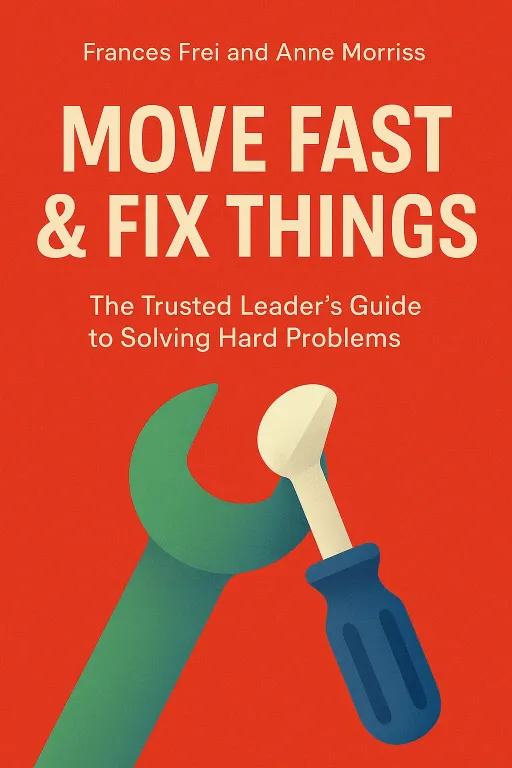
Nova: And that is precisely the friction we are going to dismantle today. We are looking at two foundational pillars of high-performing cultures. First, we have Move Fast and Fix Things by Frances Frei and Anne Morriss. This book is incredible because it reframes trust not as a soft, fuzzy feeling, but as a hard, tangible engine for organizational speed.
Atlas: And the second piece of the puzzle is Carol Dweck's classic, Mindset. Everyone talks about the growth mindset, but I think we often miss how it actually functions as a survival mechanism in a fast-paced environment.
Nova: Right. Dweck’s research on how we perceive our own abilities is the missing link. When you combine Frei and Morriss’s framework on trust with Dweck’s insights on how we process failure, you get a system that does not just tolerate mistakes, it uses them as fuel.
Atlas: Let us jump into that. Because if I am sitting in a meeting and I have just realized my project is going off the rails, my instinct is to hide that fact until I have a perfect solution. That feels like the safe play. You are telling me that is actually the most dangerous move?
The Trust Engine
SECTION
Nova: It is, because that instinct to hide failure is the exact opposite of what builds trust. Frei and Morriss argue that trust is built on three pillars: empathy, logic, and authenticity. When you hide a mistake, you are sacrificing all three, but especially authenticity. You are signaling that you care more about your image than the truth of the situation.
Atlas: That is a tough pill to swallow. I imagine a lot of our listeners are thinking, wait, if I admit I messed up, I am going to look incompetent. How does being vulnerable actually create speed?
Nova: Think about it this way. When you are the leader or the teammate who says, I messed up, here is what happened, and here is how I am fixing it, you remove the guesswork for everyone else. You are providing clarity. That is the logic piece of the trust equation. When people do not have to spend their mental energy wondering what you are hiding, they can spend that energy solving the problem. Trust acts as a lubricant for the entire system.
Atlas: So, you are saying that by being honest about a mistake, I am actually giving my team permission to stop playing detective and start playing engineer?
Nova: Precisely. If you are constantly posturing, your team has to constantly verify what you are saying. That is a massive drag on velocity. But when you lead with empathy, logic, and authenticity, you create a baseline of psychological safety. People know the truth is coming, so they do not have to brace for impact. They can just focus on the task at hand.
Atlas: That makes sense, but let us get specific. Say I am in a high-pressure environment. Maybe I am in a role where one bad move costs the company thousands of dollars. How do I balance this need for authenticity with the reality of high stakes? Is this just about being nice, or is there a strategic angle here?
Nova: It is purely strategic. Frei and Morriss worked with leaders at major global organizations, and they found that the most effective leaders do not try to be perfect. They try to be clear. Empathy is about focusing on the other person, not yourself. If you are so wrapped up in your own fear of failure, you have no capacity to empathize with your team. You are essentially hoarding the problem. When you shift that focus outward, you see that your mistake is just a data point for the team to learn from.
Atlas: So, the goal is to stop making the mistake about my personal competence and start making it about the system's resilience.
Nova: Exactly. That is the pivot. You are not a broken person; you are a system that just encountered an edge case.
Reframing Failure
SECTION
Atlas: That brings me to the second part of our discussion. If we are treating mistakes as data, we have to talk about how we view those mistakes in the first place. That is where Carol Dweck’s work on mindset becomes so critical. I have always struggled with the idea that I am either good at something or I am not. It is such an easy trap to fall into.
Nova: It is the most seductive trap in professional development. Dweck calls it the fixed mindset. It is this belief that your intelligence, your talent, and your capabilities are static traits. If you have a fixed mindset, every mistake is a verdict on your character. It is a permanent indictment.
Atlas: And that explains why we hide mistakes. If the mistake defines me, I have to bury it. I have to protect the evidence.
Nova: Right. But the growth mindset that Dweck champions is the antidote. It is the understanding that your abilities are not fixed points. They are more like muscles. They grow with stress and recovery. When you adopt a growth mindset, a mistake changes its definition. It is no longer a verdict. It is just feedback. It is data.
Atlas: I love that. Data is neutral. A verdict is emotional. That is a massive shift in how you process the day. If I drop the ball on a presentation, the fixed mindset says, I am a bad presenter. The growth mindset says, my current preparation process failed to account for this specific type of audience question.
Nova: You just hit the nail on the head. That is the precise transformation. When you treat the mistake as a data point, you can iterate. You can say, okay, I will change my prep process for next time. When you treat it as a verdict, you are stuck in a loop of shame and avoidance. And that avoidance is what kills your speed. You cannot move fast if you are constantly looking over your shoulder at your past failures.
Atlas: But let me play devil's advocate here. Is there a danger in being too casual about failure? If I just call everything data, do I lose the urgency to get it right?
Nova: That is a great question. And the answer is that the growth mindset is not about lowering standards. It is about raising the ceiling. You are not saying the mistake is okay. You are saying the mistake is a necessary part of the process of getting to a higher standard. High-performing teams are not mistake-free. They are mistake-literate. They analyze the mistake, they learn the lesson, and they move on. They do not dwell on the blame.
Atlas: So, the speed comes from the cycle time of learning. The faster you can turn a failure into a lesson, the faster you can get back to building.
Nova: Exactly. Think about the most innovative companies you know. They are not the ones that never fail. They are the ones that fail the fastest and iterate the quickest. They have built a culture where the data from the failure is shared, not hidden.
Synthesis & Takeaways
SECTION
Atlas: This is starting to connect for me. If I am using the trust framework from Frei and Morriss, I am creating an environment where it is safe to share that data. And if I am using the growth mindset from Dweck, I am mentally prepared to actually look at that data and learn from it.
Nova: That is the perfect synthesis. You need both. You need the culture of trust to share the data, and you need the mindset of growth to value the data. Without trust, you hide the mistakes. Without a growth mindset, you ignore the lessons.
Atlas: So, for our listeners who want to apply this starting tomorrow, what is the most efficient way to start? We talked about reclaiming time and focus. How do I turn this into an action?
Nova: Start with the fifteen-minute rule. Treat your development like an important meeting. Every single day, take fifteen minutes to review a mistake you made or a setback you encountered. Not to beat yourself up, but to act like a scientist. Ask yourself: What was the data here? What does this tell me about the system I am working in? What does this tell me about my own process?
Atlas: I like that. It turns the reflection into a task rather than a spiral of self-doubt. It is very pragmatic.
Nova: And then, share it. Find one person you trust—a mentor or a peer—and tell them about it. That is the authenticity piece. By being open about what you learned, you are building trust with them, and you are normalizing the idea that mistakes are just part of the job.
Atlas: It sounds simple, but I know how hard it is to actually do. It requires a lot of courage to admit you do not have it all figured out. But the payoff seems to be a level of speed and clarity that people who are hiding their mistakes can never reach.
Nova: That is the core of it. When you stop protecting your ego, you start protecting your growth. And that is where the real momentum comes from. You are not just working harder; you are working smarter because you are no longer paying the tax of concealment.
Atlas: That is a powerful way to frame it. The tax of concealment. I am going to be thinking about that all week.
Nova: It is a heavy tax, Atlas. It is time we all stopped paying it.
Atlas: Absolutely. Thank you for walking us through this. This has been a great reminder that our biggest setbacks are often just the setup for our next big leap forward.
Nova: My pleasure. It is always a joy to dissect these ideas. And to everyone listening, remember that your capacity to grow is limited only by your willingness to see your mistakes for what they really are.
Atlas: This is Aibrary. Congratulations on your growth!