

Mastering Your Inner Landscape: Emotional Intelligence & Stress Resilience
Golden Hook & Introduction
SECTION
Nova: Here's a question: What if your biggest competitive advantage wasn't a new technology or a market trend, but something you already possess, just waiting to be mastered?
Atlas: Oh man, that sounds like the kind of secret weapon every strategist and innovator is constantly searching for. Like, the ultimate cheat code for life and business.
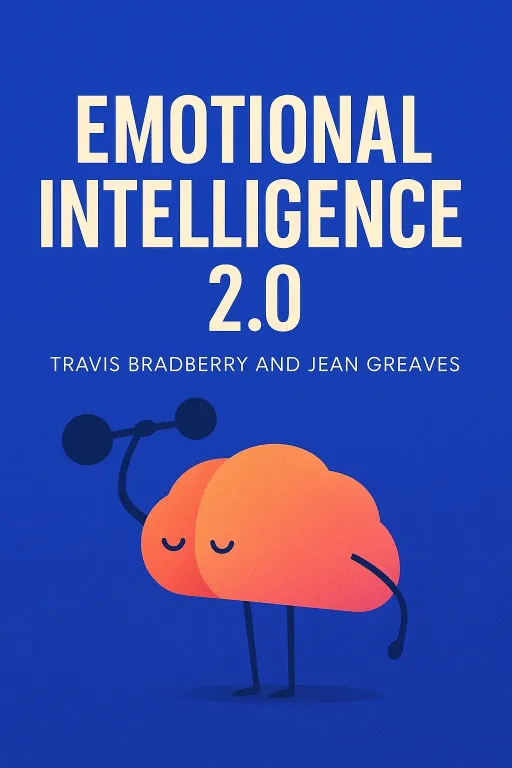
Nova: Exactly! Because today, we're diving into a pair of books that collectively lay out the blueprint for building an unshakeable core, an internal system capable of adapting to any external pressure. We're talking about 'Emotional Intelligence 2.0' by Travis Bradberry and Jean Greaves, and Carol Dweck’s groundbreaking work, 'Mindset: The New Psychology of Success.'
Atlas: Bradberry and Greaves, those two are responsible for popularizing EQ in a way that made it accessible to millions. And Dweck, her work on mindsets, it’s like she gave us the language to understand why some people thrive under pressure and others crumble.
Nova: Absolutely. Bradberry and Greaves co-founded TalentSmart, a leading provider of emotional intelligence training, and their research has touched over 75% of Fortune 500 companies. They distilled decades of psychological research into actionable steps. And Dweck’s 'Mindset' isn't just a book; it's a cultural phenomenon. It’s been translated into dozens of languages and fundamentally changed how we think about potential and achievement.
Atlas: Right, like it moved beyond just 'work hard' to 'how you think about working hard' actually matters. And that’s what we’re exploring today: the internal architecture of mastery.
Emotional Intelligence: The Four Pillars of Inner Mastery
SECTION
Nova: So, let's start with Emotional Intelligence, or EQ. Bradberry and Greaves break it down into four core skills: self-awareness, self-management, social awareness, and relationship management. These aren't just soft skills; they are the bedrock of what it means to be truly resilient and strategic.
Atlas: I like that you call them 'skills,' because it implies they can be learned, practiced, and improved, not just something you're born with or without. But, Nova, for someone who's always focused on external metrics and strategic outcomes, 'self-awareness' can sound a bit... well, fuzzy. What does it actually mean for someone driven by growth and mastery?
Nova: That’s a fantastic point. It's not about naval-gazing; it's about precision. Self-awareness is your ability to accurately perceive your own emotions in the moment and understand your tendencies. Think of it as your internal GPS. If you don't know where you are emotionally, how can you plot a course forward strategically?
Atlas: So you’re saying it’s like a diagnostic tool? Like, before I can fix a problem, I need to know what the problem actually is, and how I’m contributing to it.
Nova: Exactly. Imagine a project manager, let's call her Sarah, who always gets intensely frustrated when a deadline shifts. Without self-awareness, she might just snap at her team, feeling generally 'bad.' But with self-awareness, she can identify that specific emotion: 'frustration.' She understands it's tied to her desire for control and efficiency.
Atlas: Oh, I know that feeling. That sudden surge of irritation when things don’t go according to the meticulously planned Gantt chart.
Nova: Right? And once she can name it, she can move to the next pillar: self-management. This is what you do with that emotion. Instead of lashing out, Sarah, recognizing her frustration, might pause, take a deep breath, and then proactively communicate with her team, asking for solutions rather than assigning blame. It's about consciously choosing your response rather than being hijacked by your feelings.
Atlas: So, self-awareness is identifying the emotion, and self-management is choosing how to act on it, or not act on it. It’s the difference between a knee-jerk reaction and a considered strategy.
Nova: Precisely. And these two are the internal game. Then we move to the external: social awareness. This is your ability to understand the emotions, needs, and concerns of other people. It’s empathy, but not just passive feeling; it’s active understanding.
Atlas: That makes me wonder, how does that translate for a leader? Is it like reading the room, even when no one is explicitly saying anything?
Nova: It’s exactly that. Imagine a CEO, David, who walks into a meeting and immediately senses the tension, the unspoken anxiety about a recent company announcement. A socially aware leader doesn't ignore it; they address it. They might start by saying, “I know there’s some uncertainty about X, let’s talk about that first.”
Atlas: That’s a powerful move. It builds trust, and it shows you’re not just focused on your own agenda. You’re acknowledging the human element.
Nova: And that leads directly into the fourth pillar: relationship management. This is about using your awareness of your own emotions and others' emotions to manage interactions successfully. It’s persuasion, conflict resolution, building rapport, and inspiring others. It's where all the previous skills come together to build effective relationships.
Atlas: So, it’s not just about understanding; it’s about influencing and connecting. Like, if David from before understands the tension and manages his own frustration, he can then skillfully guide the conversation to address concerns and move forward productively.
Nova: You've got it. It's a continuous loop. Bradberry and Greaves argue that these skills are not innate; they're developed through deliberate practice. They even provide specific exercises in their book. For a strategist who values mastery, this is about refining your most critical instrument: yourself.
Growth Mindset: Rewiring Your Response to Challenge
SECTION
Nova: And that naturally leads us to the second key idea we need to talk about, which often acts as the foundational software for all that emotional intelligence work: the growth mindset, as articulated by Carol Dweck.
Atlas: Growth mindset. That’s a term that’s become pretty ubiquitous, but I sometimes worry it gets oversimplified. What's the deep dive here, beyond just 'think positive'?
Nova: That’s a crucial distinction. It's far more profound than just positive thinking. Dweck, a psychology professor at Stanford, spent decades researching why some people thrive after setbacks while others are crushed. Her work reveals two fundamental mindsets: fixed and growth.
Atlas: Okay, so what’s the difference? Because to many, 'mindset' just feels like a synonym for attitude.
Nova: Think of it this way: a fixed mindset believes your abilities, intelligence, and even personality traits are static, carved in stone. You're either smart or you're not, talented or not. When faced with a challenge, someone with a fixed mindset might avoid it to protect their image of being 'smart,' or give up quickly because they believe their innate ability isn't enough.
Atlas: Ah, so success becomes about proving how good you are, rather than improving how good you are. That sounds exhausting. And potentially limiting for an innovator.
Nova: It absolutely is. Now, a growth mindset, on the other hand, believes that your most basic abilities can be developed through dedication and hard work. Brains and talent are just the starting point. This view creates a love of learning and a resilience that is essential for great accomplishment.
Atlas: So, a challenge isn't a threat to your inherent ability; it’s an opportunity to strengthen it. Like a muscle.
Nova: Exactly like a muscle! Dweck’s research shows that people with a growth mindset literally see failure differently. They see it as information, as feedback, as a chance to learn and try again with a new strategy. They embrace challenges, persist in the face of setbacks, learn from criticism, and find inspiration in the success of others.
Atlas: That’s actually really inspiring. I imagine a lot of our listeners, who are constantly pushing boundaries and facing complex problems, would immediately resonate with the idea of 'embracing challenges.' But how does this connect back to emotional intelligence?
Nova: Beautifully. Imagine someone with high self-awareness who identifies frustration but has a fixed mindset. They might say, "I'm frustrated because I'm just not good at this," and give up. Their self-management is then limited by their belief in fixed abilities.
Atlas: And the growth mindset changes that internal script. Instead of 'I'm not good at this,' it becomes 'I'm not good at this.'
Nova: Precisely! The growth mindset provides the interpretive framework. It allows you to see that frustration as a signal that you need to try a new approach, not as proof of your inadequacy. It fuels your persistence, making your self-management more effective. It allows you to approach relationship conflicts not as proof that you're 'bad at people,' but as an opportunity to learn better communication strategies.
Atlas: So, emotional intelligence gives you the tools to understand and manage your inner world and your interactions, and the growth mindset gives you the underlying belief system that makes you to use those tools to constantly improve. It's like the operating system that allows the applications of EQ to run optimally.
Nova: That’s a perfect analogy, Atlas. True mastery, especially for those seeking to innovate and lead strategically, begins within. It's about cultivating both the acute awareness of your emotional landscape and the profound belief that you can navigate and shape it.
Synthesis & Takeaways
SECTION
Nova: When you combine the insights from Bradberry and Greaves with Dweck's work, you get a powerful synergy. You're not just reacting to the world; you're actively shaping your response to it, and believing in your capacity to grow through every challenge. It's about building an unshakeable core, not by avoiding stress, but by becoming incredibly adept at processing and learning from it.
Atlas: I can definitely see how viewing current challenges through a growth mindset lens would completely alter your immediate response. Instead of seeing a problem as a personal failing, it becomes a puzzle to solve, a skill to acquire.
Nova: Exactly. And that small shift in perspective has monumental long-term strategic implications. It means you don't just survive; you evolve. You don't just overcome; you transcend. For those driven by personal evolution, these aren't just concepts; they are the path to true self-mastery.
Atlas: And for anyone who hears this and thinks, 'Okay, but where do I start?' Bradberry and Greaves's tiny step is brilliant: for the next week, identify just one emotion you experience daily and try to name it specifically. Not 'bad,' but 'frustration,' 'anxiety,' 'irritation.' That simple act builds self-awareness, the first pillar.
Nova: It’s the foundational work. And once you start accurately naming your emotions, you begin to gain power over them. It's a small step that unlocks an entire landscape of inner mastery.
Atlas: This is Aibrary. Congratulations on your growth!









