

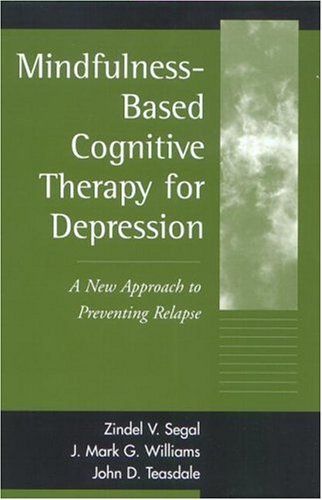
Mindfulness-based cognitive therapy for depression
Introduction
Nova: Imagine you have finally climbed out of a deep, dark hole. You are standing in the sunlight, feeling the warmth on your face, and you think, I am never going back down there. But then, a few months later, a small cloud passes over the sun. Just a tiny dip in your mood. And suddenly, it is like a trapdoor opens beneath you, and you are right back at the bottom of that hole.
Atlas: That sounds incredibly frustrating and honestly, pretty terrifying. It is that feeling of, here we go again, right? Like you are stuck in a loop you cannot escape.
Nova: Exactly. And that is the exact problem that Zindel Segal, Mark Williams, and John Teasdale set out to solve in their groundbreaking book, Mindfulness-Based Cognitive Therapy for Depression. They realized that for people who have struggled with depression, the real battle is not just getting well, it is staying well.
Atlas: So, we are not just talking about a general self-help book here. This is a specific clinical approach for preventing that relapse, that revolving door of depression.
Nova: Precisely. It is a fusion of modern cognitive science and ancient meditative practices. Today, we are diving into how this 8-week program changed the way we think about the mind and why it has become a gold standard for mental health professionals worldwide.
Atlas: I am ready. I want to know how sitting still and breathing can actually stop a major depressive episode from coming back.
Key Insight 1
The Skeptics' Journey
Nova: What is fascinating about this book is that the authors did not start out as mindfulness gurus. In fact, they were quite skeptical. Segal, Williams, and Teasdale were all world-class experts in Cognitive Behavioral Therapy, or CBT.
Atlas: Right, CBT is all about challenging your thoughts, right? If I think I am a failure, CBT tells me to look at the evidence and prove that thought wrong.
Nova: Exactly. It is very active, very logical. But they noticed a problem. Even when people got better using CBT, many would still relapse later on. They were looking for a maintenance version of CBT, something to keep people in the clear.
Atlas: So they were looking for a way to keep the logic working even when the person was not in therapy anymore?
Nova: That was the original plan. But as they researched, they realized that when someone has been depressed multiple times, their brain becomes sensitized. Even a tiny bit of sadness can trigger a massive avalanche of negative thoughts. They called this the Differential Activation Hypothesis.
Atlas: Differential Activation. That sounds like a technical way of saying the brain has a hair-trigger for sadness.
Nova: That is a perfect way to put it. For someone who has never been depressed, a bad day is just a bad day. But for someone who has, a bad day feels like the beginning of the end. Their brain automatically links that small sadness to every failure they have ever felt.
Atlas: So the old CBT approach of arguing with the thoughts was not enough because the thoughts were coming back too fast and too hard?
Nova: Right. They realized they did not need to change the content of the thoughts. They needed to change the person's relationship to the thoughts entirely. And that is when they looked at Jon Kabat-Zinn's work with mindfulness and realized that was the missing piece.
Atlas: It is wild to think that these hardcore clinical scientists had to go to a meditation retreat to find the answer to their research question.
Nova: They actually did! They went to a retreat themselves to see if it was legit. They had to experience it before they could build a program around it. They realized that instead of fighting the thoughts, you could just... watch them.
Atlas: That sounds simple, but I bet it is incredibly hard to do when you are actually feeling down.
Key Insight 2
The Mental Trap: Doing vs. Being
Nova: One of the most powerful concepts in the book is the distinction between what they call the Doing mode and the Being mode of the mind.
Atlas: I feel like I am always in Doing mode. Checking off lists, solving problems, trying to get from point A to point B.
Nova: Most of us are! And Doing mode is great for practical things. If your car breaks down, you want to be in Doing mode to fix it. You look at the gap between where you are and where you want to be, and you work to close that gap.
Atlas: But I am guessing that does not work so well for emotions?
Nova: That is the trap! When we feel sad, the Doing mode kicks in and says, Okay, why am I sad? How do I stop being sad? What is wrong with me? It treats sadness like a broken car that needs to be fixed.
Atlas: And the more you try to fix the sadness, the more you focus on it, which just makes you feel worse. It is like trying to put out a fire with gasoline.
Nova: Exactly. Segal and his colleagues argue that this discrepancy-based processing is what keeps people stuck. You are constantly comparing your current sad state to a hypothetical happy state, and that gap just creates more distress.
Atlas: So what is the alternative? What does Being mode look like?
Nova: Being mode is not about fixing anything. It is about allowing things to be exactly as they are in this moment, without judgment. It is moving from solving to sensing.
Atlas: That sounds almost passive. Is it just giving up?
Nova: Not at all. It is actually a very active form of awareness. It is the difference between being caught in a storm and standing on the porch watching the storm. You are still aware of the rain and the wind, but you are not being swept away by it.
Atlas: So instead of saying, I have to stop feeling this way, you say, Oh, look, there is a feeling of sadness right now. That is interesting.
Nova: Precisely. They call this decentering. You see your thoughts and feelings as mental events rather than as facts or as who you are. A thought is just a cloud passing through the sky of your mind. You are the sky, not the cloud.
Atlas: I love that analogy. It takes the pressure off. You do not have to fight the clouds; you just have to wait for them to pass.
Key Insight 3
The 8-Week Blueprint
Nova: The book outlines a very specific 8-week program. It is not just a theory; it is a curriculum. And it starts with something as simple as eating a single raisin.
Atlas: Wait, a raisin? How does a raisin stop depression?
Nova: It is the ultimate exercise in breaking autopilot. Most of us eat without even tasting our food. In the raisin exercise, you look at it, smell it, feel the texture, and then slowly, mindfully eat it. It is about training the brain to come back to the present moment.
Atlas: So the first step is just proving to yourself that you can actually pay attention to something other than your internal monologue.
Nova: Exactly. From there, they move into the Body Scan, where you spend 45 minutes just feeling sensations in different parts of your body. It sounds tedious, but it is training that Being mode we talked about.
Atlas: I can imagine my mind wandering a thousand times during a 45-minute body scan.
Nova: And that is actually part of the training! The goal is not to have a blank mind. The goal is to notice when your mind has wandered and gently bring it back. Every time you do that, you are strengthening your mental muscles.
Atlas: It is like a bicep curl for your brain.
Nova: Totally. By week four and five, they start introducing the cognitive part. You learn to recognize the early warning signs of a mood dip. You start to see the patterns of your own mind.
Atlas: So you are becoming a scientist of your own experience.
Nova: Yes! And one of the most practical tools they teach is the 3-Minute Breathing Space. It is a mini-meditation you can do anywhere. Step one is Awareness: what is happening right now? Step two is Gathering: focusing all your attention on the breath. Step three is Expanding: bringing that awareness back out to the whole body.
Atlas: I like that it is only three minutes. It feels like something you could actually do in the middle of a stressful workday or when you feel that first hit of anxiety.
Nova: That is the point. It is a circuit breaker. It stops the autopilot from taking you down that dark path of rumination. By the end of the eight weeks, the goal is to have a toolkit of these practices so you can catch the relapse before it even starts.
Key Insight 4
The Science of Staying Well
Nova: Now, we have to talk about the results, because this is where the book really shines. The clinical trials for MBCT were stunning.
Atlas: Give me the numbers. Does this actually work better than traditional methods?
Nova: For people who have had three or more episodes of depression, MBCT reduced the risk of relapse by about 50 percent. That is roughly the same effectiveness as staying on maintenance antidepressant medication.
Atlas: Wow. So you are saying that a mental practice can be as powerful as a pill for preventing relapse?
Nova: In many cases, yes. And for many people, that is a huge deal because they might want to avoid the side effects of long-term medication or they just want more agency over their own health.
Atlas: Why does it work so much better for people with three or more episodes? That seems specific.
Nova: It goes back to that hair-trigger we mentioned. The more times you have been depressed, the more your brain has learned to associate sadness with negative thinking. People with only one or two episodes might not have that same level of cognitive reactivity yet.
Atlas: So MBCT is like a specialized shield for the people who are most vulnerable to the storm.
Nova: Exactly. It is so effective that the National Institute for Health and Care Excellence in the UK, which is very rigorous, actually recommends MBCT as a primary treatment for preventing relapse in recurrent depression.
Atlas: That is a massive endorsement. It is not just some niche alternative therapy; it is mainstream medicine now.
Nova: It really is. And the book explains why: it is because it targets the root cause of relapse, which is not the sadness itself, but how we react to the sadness. By teaching people to stay in the Being mode, they stop the downward spiral before it gains momentum.
Atlas: It is about changing the environment of the mind so the seeds of depression cannot take root again.
Conclusion
Nova: We have covered a lot today, from the skeptics' journey of the authors to the practical 3-minute breathing space. The core message of Mindfulness-Based Cognitive Therapy for Depression is that while we cannot always control the weather of our emotions, we can change how we relate to the storm.
Atlas: It is really empowering to think that by simply shifting from Doing to Being, we can break a cycle that feels so inevitable. You do not have to fix your sadness; you just have to learn how to sit with it until it passes.
Nova: That is the heart of it. The book is a guide to finding that place of stillness within yourself, even when things feel chaotic. It is about reclaiming your life from the fear of the next relapse.
Atlas: If you are listening and you have felt that trapdoor of depression before, this book offers a very real, evidence-based path forward. It is not an easy fix, but it is a lasting one.
Nova: Thank you for joining us on this deep dive into the work of Segal, Williams, and Teasdale. Their work reminds us that the mind is a powerful tool, and with the right training, we can learn to use it to heal ourselves.
Atlas: This has been an eye-opening conversation. I am definitely going to try that 3-minute breathing space next time I feel overwhelmed.
Nova: This is Aibrary. Congratulations on your growth!