Mindful Minds: What Corporate Giants Can Teach Us About the Science of Learning and Focus
Golden Hook & Introduction
SECTION
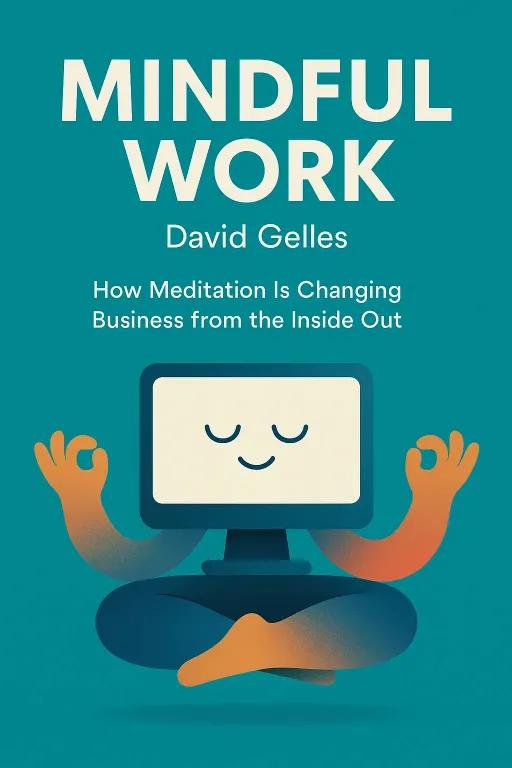
Nova: Picture this. It is a steamy summer day in 1981, backstage at a massive tech keynote in Boston. The crowd is roaring, and the young organizer is absolutely panicking because his guest of honor has completely vanished minutes before he is supposed to go on stage. He frantically searches the hallways and finally finds him in a quiet corner, sitting flat on the floor, legs crossed, posture perfectly erect, meditating. That twenty-six-year-old was Steve Jobs. Today, we are diving into David Gelles' incredible book,, to explore how this ancient practice of meditation is changing modern business from the inside out. And we are looking at it through a really unique lens today with our guest, educator John Steven. John, welcome!
John Steven: Thanks, Nova! It is wonderful to be here. You know, that story about Steve Jobs is so striking because we often think of him as this hyper-intense, restless disruptor. But he understood early on that to navigate immense external chaos, you have to find a way to quiet the internal chaos first. As an educator, that immediately makes me think of our classrooms today. We are asking students and teachers to perform in environments that are noisier and more distracting than ever before.
Nova: Oh, absolutely! We are all swimming in a sea of pings, dings, and notifications. Today, we are going to tackle this book from two different angles. First, we will explore the cognitive science of attention and how we can actually train our brains to resist digital distraction. Then, we will discuss the emotional and relational side of mindfulness—how it combats burnout and fosters genuine compassion in our communities. Let us get into it!
Deep Dive into Core Topic 1
SECTION
Nova: So, John, let us start with this idea of attention. Gelles writes about how mindfulness is not just some fuzzy, feel-good concept. It is actually like physical weightlifting for the brain. And the science behind this is just fascinating. Have you ever heard of the study on London taxi drivers?
John Steven: Yes! The study on 'the Knowledge,' right? It is a classic in cognitive science.
Nova: Yes, exactly! To get their license, these drivers have to memorize a complete map of London's streets—thousands of streets, landmarks, and routes. Researchers did brain scans on these drivers and found that the gray matter in their hippocampus, the area of the brain associated with memory and spatial awareness, was substantially thicker than in non-cabbies. Their brains physically changed because of their intense training!
John Steven: That is the beauty of neuroplasticity. The brain is not a static block of clay; it is a muscle that molds itself to whatever we repeatedly do. If we spend our days constantly shifting our attention from one tab to another, we are actually training our brains to be distracted. We are building the 'distraction muscle.'
Nova: Exactly! And Gelles highlights a study from the University of Washington that looked at this exact issue with office workers. They took a group of human resources professionals and split them into three groups. One group got mindfulness training, one got relaxation training, and one was the control group. Then, they put them through this stressful, multi-tasking test—answering emails, scheduling meetings, taking phone calls, all at once.
John Steven: Oh, the classic modern workday nightmare. How did they do?
Nova: Well, the results were wild! The HR professionals who had not done the mindfulness training were bouncing all over the place, doing an average of fifty-four activities per session. But the group that had gone through just eight weeks of mindfulness training? They only did an average of forty activities. They were twenty percent more concentrated, stayed on a single task longer, and reported feeling significantly less stressed. They literally trained themselves to stop frantic task-switching.
John Steven: That is a massive insight for education. In schools, we often see students struggling with what we call 'continual partial attention.' They have a textbook open, a laptop running, music playing, and phone notifications buzzing. We tell them to 'just focus,' but we rarely teach them to focus. What this study shows is that focus is a teachable, trainable skill. It is not just something you either have or do not have.
Nova: Right! It is about training what scientists call the default mode network in the brain. Gelles actually participated in an EEG study himself with a neuroscientist named Judson Brewer at Yale. They hooked Gelles' brain up to all these electrodes and watched his brain activity in real-time on a screen. When Gelles was asked to think about himself—like judging whether certain words described his personality—this area called the posterior cingulate cortex, which is part of the default mode network, lit up like a Christmas tree. That is the 'me' network, the part of the brain that wanders, worries, and ruminates.
John Steven: The inner critic! The voice that says, 'Am I doing this right? What did that email mean? Why did I say that in the meeting?'
Nova: Yes, exactly! But then, Brewer asked Gelles to simply focus on the physical sensation of his breath. And right before their eyes, the graph plummeted. The default mode network went completely quiet. Gelles described it as this feeling of effortless awareness. He was not suppressing his thoughts; he was just changing his relationship to them.
John Steven: That is a crucial distinction. Judson Brewer has this great quote in the book: 'It is not about not thinking; it is about how we are relating to the thinking.' In a learning environment, if a student is anxious about a math test, their default mode network is working overtime, consuming valuable cognitive load. If we can teach them to quiet that network through a simple breathing exercise, we are literally freeing up brainpower for them to actually solve the math problems. We are moving them from a state of threat to a state of learning.
Nova: I love that! Moving from threat to learning. It is like clearing the static off a radio station so you can actually hear the music.
John Steven: Exactly. And it applies to teachers, too. A teacher who is constantly worrying about lesson plans, grading, and administrative tasks is operating on autopilot. Mindfulness allows us to step out of that busyness and actually be present with the human being standing in front of us.
Deep Dive into Core Topic 2
SECTION
Nova: That is the perfect transition to our second big topic: stress, burnout, and how mindfulness fosters compassion. Gelles shares some pretty sobering statistics in the book. Did you know that stress costs American businesses up to three hundred billion dollars a year? And work is cited as the single greatest source of stress for nearly seventy percent of employees.
John Steven: It is an epidemic, truly. And in education, the burnout rate is staggering. We are losing incredible teachers every year because they are simply exhausted. They are giving everything they have until there is nothing left.
Nova: It is heartbreaking. Gelles tells this incredibly moving story about Janice Marturano, who was the deputy general counsel at General Mills. Talk about a high-pressure job! In the early 2000s, she was leading this massive ten-billion-dollar acquisition of Pillsbury. It was intense, high-stakes, round-the-clock work. And right in the middle of these intense negotiations, both of her parents passed away.
John Steven: Oh, my goodness. That is an unimaginable amount of grief and pressure to carry all at once.
Nova: She was completely drained, emotionally and intellectually. She pushed the deal through, but she was running on empty. A friend finally convinced her to go on a mindfulness retreat led by Jon Kabat-Zinn, the creator of Mindfulness-Based Stress Reduction. Janice was super skeptical at first. She was a corporate lawyer, right? She did not think she had time to sit on a cushion. But she went, and she learned to meditate. She started practicing every morning before work, and she said it completely transformed her. She was able to manage her grief, focus better, and react with much more composure.
John Steven: And she did not just keep it to herself, did she?
Nova: No! She brought it back to General Mills. She started the Mindful Leadership program there. They created dedicated meditation rooms, offered training, and hundreds of employees went through it. The internal data showed that after the training, employees felt more comfortable being themselves, they were better listeners, and they were much more efficient at prioritizing tasks. It changed the entire corporate culture from the inside out.
John Steven: That story is so powerful because it shows that mindfulness is not about escaping your responsibilities or escaping your pain. It is about building the capacity to hold them. In education, we talk a lot about Social-Emotional Learning, or SEL, for students. But we often forget that teachers need it just as much. There is a study Gelles mentions by Michael Krasner at the University of Rochester, where they trained physicians in mindfulness to combat burnout.
Nova: Oh, yes! The doctors who were running on autopilot.
John Steven: Exactly. After just eight weeks of learning to meditate and practicing mindful communication, these doctors reported feeling significantly less emotionally drained. But here is the kicker: they also became more empathetic and sensitive to their patients' mental states. Their technical skills actually improved because they were more present. When we care for the caregiver—or in our case, the educator—the benefits ripple out to everyone in their care.
Nova: It is that classic airplane safety rule, right? You have to put your own oxygen mask on first before helping others.
John Steven: Absolutely. And that presence naturally leads to compassion. Gelles highlights this fascinating study from Northeastern University that I think about all the time. They took a group of people, gave half of them an eight-week mindfulness course, and kept the other half on a waiting list. Then, they brought them into a lab, ostensibly for a memory test. But the real test happened in the waiting room.
Nova: Oh, this is the waiting room experiment! Tell us how it worked.
John Steven: So, the participant sits down in a waiting room with three chairs. Two of the chairs are occupied by actors who are in on the experiment. Then, a woman on crutches, wearing a medical boot, walks in. She audibly sighs in pain and leans uncomfortably against the wall. The two actors ignore her. The question was: would the participant stand up and offer their seat?
Nova: And what happened?
John Steven: Among the group that had taken the mindfulness course, only sixteen percent offered their seat. But among those who had been trained in basic mindfulness? That number jumped to fifty percent! Even with the powerful social pressure of the bystander effect—where everyone else is ignoring the problem—the mindful participants were three times more likely to act with compassion.
Nova: That is incredible! Why do you think that is?
John Steven: Well, Gelles suggests that mindfulness helps us slow down enough to actually notice the suffering of others, and it reduces our own self-referential anxiety. We stop thinking, 'Oh, this is awkward, what should I do?' and instead, we just see a human being in need and respond. In schools, we are constantly trying to prevent bullying and build inclusive communities. This study suggests that the most effective way to foster a compassionate school culture might not be more rules, but rather training our minds to be present and aware.
Nova: It is about moving from a state of self-absorption to a state of connection. Gelles also shares the story of Cheri Maples, a police officer in Madison, Wisconsin. She was dealing with intense trauma and violence daily, and she attended a retreat with the Buddhist monk Thich Nhat Hanh. She realized that carrying a gun could actually be an act of love if she was armed with mindfulness. She started checking her intentions before responding to calls, focusing on minimizing harm and de-escalating situations. She completely transformed how she did her job.
John Steven: That is a profound shift. It is moving from a mindset of control and aggression to one of service and protection. Whether you are a police officer, a CEO, or a teacher, mindfulness helps you pause in that critical moment between a stimulus and your reaction. In that pause lies your freedom to choose a compassionate response instead of a defensive one.
Synthesis & Takeaways
SECTION
Nova: It really is all about that pause, isn't it? We have covered so much ground today, John. From the physical rewiring of our brains to the way mindfulness can literally make us more compassionate human beings in our workplaces and classrooms. If you had to synthesize the core message of for our listeners, what would it be?
John Steven: I think the core message is that mindfulness is not a luxury, and it is not a selfish pursuit of personal peace. It is a foundational cognitive and emotional skill. In a world that is increasingly complex and distracted, the ability to steady your mind, manage your stress, and connect empathetically with others is the ultimate competitive advantage—and the ultimate tool for social good.
Nova: Well said! And for our listeners who want to start integrating this into their own busy lives today—especially the educators and parents out there—what is one practical, actionable step they can take?
John Steven: I love the 'one-minute transition' inspired by Phil Jackson, the legendary NBA coach Gelles writes about. Jackson would have his players—including Michael Jordan and Kobe Bryant—start their practices with just one minute of silent meditation together to align their focus. You can do this before a staff meeting, at the start of a class, or even just sitting in your car before you walk into your house at the end of the day. Just take sixty seconds to close your eyes, feel your breath, and arrive fully in the present moment. It is small, but it is incredibly potent.
Nova: I love that. Just one minute to step out of the busyness and find your center. John, thank you so much for sharing your insights and your passion with us today. This has been such an encouraging and eye-opening conversation.
John Steven: Thank you, Nova. It was an absolute pleasure.
Nova: And thank you to all our listeners! We leave you today with a question to ponder: In your busy day tomorrow, where can you find just one minute to pause, breathe, and truly show up? Until next time, keep breathing, keep learning, and stay mindful!