

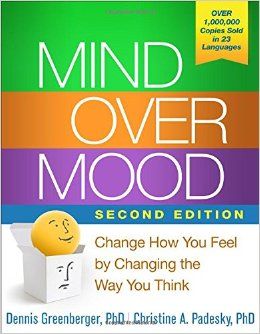
Mind over mood
Change how you feel by changing the way you think
Introduction
Nova: Have you ever had one of those days where a single negative comment or a small mistake just spirals into a cloud of gloom that follows you around for hours? It is like your brain takes one tiny thread and weaves a whole sweater of misery out of it.
Nova: It really is. But what if I told you there is a manual for that? A literal workbook that has been called the Bible of Cognitive Behavioral Therapy. Today we are diving into Mind Over Mood by Dennis Greenberger and Christine Padesky. It is a book that has sold over a million copies because it actually gives people the tools to dismantle those emotional spirals.
Nova: Not at all. In fact, the authors are very clear that this is not about positive thinking. It is about accurate thinking. It is a distinction that changes everything. We are going to explore how this book teaches you to become a scientist of your own mind, testing your thoughts against reality to see if they actually hold up.
Key Insight 1
The Five-Part Model
Nova: To understand Mind Over Mood, we have to start with their foundational framework, which is the five-part model. Greenberger and Padesky argue that our lives are made up of five interconnected areas: environment or life situations, thoughts, moods, behaviors, and physical reactions.
Nova: That is the fascinating part. They are all connected in a circle, and a change in any one of them will trigger a change in the others. Imagine you are walking down the street and you see a friend, but they do not wave back. That is the environment or the situation.
Nova: Exactly. That is the thought. Now, because of that thought, your mood shifts to feeling anxious or sad. Physically, you might feel a knot in your stomach or a heaviness in your chest. And then your behavior changes. Maybe you decide not to text them later like you planned, or you spend the rest of the day ruminating.
Nova: Precisely. The book teaches that while we often cannot change the environment or our immediate physical reactions, we have the most leverage over our thoughts and our behaviors. If you can shift the thought from they are mad at me to maybe they just did not see me because they were distracted, the whole domino effect changes.
Nova: It starts with awareness. The authors use worksheets to help you map out these five areas during specific moments of distress. By writing it down, you pull the experience out of your head and put it on paper where you can look at it objectively. You start to see the patterns of how your thoughts are driving your misery.
Nova: Right. And once you see that your mood is being fueled by a specific thought, you can start to do the real work, which is what they call cognitive restructuring. But before you can restructure, you have to identify what they call the hot thought.
Nova: Spot on. In any given situation, we might have ten different thoughts, but usually, there is one that is the primary driver of our mood. Identifying that hot thought is the key to unlocking the whole system.
Key Insight 2
The 7-Column Thought Record
Nova: If Mind Over Mood has a superstar tool, it is definitely the 7-column thought record. This was actually developed by Christine Padesky and it is the heart of the entire workbook. It is a structured way to challenge those hot thoughts we just talked about.
Nova: It is a journey from emotion to evidence. The first few columns are basic: the situation, the moods you felt, and the automatic thoughts that popped up. You rate the intensity of your moods on a scale of zero to one hundred percent. Then you circle that hot thought.
Nova: This is where the science comes in. Column four is for evidence that supports the hot thought. You have to be honest. If you think your boss hates you, maybe the evidence is that they gave you a critical performance review. You put that in the box.
Nova: Exactly. Column five is evidence that does not support the hot thought. This is the hardest part for most people. You have to look for facts that contradict your negative assumption. Maybe that same boss gave you a high-profile project last week, or they were friendly in the breakroom this morning.
Nova: That is actually a cognitive distortion called mental filtering, and the book covers those in detail. The thought record forces you to take the blinders off. Once you have both sets of evidence, column six is where you write a balanced or alternative thought. It is not a happy thought; it is a thought that accounts for all the facts.
Nova: Exactly. And then the final column, column seven, is where you re-rate your moods. Usually, people find that their sadness or anxiety drops significantly. It might not go to zero, but it goes from a ninety percent to a forty percent, which is the difference between being paralyzed and being able to function.
Nova: The research shows it is incredibly effective for clinical depression and anxiety disorders. The second edition of the book even expanded this to cover things like guilt, shame, and anger. It is about building a habit. The more you do these records, the more your brain starts to do this automatically without needing the paper.
Key Insight 3
Behavioral Experiments
Nova: Now, sometimes just thinking differently isn't enough. You can tell yourself a new thought a thousand times, but if you don't believe it deep down, it won't stick. That is why Greenberger and Padesky emphasize behavioral experiments.
Nova: It is about testing your beliefs in the real world. Let us say you have a belief that if you speak up in a meeting, everyone will think you are stupid and you will be humiliated. That is a prediction, right?
Nova: Exactly. So an experiment would be to intentionally speak up and then observe what actually happens. You write down your prediction, you rate how much you believe it, and then you go do the thing. Afterward, you record the actual outcome.
Nova: Then you have data! You look at whether the eye-roll actually led to the catastrophe you predicted. Did you lose your job? Did everyone stop talking to you? Usually, the reality is far less devastating than the mental horror movie we play for ourselves. The goal is to gather evidence that your catastrophic predictions are often wrong.
Nova: It really does. The book also talks about action plans for things like depression. When you are depressed, your behavior usually involves withdrawing and stopping activities that used to bring you joy. This creates a feedback loop where you feel worse because you are doing less.
Nova: Not just do things, but do them strategically. They use something called activity scheduling. You track your activities and rate them for pleasure and mastery. You might find that even though you did not want to go for a walk, you felt a five percent increase in your mood afterward. That is a win.
Key Insight 4
Core Beliefs and Long-term Change
Nova: As you move deeper into the workbook, you move past these situational thoughts and start looking at what the authors call core beliefs. These are the deep-seated templates we have about ourselves, other people, and the world.
Nova: Exactly. Core beliefs are like the operating system running in the background. You might not even realize they are there, but they color every single thought you have. If you have a core belief that you are incompetent, every mistake you make is seen as proof, and every success is seen as a fluke.
Nova: They use a tool called the Core Belief Record. It is similar to the thought record but it takes place over a much longer period. You start by identifying the negative core belief and then you actively look for evidence for a new, more constructive core belief. For example, instead of I am a failure, the new belief might be I am a person with strengths and weaknesses who can learn.
Nova: That is the key. It has to be something you can actually find evidence for. You might keep this record for weeks or months, jotting down every small thing that supports the new belief. Over time, you are literally retraining your brain to notice the positive data that you have been ignoring for years.
Nova: It definitely is not. The authors are very upfront about that. They even included a chapter in the second edition about gratitude and mindfulness, which helps you stay present and appreciative of the progress you are making. The book is designed to be a lifelong resource, not something you read once and put on a shelf.
Nova: Absolutely. The second edition also has much more on how to manage things like chronic guilt and shame, which are often tied to those core beliefs. It is a very compassionate approach. It is not about blaming yourself for your thoughts; it is about taking responsibility for how you respond to them.
Conclusion
Nova: We have covered a lot of ground today. From the five-part model that shows how our environment, thoughts, and moods are all linked, to the practical power of the 7-column thought record and behavioral experiments.
Nova: That is a perfect summary. If you are listening and feeling overwhelmed by your moods, the first step is often just to start tracking. Grab a notebook and try to identify one hot thought today. Ask yourself: what is the evidence for this, and what is the evidence against it?
Nova: The beauty of this approach is that it is evidence-based and accessible. You do not have to wait for a crisis to start using these tools. They are just as useful for building resilience as they are for treating depression.
Nova: It really does. Thank you for joining us on this deep dive into Mind Over Mood. If you want to take this further, I highly recommend picking up the workbook and actually doing the exercises. It is the doing that makes the difference.
Nova: This is Aibrary. Congratulations on your growth!