

Personalized Podcast
Golden Hook & Introduction
SECTION
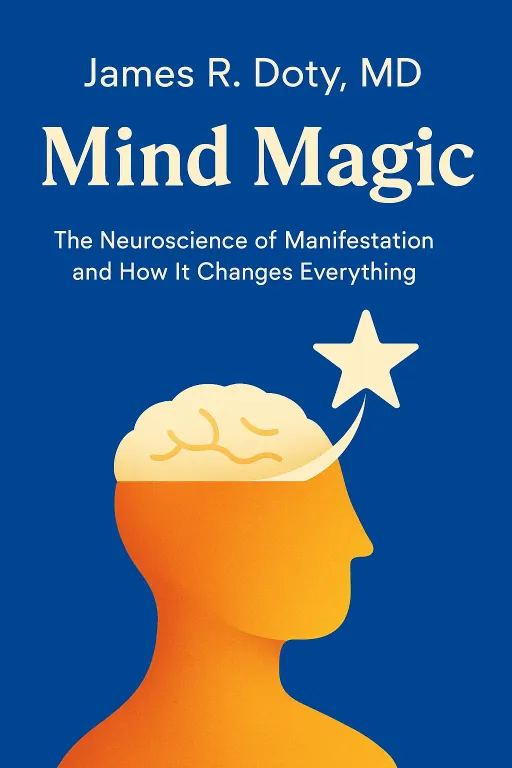
Nova: What if I told you that the most sophisticated autonomous agent in the world isn't running on a server cluster in Silicon Valley, but right inside your own skull? Welcome to the show! Today, we are diving deep into Dr. James Doty’s groundbreaking book,. But we aren't talking about wishful thinking or cosmic wishes here. No, we are looking at manifestation through a strictly scientific, systems-engineering lens. And to help us unpack this, we have full-stack and software engineer Asoiso with us. Welcome, Asoiso!
Asoiso: Thanks, Nova. It's great to be here. You know, when I first picked up a book with "manifestation" in the title, my inner skeptic—the part of me that debugs code and looks for logical proof—was a bit wary. But as I read Dr. Doty's work, I realized he’s actually describing a highly logical, biological operating system. It’s all about how we program our neural networks, direct our attention filters, and optimize our cognitive architecture.
Nova: Exactly! It’s about taking control of your own internal code. Today, we’re going to tackle this book from three key angles. First, we’ll explore the brain’s "agentic architecture"—how networks like the Default Mode and Salience networks collaborate to filter reality. Second, we’ll talk about "debugging the system"—how to identify and refactor those deeply ingrained, limiting beliefs that act like legacy bugs in our subconscious. And finally, we’ll look at "runtime execution"—how to use visualization and positive feedback loops to actually manifest our goals in the real world.
Asoiso: I love that roadmap, Nova. As someone working on Agent engineering, the parallels are striking. In AI, we design agents with perception, memory, and planning modules. Dr. Doty is essentially showing us how to optimize those exact same modules in our own minds. It’s like prompt engineering for the human subconscious.
Nova: Oh, "prompt engineering for the subconscious"—I am absolutely stealing that! Let’s start right there.
Nova: -
Deep Dive into Core Topic 1
SECTION
Nova: Dr. Doty starts the book by completely dismantling the popular, mystical view of manifestation. He writes, and I love this quote: "The universe doesn’t give a fuck about you... because it has no fucks to give." It’s harsh, but so freeing! He’s saying the universe is indifferent. The real magic isn't out there; it’s inside our neural pathways. Specifically, it’s about how we direct our attention. Asoiso, how does this look from a systems perspective?
Asoiso: It’s a classic data-filtering problem. Think about it: our brains are bombarded with an overwhelming amount of sensory input every single second. Dr. Doty points out some incredible numbers here. The brain receives about ten million bits of data per second, but our conscious mind can only process about fifty bits. Fifty! That is a massive bottleneck.
Nova: Wow, that is a huge drop-off. It’s like trying to download a massive database through a tiny dial-up connection!
Asoiso: Exactly. So, how does the brain decide which fifty bits get through? It uses what neuroscientists call the Salience Network. The Salience Network acts like an attention filter or a priority queue. It decides what is "salient"—what is important enough to be passed up to our conscious awareness. If you don't consciously program this filter, it defaults to survival mode, which means it prioritizes threats, fear, and negativity.
Nova: Right, the classic "negativity bias." It’s like our operating system is running on ancient, Pleistocene-era security software that treats every shadow like a saber-toothed tiger! And Dr. Doty shares a famous psychological study that perfectly illustrates this filtering mechanism—the Invisible Gorilla Experiment. Have you heard of this one?
Asoiso: Oh, yes! It’s a classic in cognitive psychology, but seeing it in the context of manifestation was a real "aha" moment for me.
Nova: For anyone listening who hasn't heard of it, the researchers had participants watch a video of people passing a basketball. The participants were given a very specific task: count the exact number of passes made by the players wearing white shirts. While they were hyper-focused on counting, a person in a full gorilla suit walked right into the middle of the court, beat their chest, and walked off.
Asoiso: And the result is mind-blowing. Fifty percent of the participants completely missed the gorilla! They didn't see it at all because their directed attention was fully occupied by counting the passes.
Nova: It’s wild, right? A literal gorilla in the room, completely invisible because of a software filter!
Asoiso: Yes! And this is the core of why manifestation works or fails. If your attention filter is programmed to look for scarcity, failure, or reasons why you can't succeed, you will be completely blind to the opportunities—the "gorillas"—walking right in front of you. Manifestation is the process of consciously updating the weights in your neural network so that your Salience Network starts flagging opportunities, resources, and connections that align with your goals.
Nova: That makes so much sense. Dr. Doty calls this process "value tagging." It’s how the brain decides what is significant enough to be imprinted at the deepest levels of the subconscious. And he shares this beautiful, deeply personal story from his own childhood that shows how this works in real life. When he was just twelve years old, growing up in poverty in Lancaster, California, with an alcoholic father and a depressed mother, he felt completely powerless. He felt like his life was under a curse. But then, he wandered into a local magic shop and met a woman named Ruth.
Asoiso: Ruth is really the unsung hero of this book. She wasn't a neuroscientist, but she understood human psychology intuitively.
Nova: She really did. She saw this young, stressed-out boy and offered to teach him "real magic" over six weeks. And the very first thing she taught him wasn't how to make things appear out of thin air. It was how to relax his body and tame his mind. She taught him to sit still, breathe deeply, and systematically release the tension in his muscles, from his toes to his head. Why was that physiological step so critical before any "manifesting" could happen?
Asoiso: From a systems view, she was shifting his autonomic nervous system out of a high-stress state. When you are in a chronic fight-or-flight state, your Sympathetic Nervous System is dominant. Your amygdala is firing, flooding your system with cortisol and adrenaline. In that state, your brain's resources are diverted away from the prefrontal cortex—the area responsible for planning, creativity, and decision-making. You can't think long-term when your brain thinks you're about to be eaten. By teaching him to relax, Ruth activated his Parasympathetic Nervous System—the "rest and digest" state. This lowered his heart rate, increased his Heart Rate Variability, and essentially freed up cognitive bandwidth so he could actually begin to reprogram his mind.
Nova: It’s like clearing the CPU usage so you can run a heavy compilation task!
Asoiso: Exactly! You can't write new code while the system is crashing from an infinite loop of panic.
Nova: -
Deep Dive into Core Topic 2
SECTION
Nova: So, once we clear that CPU bandwidth and calm the nervous system, we have to address the existing code. And that brings us to our second major topic: debugging the subconscious. Dr. Doty emphasizes that we are all constantly manifesting, but we are often manifesting our fears and limiting beliefs because those are the programs running in the background.
Asoiso: Right. In software, if you have a bug in your background daemon, it doesn't matter how beautiful your front-end UI is; the system is still going to output errors. Our subconscious mind is that background daemon. It processes millions of bits of data and runs our automatic behaviors based on early conditioning.
Nova: Yes, and those early childhood wounds can create massive system errors. Dr. Doty shares the story of a highly successful woman in her fifties, a healthcare executive with a PhD in nursing, who attended one of his lectures on imposter syndrome. During the Q&A, she broke down in tears. Despite all her incredible academic and professional achievements, she was still haunted by the voice of her critical father, who had told her childhood self that she would never amount to anything.
Asoiso: That story really hit home for me. It shows that external success cannot override a corrupt internal database. She had spent her entire life trying to "prove him wrong," which meant her primary motivation was still rooted in fear and a sense of inadequacy. She was running a program called "I am not enough."
Nova: It’s heartbreaking, but so common. We build these massive structures of success on top of a foundation of shame. And Dr. Doty points out that every time we agree with that inner critic, we are "adding a brick to the walls of our self-created prison." So, how do we debug this? How do we refactor this legacy code?
Asoiso: Dr. Doty introduces a practice called "Beliefs and Their Opposites," combined with radical self-compassion. In engineering, when you find a bug, you don't just get angry at the code. That doesn't fix anything. You have to look at it with objective curiosity. You trace the error to its source. With our minds, we have to look at our limiting beliefs—like "I'm not smart enough" or "I don't have enough experience"—and trace them back to where they were written. Often, they were written in childhood as a coping mechanism to keep us safe.
Nova: Oh, that is such a beautiful way to look at it. The bug was actually a feature at one point! It was trying to protect us.
Asoiso: Exactly. It was a security patch for a vulnerable system. But now, as adults, that patch is obsolete and causing system instability. So, we look at it with compassion, thank it for its service, and then we write the override. We consciously formulate the opposite, empowering belief. But here is the catch: you can't just repeat a positive affirmation like a mindless script. The brain is too smart for that. It will reject it as spam.
Nova: Ah, yes! The "miserly brain" resists new data because changing neural pathways takes energy. So, how do we make the override stick?
Asoiso: We have to associate the new belief with strong, positive emotions. Dr. Doty explains that emotions are the "vibrational energy" that tags information as highly valuable. When you visualize your goal and actively feel the gratitude, joy, or relief of achieving it, you release neurotransmitters like dopamine, oxytocin, and serotonin. This chemical cocktail signals to the brain: "This is important! Write this to the long-term storage!" It’s like committing a code change with a high-priority tag.
Nova: Yes! And he uses the incredible story of actor Jim Carrey to show this in action. Long before he was a household name, when he was a struggling, broke comedian in Los Angeles, Carrey would drive up to Mulholland Drive every night. He would look out over the city, visualize himself as a successful actor being offered massive movie roles, and he would actively feel that success. He even wrote himself a check for ten million dollars for "acting services rendered," dated it Thanksgiving 1995, and kept it in his wallet.
Asoiso: And the timeline is just incredible. Just before Thanksgiving 1995, he found out he was cast in for exactly ten million dollars!
Nova: It’s like a movie script itself! But Dr. Doty explains the neurobiology behind it. Carrey wasn't just daydreaming; he was performing a highly structured mental rehearsal. Because the brain does not distinguish between an actual physical experience and one that is intensely imagined, Carrey was literally rewiring his neural circuits. He was priming his brain to recognize and seize the opportunities that would lead to that ten-million-dollar outcome. When the opportunity came, his conscious mind had already lived it, so he stepped into it without fear or hesitation.
Asoiso: It’s like running a simulation. In AI, we train models in simulated environments millions of times so that when they deploy in the real world, they perform flawlessly. Carrey was running simulations of his own success, training his neural networks to execute the optimal actions when the runtime environment—the real world—presented the opportunity.
Nova: -
Synthesis & Takeaways
SECTION
Nova: This has been such an eye-opening conversation, Asoiso. We’ve looked at how our brain's Salience Network acts as an attention filter, how we can debug our subconscious legacy code through self-compassion, and how visualization acts as a high-fidelity simulation to prime us for success. As we wrap up, what is the ultimate takeaway for someone listening, especially someone with an analytical, systems-oriented mind like yours?
Asoiso: I think the biggest takeaway is that manifestation is not a passive process. It’s an active, iterative feedback loop. Dr. Doty’s final step in his six-week program is "releasing expectations and opening to magic." In engineering terms, this is about decoupling your system from a rigid, hardcoded output. If you are too attached to your goal must manifest, you close off better, unexpected pathways. You have to set the intention, run the program, and then let the system optimize itself.
Nova: I love that. "Decoupling from a hardcoded output." It’s about trusting the process and being open to the "golden cracks"—like the Japanese art of kintsugi, where broken pottery is repaired with gold, making it more beautiful and resilient than before. Our past bugs and failures aren't system crashes; they are just data points that make our final code stronger.
Asoiso: Absolutely. Dr. Doty reminds us in the conclusion that the universe isn't separate from us. We are the universe. We have the source code. And as Dr. Doty says, "Only when we believe we are enough in ourselves do we find the ability to contribute to life, but only in contributing to our world do we discover we are inherently enough."
Nova: What a perfect note to end on. Asoiso, thank you so much for bringing your incredible engineering perspective to this discussion. And to our listeners, your challenge for this week is simple: take five minutes today to sit in a quiet space, quiet your nervous system, and ask yourself: "What legacy program is running in my background, and what is the override I need to write today?"
Asoiso: Get debugging, everyone. Thanks for having me, Nova.
Nova: Thank you, Asoiso! Until next time, keep programming your mind, open your heart, and let the magic happen. See you in the next episode!









