

Architect of Reality: A Creator's Guide to Mind Magic
Golden Hook & Introduction
SECTION
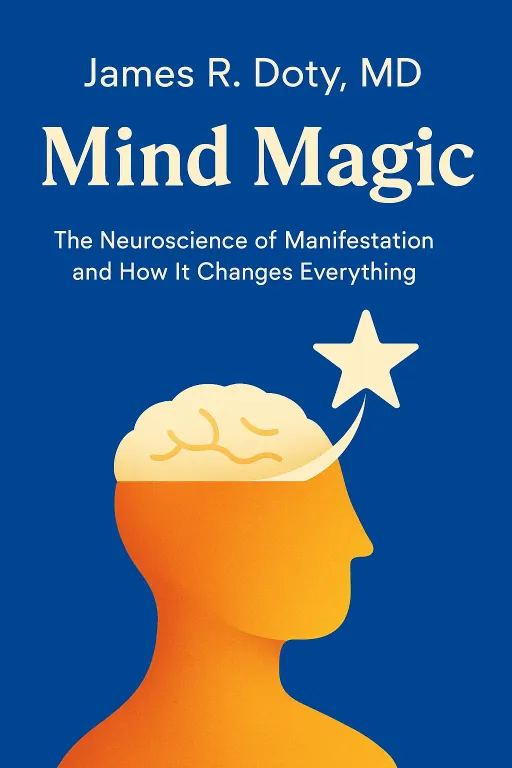
Nova: What if I told you the universe doesn't care about you? That's the brutally honest opening line from neurosurgeon Dr. James Doty's book, 'Mind Magic.' He argues that waiting for some cosmic force to grant your wishes is a waste of time. The real power to create the life you want—whether you're an artist, an entrepreneur, or a writer—isn't out there in the cosmos. It's locked inside three pounds of tissue between your ears.
Lyra: It’s such a provocative way to start, isn't it? It completely flips the script on the popular idea of manifestation. It takes it from something passive—asking and waiting—to something incredibly active and, frankly, more empowering.
Nova: Exactly! And that’s what we’re diving into today. Welcome everyone. With me is Lyra, a writer and thinker who loves exploring the boundaries between science, philosophy, and what we might call the 'fringe.' And her perspective is perfect for this book. We're exploring how to become an architect of your own reality, using neuroscience as your blueprint.
Lyra: I'm so excited for this, Nova. As a creator, the idea of building something from a pure thought is my entire world. This book feels like it's providing the user manual for that process.
Nova: It really does. And today we'll dive deep into this from two perspectives. First, we'll explore the brain's hidden operating system for creating reality, looking at the actual neuroscience behind manifestation. Then, we'll discuss the creator's ritual—how to translate a mental blueprint into a tangible outcome, using a fascinating real-world example. So, Lyra, let's start with that provocative idea. If it's not the universe, what it?
Lyra: Well, the book’s answer is both simple and profound: it's about where you point your flashlight. It's about attention.
Nova: Precisely. The book argues it's all about directing our attention. And it uses a powerful story to show how this works, even under the most extreme pressure. Let's talk about a young woman named Anula.
Deep Dive into Core Topic 1: The Brain's Operating System for Reality
SECTION
Nova: Anula's story is just incredible. She grew up in Sri Lanka during a civil war. Her family eventually emigrated to the United States after the 2004 tsunami, but the struggle didn't end there. Her father, a microbiologist, could only find work driving an Uber. Her mother got sick. The weight of all this, the financial instability, the pressure to succeed in a new country... it all fell on Anula.
Lyra: You can just imagine the stress. It's not just external pressure; it's a constant, internal state of alarm.
Nova: A constant state of alarm is the perfect way to describe it. She developed chronic anxiety and depression. Her pre-med advisors were blunt, telling her that her GPA just wasn't good enough for medical school. She was trapped. But then, she discovered the concept of manifestation, not as some magical cure, but as a practical tool.
Lyra: And this is where the neuroscience comes in. Her problem wasn't a lack of intelligence; it was that her 'threat detection system'—what the book calls the sympathetic nervous system—was constantly firing. You can't do complex problem-solving for the MCAT when your brain thinks you're running from a tiger.
Nova: Exactly! Her body was in a perpetual state of fight-or-flight. So, she started practicing meditation and relaxation techniques. She was consciously working to calm that system down and activate its opposite: the parasympathetic nervous system, the 'rest-and-digest' state. This is the state where you can think clearly, learn, and be creative.
Lyra: It's like she was manually rebooting her own operating system. She was creating a space between the stimulus—the stress—and her response. The book talks about how this allows the brain's major networks to coordinate properly.
Nova: Yes! It’s fascinating. The book explains that for manifestation to work, you need a few key networks online. The salience network has to identify your goal as important. The attention network has to focus on it. And the central executive network needs to be able to plan and make decisions towards that goal. None of that can happen effectively when your amygdala is screaming 'DANGER!'
Lyra: Right. And what's so interesting to me is the in her motivation. She didn't just visualize herself getting a good score. She changed her focus from 'I want to be a doctor' to 'I want to my future patients.' She imagined the healing and care she could provide.
Nova: That was the key, wasn't it?
Lyra: I think so. The book frames this as connecting to a higher purpose, which is a beautiful spiritual concept. But from a neurochemical perspective, she was likely flooding her brain with what scientists call the 'happy hormones'—oxytocin from connection, serotonin from a sense of meaning. That's an incredibly powerful way to do what the book calls 'value tagging.' She was telling her brain, 'This goal isn't just a desire; it's a matter of profound importance and positive emotion.'
Nova: A perfect way to put it. She wasn't just wishing; she was actively changing her brain chemistry to support her goal. She was teaching her brain what to pay attention to. And, of course, after all this internal work, she retook the MCAT, scored exceptionally well, and was accepted into medical school.
Lyra: It’s a testament to the idea that our internal environment can be more powerful than our external one. She didn't change her circumstances first. She changed her mind, and that allowed her to change her circumstances.
Nova: And that idea of 'value tagging' through emotion is the perfect bridge to our second topic. It's one thing to calm your mind, but how do you embed a huge, audacious goal so deeply that your subconscious starts working on it 24/7? This is where the creator's ritual comes in, and the book uses an iconic example: Jim Carrey.
Deep Dive into Core Topic 2: The Creator's Ritual: From Blueprint to Building
SECTION
Lyra: Ah, the famous check. This story is legendary, and it's often told in a very 'woo-woo' way. But through the lens of this book, it's a masterclass in subconscious programming.
Nova: It really is. For anyone who doesn't know the story, Jim Carrey's early life was incredibly difficult. His family was poor, at one point even living out of a van. His father was a talented musician who had to give up his dream for a 'safe' job as an accountant, which he then lost, plunging the family into poverty. Carrey saw firsthand what can happen when you fail at something you don't even love.
Lyra: A powerful, and painful, lesson. It fueled his desire to take a chance on what he love: comedy.
Nova: Absolutely. So, when he was a struggling actor in Los Angeles, he developed a ritual. He would drive his beat-up car to the top of Mulholland Drive, look out over the city, and visualize his success. He would tell himself, "Everybody wants to work with me. I’m a really good actor. I have all kinds of great movie offers." But then he did something else. He took out a checkbook, wrote himself a check for ten million dollars, and in the memo line, he wrote, "For Acting Services Rendered." He post-dated it for three years in the future.
Lyra: And he didn't just put it in a drawer. He kept it in his wallet. It was a constant, physical, tangible reminder of his intention. The check wasn't a letter to the universe; it was a command prompt for his own brain.
Nova: Right! The book explains that the brain is, in its own way, 'miserly.' It wants to conserve energy, so it prefers familiar thoughts and patterns. It resists new, unfamiliar, and difficult goals. Carrey's ritual did two crucial things. First, through constant repetition—seeing that check every day—he made the idea of 'being a $10 million actor' familiar to his brain.
Lyra: It normalized the outrageous. It took it from a fantasy to a pending transaction.
Nova: Exactly. And second, by associating it with the powerful emotions he felt on Mulholland Drive—the excitement, the confidence, the joy of imagining it as real—he was teaching his brain's reward system to crave that outcome. He was creating what the book calls a 'memory of the future.'
Lyra: I love that phrase. 'A memory of the future.' Because the brain, as the book points out, doesn't really distinguish between a real, vivid experience and an intensely imagined one. The same neural pathways fire. So by the time the opportunity for 'Ace Ventura: Pet Detective' came along, his brain didn't see it as a scary, new, impossible leap. It saw it as the next logical step on a path it had already walked a thousand times in his mind. There was no resistance.
Nova: And that's the magic, isn't it? It's not about the universe magically delivering a check. It's about priming your own neurology to recognize and seize the opportunity when it appears. He didn't just sit on his couch and wait; he worked like crazy, but his inner world was already aligned with the outcome he wanted. And just before the check's date came due, he signed his deal for 'Dumb and Dumber' and made his ten million dollars.
Lyra: From an ontological perspective, it raises such fascinating questions about what's 'acting' on what. Is it just psychological priming? Or does focusing consciousness in such a directed way actually influence the field of possibilities? The book leans into the neuroscience, but for someone interested in fringe theory, it's hard not to see the overlap. He was creating a powerful coherence between his mind, his emotions, and his actions.
Nova: A coherence that made him ready. The book quotes him saying, "Your job is not to figure out how it’s going to happen for you, but to open the door in your head. And when the door opens in real life, just walk through it." His ritual was the process of opening that door in his head.
Synthesis & Takeaways
SECTION
Nova: So, when we put these two stories together, Anula and Jim Carrey, what we've really seen today are two sides of the same coin. First, we have to become the master of our own attention, calming the internal noise like Anula did, so we can actually focus.
Lyra: We have to get out of 'fight-or-flight' and into a state where we can actually think and create.
Nova: And second, we need to give that focused attention a clear, emotionally-charged target, a 'memory of the future,' through deliberate practice and ritual, just like Jim Carrey did with his check.
Lyra: Exactly. And for anyone listening, especially fellow creators, this doesn't have to be about manifesting a private island or a ten-million-dollar paycheck. The power of this is in its scalability. It can be applied to finishing a chapter, launching a podcast, or just getting through a difficult week.
Nova: So what's a practical first step? How can someone listening right now start applying this?
Lyra: The book offers a really simple and brilliant starting point. It's a practice called 'Building Inner Power,' and it's designed to build that muscle of self-agency. Tonight, before you sleep, pick one small, concrete thing you want to accomplish tomorrow. And I mean small. Maybe it's 'I will write one perfect paragraph,' or 'I will make that one difficult phone call,' or 'I will go for a 10-minute walk without my phone.'
Nova: Something you know you can do, but might put off.
Lyra: Precisely. Then, just for a minute or two, visualize yourself doing it. Don't just see it, it. Feel the satisfaction of the paragraph being written, the relief of the phone call being over, the calm of the walk. Connect a positive emotion to it. And then just... let it go. Go to sleep. See what happens the next day. It's about proving to yourself, on a micro-level, that you are the one directing your mind. You are the architect. And from there, you can start building your empire.









