

Designing Reality: A Metahuman's Guide to Breaking the Illusion
Golden Hook & Introduction
SECTION
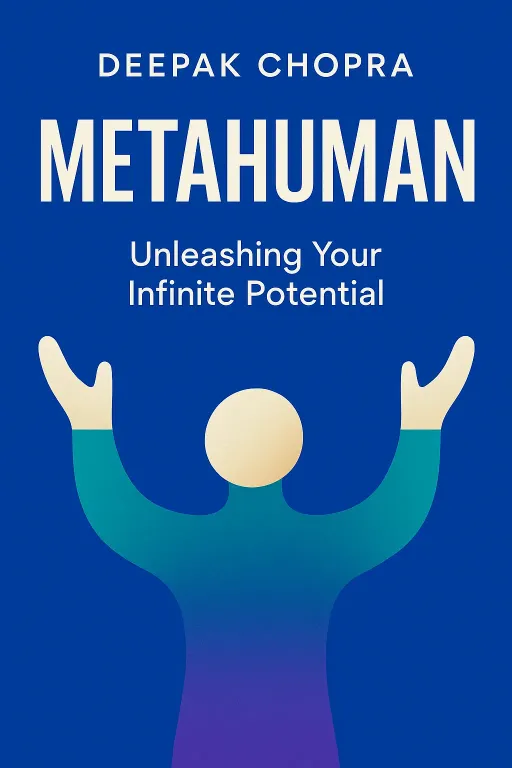
Socrates: Jin, as a designer, you spend your days creating worlds, shaping how people perceive and interact with information. Your love for Tokusatsu films is all about appreciating the craft of building fantastical, believable realities. But what if I told you the most profound design project you'll ever encounter is the one you're experiencing right now? That your everyday reality is a kind of personal special effect, a virtual world meticulously constructed by your own consciousness? This is the radical premise of Deepak Chopra's book,.
Jin: That’s a powerful opening thought. It reframes everything. We think of design as something we do to the world, but the idea that the world is something being done us, or by our consciousness… that’s a massive paradigm shift. It’s both intimidating and incredibly liberating.
Socrates: Exactly. And that's the journey Chopra invites us on. He argues we are not just living reality, we are actively it. This isn't just abstract philosophy; it's a creative act happening every single moment.
Jin: A creative act we're mostly unconscious of. Like a brilliant piece of code running silently in the background.
Socrates: Precisely. So today, we're going to dive deep into this from two perspectives. First, we'll explore the shocking idea that reality itself is a designed illusion, like an elaborate special effect. Then, we'll unmask the director of this illusion—our own ego—and discover its hidden agenda.
Deep Dive into Core Topic 1: Reality as a Designed Illusion
SECTION
Socrates: To grasp this, Chopra asks us to question the most basic thing we trust: our sight. He tells a powerful story about children born blind who are given sight for the first time through medical procedures. You'd think they would just open their eyes and see the world as we do, right?
Jin: You would. You assume sight is just a direct input, like a camera turning on.
Socrates: But that’s not what happens. These children are utterly baffled. Chopra describes how a distant cow looks the same size as a nearby cat. A flight of stairs doesn't look like a three-dimensional object you can climb; it looks like a flat, painted pattern on the wall. Their own shadow is a terrifying, dark creature that follows them. They have the raw data from their eyes, but they haven't learned how to assemble it into what we call 'reality'.
Jin: That's incredible. It's the ultimate user onboarding problem. Their hardware—the eyes—is working, but the software—the brain's interpretation engine—has no training data. As designers, we know you can't just throw raw information at a user. You have to build a mental model for them, an intuitive interface. It sounds like our brain is the original UX designer, creating a seamless interface for an otherwise chaotic world.
Socrates: An interface! That's the perfect word. And Chopra argues this interface is so good, so seamless, that we forget it's an interface. We mistake the icon on the screen for the actual file. We think the world we see the world, not just a very convincing interpretation of it. What do you think, in design or film, is the key to making an illusion feel 'real'?
Jin: It's all about consistency. The rules of the world, however strange, have to be consistent. In a Tokusatsu film, even if a monster is clearly a guy in a rubber suit, it has to interact with the miniature city in a believable way. If it knocks over a building, the building has to crumble convincingly within that world's physics. Our brain seems to be a master at maintaining this consistency, so we never question the 'rubber suit' of our own reality.
Socrates: So our reality is a consistent, well-designed illusion. It's a world with rules we've learned to accept without question. But what happens when we start to pull at the threads of that design?
Jin: That's where it gets interesting. That's where the potential for a new design, a new experience, comes in. It’s like discovering the developer tools for your own life.
Deep Dive into Core Topic 2: The Ego: Director of the Illusion
SECTION
Socrates: I love that. The consistency of the illusion. But that brings us to the next critical question: who is enforcing these rules? Who is the director behind the camera, choosing the angles and editing the scenes? Chopra points his finger directly at the 'I'—the ego.
Jin: The ego as the director. I can see that. In any creative project, there's a driving vision. Sometimes it's brilliant, sometimes it's a bottleneck.
Socrates: And Chopra argues the ego isn't just a passive observer; it's an active, and often tyrannical, director. It's constantly editing reality. He tells this simple but profound story he calls the "Vindaloo Curry Experience." Imagine two people at an Indian restaurant. They both order the vindaloo, a famously spicy dish.
Jin: Okay, I'm with you.
Socrates: Person A has never had it before. They take a bite, and their brain screams "PAIN! FIRE! DANGER!" The experience is overwhelmingly negative. They decide they hate vindaloo and will never order it again. Person B, however, grew up in Goa, where their mother made vindaloo every week. They take a bite, and while their tongue registers the same level of capsaicin, their brain floods with feelings of home, comfort, and nostalgia. Same sensory data, two completely different realities.
Jin: Right. The director, the ego, is applying a filter. It's a 'nostalgia' filter for one person, and a 'danger/unpleasant' filter for the other. In design, we call this personalization, and it's based on a user's history and preferences. The ego is a personalization engine, but Chopra says its algorithm is ruthlessly simple: 'More for me.' It's curating a reality that reinforces its own story.
Socrates: Precisely. And this is where we get trapped. The director gets stuck on one story, one genre. Chopra tells another quick story about his son, Gotham, who grew up in Boston as a die-hard Celtics fan. Hating the rival Lakers wasn't just an opinion; it was a core part of his identity. It was 'me' versus 'not me'.
Jin: A classic rivalry. It defines who you are by defining who you're against.
Socrates: Exactly. But then, as a young adult, Gotham moves to Los Angeles for work... and finds himself working closely with the Lakers organization. Suddenly, this thing that was fundamentally 'not me' had to become 'me'. Chopra describes it as a wrenching change because the ego had built such a strong wall.
Jin: That's a brutal creative constraint! It's like a director famous for dark, gritty noir films suddenly being forced to make a children's musical. The ego builds a brand, an identity, and it fiercely resists anything that doesn't fit that brand. It limits our creative range as human beings. We get typecast by our own minds.
Socrates: 'Typecast by our own minds.' That's brilliant. We become a character actor in our own life, playing the same role over and over, because the director is afraid to try anything new.
Synthesis & Takeaways
SECTION
Socrates: So, to bring this all together, we've seen that reality is a beautifully consistent, but ultimately constructed, interface. It’s a design.
Jin: And the director of this interface, our ego, is a brilliant but often limited storyteller, stuck in its own genre and driven by a simple, self-serving script. We're living inside a well-designed product, but we have the option to look at the source code, to question the design choices.
Socrates: And Chopra offers a way to start looking at that source code. It's a concept he calls 'Putting Experience First.' It's a simple act of deconstruction. So here's the takeaway for our listeners. Pick an object you think you know well—your phone, a coffee mug.
Jin: And instead of seeing 'mug,' try to experience it as raw data. A field of white color, a sensation of warmth from the coffee, the smooth curve of the handle against your fingers, the dark, circular shape of the liquid inside. Don't label it. Just experience the components. It's like looking at the wireframe of a website instead of the finished, rendered page. You're seeing the structure before the story is applied.
Socrates: Precisely. You're deconstructing the special effect. What happens when you stop seeing the final illusion and start seeing the raw elements it's made of? That's the first step on the path to becoming metahuman. And it leaves us with a powerful question to ponder: What part of your reality have you mistaken for the truth, when it's really just a very, very good design?
Jin: And are you ready to become the designer?









