

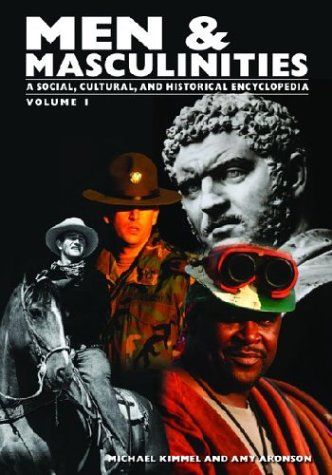
Men & Masculinities
A Social, Cultural, and Historical Encyclopedia
Introduction: Manhood is Not a Birthright
Introduction: Manhood is Not a Birthright
Nova: Welcome to the show. Imagine this: You’re at a high-stakes audition, but the role never ends, the judges are all other men, and the script keeps changing every decade. That is, according to leading scholar Michael S. Kimmel, the reality of modern manhood.
Nova: : That sounds exhausting, Nova. I always thought being a man was just… being. What book are we diving into today that suggests it’s a constant performance?
Nova: We are dissecting the foundational ideas behind Michael S. Kimmel’s extensive work, particularly as synthesized in his major texts like the Encyclopedia and Handbook of Studies on Men and Masculinities. Kimmel argues that masculinity isn't a biological given; it’s a social, cultural, and historical construction. It’s something men must constantly strive to prove they possess.
Nova: : So, it’s less about biology and more about a social contract? If I’m not actively proving I’m a man, I risk being labeled something else entirely?
Nova: Precisely. And that risk, that fear of failure, is what drives so much of male behavior. Kimmel’s work forces us to look at manhood not as a stable state, but as a moving target, often defined by what it is emphatically. Today, we’re exploring the contest, the crisis, and the consequences of this relentless pursuit of manhood.
Nova: : I’m ready to see behind the curtain. Let’s start with this idea of a contest. What are the rules of this game Kimmel describes?
Nova: Let’s jump right into the first core insight: Masculinity as a Relentless Test.
Key Insight 1: The Performance of Manhood
The Contest: Masculinity as a Relentless Test
Nova: Kimmel’s analysis often frames masculinity as a performance designed primarily for an audience of other men. He suggests that manhood is maintained through a constant, often unconscious, competition.
Nova: : A competition for what? Bragging rights? Or something deeper?
Nova: Deeper. It’s a competition for status, for social acceptance within the male hierarchy. And critically, this status is often secured by demonstrating distance from anything coded as feminine or, perhaps most powerfully, anything coded as homosexual. Kimmel famously explored this in his concept of 'Masculinity as Homophobia.'
Nova: : That’s a strong claim. So, the fear of being perceived as gay is a primary motivator for how many men behave, even if they are straight?
Nova: That’s the argument. If femininity is the negative pole on the spectrum of acceptable male behavior, then homosexuality becomes the ultimate failure state. Men police each other rigorously. Think about casual language—the casual deployment of homophobic slurs, even among friends, isn't just about prejudice; it's a micro-performance confirming, 'I am not.'
Nova: : That makes a lot of sense in terms of group bonding. It’s like an initiation ritual that never stops. But does this contest apply equally to all men? A CEO and a construction worker—are they playing the same game?
Nova: That’s where the nuance of his work, especially in the Encyclopedia, comes in. Kimmel acknowledges that there isn't one monolithic masculinity. There are hegemonic masculinities—the dominant, idealized forms—and then there are subordinate ones. But the of the contest remains. The CEO might prove his manhood through financial dominance and stoicism, while the construction worker proves his through physical toughness and risk-taking. The goal is still to achieve the highest status within their respective spheres by adhering to the dominant cultural script.
Nova: : So, the script changes based on the setting, but the need to perform adherence to that script is universal for men seeking validation.
Nova: Exactly. And this performance is incredibly costly. Kimmel points out that this relentless testing leads to emotional constriction. Men are discouraged from seeking help, expressing vulnerability, or prioritizing intimacy over achievement. It’s a high-stakes game where the prize is acceptance, but the cost is often genuine connection and mental well-being.
Nova: : I recall reading about how this pressure manifests in everyday life. Are there statistics on how this emotional suppression impacts men’s health?
Nova: There are compelling correlations. Studies Kimmel references often show men having fewer close friendships than women, higher rates of substance abuse as a coping mechanism, and tragically, significantly higher rates of suicide. When you can’t admit you’re struggling because that would be failing the test, you internalize the pressure until it becomes unbearable. It’s a self-imposed isolation booth.
Nova: : It sounds like the very structure designed to grant status ends up isolating the participants. If this is the structure, how did we get here? Was manhood always this fragile and competitive?
Nova: That brings us perfectly to our second chapter: the historical context. Because Kimmel argues forcefully that no, it was not always this way. Manhood has a history, and that history is currently in crisis.
Key Insight 2: From Provider to Question Mark
The Historical Shift: The Crisis of Manhood
Nova: Kimmel’s historical essays, like those in 'The History of Men,' show that what we consider 'manhood' today is relatively new. The 20th century, particularly the post-WWII era, cemented a very specific ideal: the male breadwinner, the stoic provider, the soldier.
Nova: : That image is still incredibly powerful in media, even today. The man who fixes things, who never cries, who brings home the bacon.
Nova: It was powerful, but Kimmel argues that the foundations of that ideal began crumbling around the 1960s and 70s. This is the 'crisis of masculinity' he frequently discusses. What caused it?
Nova: : I’d guess economic shifts? When manufacturing jobs disappear, the traditional working-class male identity tied to physical labor and providing security takes a massive hit.
Nova: You hit the nail on the head. Economic restructuring—the decline of industrial jobs and the rise of the service and information economy—meant the physical strength and reliable factory wage that defined manhood for generations became less central. Simultaneously, the second wave of feminism directly challenged the domestic and political roles assigned to men.
Nova: : So, the two pillars supporting the traditional male identity—economic indispensability and unquestioned authority at home—were simultaneously weakened. That must have created a massive vacuum.
Nova: A vacuum filled with anxiety. Kimmel notes that when the old script fails, men don't just adopt a new one easily. They often retreat into defending the old one, or they become deeply confused about their purpose. He points out that men’s identities became unmoored from their work in a way women’s identities had not been, because women were already fighting for roles outside the home.
Nova: : That’s a fascinating asymmetry. Women were fighting to get to the public sphere, while men were suddenly finding their traditional role in the public sphere devalued or outsourced.
Nova: Precisely. And this historical shift explains a lot of contemporary male frustration. If your value was tied to being the sole provider, and now your partner might earn more, or your job is automated, where does your value reside? Kimmel suggests men often look for new ways to prove their masculinity, often by doubling down on the few areas where they still feel they have undisputed control.
Nova: : And those areas often circle back to the first point, don't they? Control over bodies, control over public space, or aggressive displays of dominance.
Nova: They do. The crisis doesn't lead to a sudden embrace of vulnerability; it often leads to a defensive hardening. When the traditional markers of success—the corner office, the steady paycheck—become harder to attain or less meaningful, men may turn to more primal, often aggressive, displays to signal their status.
Nova: : It sounds like the historical context is crucial for understanding why we see certain political and social reactions today. It’s not just random anger; it’s anxiety rooted in a cultural identity crisis.
Nova: Absolutely. And this brings us to the final, most urgent part of Kimmel’s research: the real-world consequences when this anxiety meets power.
Key Insight 3: When Performance Turns Destructive
The Stakes: Backlash and Toxic Manifestations
Nova: We’ve established that manhood is a contest defined by exclusion, and that the rules have been changing rapidly since the mid-20th century. Now, let’s look at the fallout. Kimmel’s later work, especially in discussions around 'toxic masculinity,' connects this identity struggle directly to social problems.
Nova: : When we talk about 'toxic masculinity,' what is Kimmel specifically identifying? Is he saying masculinity itself is toxic, or is it the it’s currently performed?
Nova: He is very clear: it’s the latter. It’s not masculinity that’s the problem; it’s the rigid, narrow, and often violent definition of it that demands emotional suppression and dominance. He argues that when men feel their traditional power slipping—due to economic changes, or gains made by women and minorities—they often engage in a 'backlash politics.'
Nova: : Backlash politics—that sounds like a direct response to feeling disempowered. Can you give us a concrete example of how this plays out?
Nova: Consider the rise of certain political movements that emphasize hyper-masculine rhetoric, a return to perceived 'traditional values,' or aggressive stances against perceived threats to male status. Kimmel sees this as men attempting to reassert control over the cultural narrative when they feel they’ve lost control over their economic or social standing. It’s a desperate attempt to win the contest by any means necessary.
Nova: : So, the anxiety from the historical crisis fuels a need for dominance in the present-day contest. It’s a feedback loop.
Nova: Exactly. And this loop manifests in areas like sexual violence and harassment. Kimmel’s research shows that the pressure to be dominant, sexually aggressive, and emotionally invulnerable creates an environment where empathy is sidelined. If a man’s status is tied to conquest or control, the line between assertive behavior and harmful behavior becomes dangerously blurred.
Nova: : It’s a system that rewards the worst behaviors because those behaviors are the easiest, most visible ways to signal adherence to the old, rigid script.
Nova: That’s the tragedy of it. And this is why Kimmel’s work is so vital. He doesn't just diagnose the problem; he offers a path forward by showing that the script is. If men constructed this system, men can deconstruct it and build healthier alternatives.
Nova: : So, what does that healthier alternative look like, according to Kimmel? If we stop policing each other for being 'not manly enough,' what are we left with?
Nova: We are left with the potential for what he calls 'emancipatory masculinity.' It’s a manhood that is defined by connection, responsibility, and emotional literacy, rather than dominance and emotional isolation. It means men can be fathers who are fully present, friends who can share their struggles, and citizens who value equality over hierarchy. It’s about redefining success on human terms, not just masculine terms.
Nova: : It sounds like the ultimate goal is to make the performance optional, to allow men the freedom to simply without the constant fear of failing the audition.
Nova: That’s the hope. It requires recognizing that the history of manhood is a history of choices, and we have the power to choose differently now.
Conclusion: Choosing a New Script
Conclusion: Choosing a New Script
Nova: We’ve covered a lot of ground today, moving from the relentless performance of manhood to the historical forces that destabilized it, and finally to the destructive consequences of clinging to outdated scripts.
Nova: : The key takeaway for me is that masculinity is fluid, not fixed. Kimmel shows us that the anxiety many men feel isn't a personal failing; it’s a systemic pressure resulting from cultural expectations that no longer match economic or social reality.
Nova: Precisely. The contest is exhausting because the prize—a rigid, emotionally stunted form of dominance—is ultimately hollow. The historical crisis isn't a sign of men's failure, but an opportunity for cultural evolution.
Nova: : So, the actionable takeaway is self-awareness. Recognizing when we are policing ourselves or others based on these old, invisible rules. And then, perhaps, choosing to support the men who dare to step off the stage.
Nova: That’s the call to action. Understanding the social construction of manhood, as detailed in Kimmel’s vast body of work, is the first step toward building a world where men are valued for their humanity, not just their adherence to a narrow, often harmful, definition of strength.
Nova: : It’s a powerful framework for understanding everything from locker room talk to political movements. Thank you for guiding us through the essential arguments of Michael S. Kimmel today.
Nova: My pleasure. Understanding the history and culture of manhood is crucial for everyone, regardless of gender. This is Aibrary. Congratulations on your growth!