

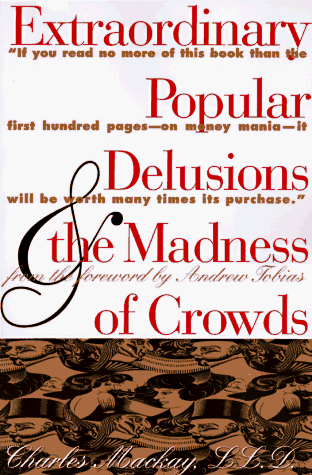
Memoirs of extraordinary popular delusions
Introduction
Nova: Imagine a man in 1840s London, a Scottish journalist, sitting down to write a book that would still be quoted on Wall Street trading floors 180 years later. He would call it "Memoirs of Extraordinary Popular Delusions and the Madness of Crowds." And his central insight was so sharp it still stings: "Men, it has been well said, think in herds; it will be seen that they go mad in herds, while they only recover their senses slowly, and one by one."
Nova: Great question. Mackay was fascinated by the moments when entire societies seemed to lose their collective minds. Not just individuals making bad decisions, but whole nations, millions of people, all chasing the same delusion at the same time. He called them "moral epidemics." And he argued that these weren't random — they followed patterns as predictable as any disease.
Nova: Not at all. It covers financial manias, sure — the Tulip Mania, the South Sea Bubble, the Mississippi Scheme. But it also dives into witch hunts, the Crusades, alchemy, haunted houses, fortune-telling, dueling, even the politics of men's beards. Mackay was cataloguing human folly in all its glorious variety. Bernard Baruch, the famous financier, credited this book with convincing him to sell all his stocks just before the 1929 crash. Michael Lewis called the financial chapters one of the six great works of economics.
Nova: Let's start with flowers. Specifically, tulips.
The Dutch Tulip Mania
When Flowers Cost More Than Houses
Nova: Picture the Netherlands in the early 1630s. Tulips had been introduced from the Ottoman Empire and were becoming a status symbol among the wealthy. But something strange happened. The flowers started being treated less like garden decorations and more like lottery tickets.
Nova: According to Mackay, some single tulip bulbs were selling for more than ten times the annual income of a skilled craftsman. People were trading land, jewelry, carriages, even their homes for a single bulb. The most famous variety, the Semper Augustus, allegedly commanded 5,500 florins at its peak.
Nova: For a flower that hadn't even bloomed yet, in many cases. Mackay describes a futures market emerging — people weren't trading actual bulbs, but contracts for bulbs that hadn't been dug up. A sailor allegedly mistook a rare tulip bulb for an onion and ate it with his herring sandwich, and was thrown in prison for months.
Nova: That's the story Mackay tells. And then, in February 1637, the market just collapsed. Buyers stopped showing up at the tulip auctions in Haarlem. Panic spread. Within weeks, bulbs that had been worth a fortune were nearly worthless. People who had mortgaged their homes were ruined.
Nova: You're absolutely right, and this is a fascinating layer. Modern researchers like Peter Garber and Anne Goldgar have shown that Mackay probably did exaggerate the scale and social impact. He borrowed heavily from moralistic pamphlets written right after the crash — propaganda, essentially. The tulip trade didn't actually devastate the Dutch economy. Most of the stories about ruined weavers and sailors may have been invented to warn against speculation.
Nova: Ironic, isn't it? And it gets even more ironic later, as we'll see. But even if the facts are embellished, the pattern Mackay described — escalating prices driven by the belief that they'll just keep going up, followed by sudden collapse — that's real, and it repeats.
The Mississippi Scheme and South Sea Bubble
The Gambler Who Took Over France
Nova: Now let's talk about John Law. Here's a man who killed someone in a duel, fled Scotland, became a professional gambler across Europe, and somehow talked his way into running the entire French economy.
Nova: Effectively, yes. In the early 1700s, France was drowning in debt after Louis XIV's wars. John Law showed up with a radical idea: replace gold and silver with paper money. He also created the Mississippi Company, which held a monopoly on trade with French Louisiana. Law convinced the French public that Louisiana was overflowing with gold and silver, just waiting to be collected.
Nova: It was definitely not. But for a while, the scheme was dazzling. Mackay describes a scene of total frenzy on the Rue Quincampoix in Paris, where stock trading took place. The narrow street became so packed with speculators that a hunchback allegedly made a small fortune by renting out his hump as a writing desk.
Nova: That's the Mackay anecdote. The share price of the Mississippi Company went from 500 livres to 10,000 livres. People from every walk of life — shopkeepers, aristocrats, servants — threw their savings into it. John Law was treated like a celebrity. He converted to Catholicism to fit in. He was made a duke.
Nova: And then people started wanting to convert their paper back to gold, and there wasn't enough. The whole thing unraveled in 1720. Law fled France in disgrace, dying in poverty in Venice a few years later. Meanwhile, across the Channel, a nearly identical mania was playing out — the South Sea Bubble. Same pattern: a company promising riches from faraway trade, shares soaring to insane heights, and then catastrophe. Even Sir Isaac Newton lost a fortune — about twenty thousand pounds, which was a staggering sum at the time. He later said, "I can calculate the motion of heavenly bodies, but not the madness of people."
Nova: Exactly. And Mackay was the first to connect all these dots and say: this isn't about economics. This is about psychology.
Witch Hunts, Alchemy, and the Darker Delusions
Burning Neighbors and Chasing Gold
Nova: The financial chapters are what the book is famous for, but honestly, some of the most gripping material comes later, in the sections on witch mania and alchemy. Mackay's account of the European witch hunts is chilling.
Nova: He argued that the witch trials of the 16th and 17th centuries were a mass delusion — not just a few superstitious villagers, but entire legal systems, churches, and governments convinced that their neighbors were in league with the devil. Mackay estimated that thousands upon thousands were executed, with the largest number in Germany.
Nova: He saw it as a combination of factors: the Church's authority, local grudges, and what we'd now call confirmation bias. Once the belief took hold, any misfortune — a bad harvest, a sick cow, a child's illness — could be blamed on witchcraft. And the standards of evidence were shockingly low. There's a grim pattern Mackay traces where one accusation would trigger a cascade. Once a few witches were found in a town, suddenly more were discovered everywhere. The belief created its own evidence.
Nova: That one is more darkly comic. Mackay traces centuries of alchemists trying to turn base metals into gold and discover the elixir of life. He profiles figures like Cornelius Agrippa, Paracelsus, John Dee, and the Comte de Saint-Germain. One of my favorite lines from Mackay is in his introduction to the alchemy section. He writes that three things have always tormented humanity: death, toil, and ignorance of the future. Alchemy promised to solve all three — the philosopher's stone for unlimited wealth, the elixir of life for immortality, and astrology for knowing what's coming.
Nova: That's the nuance Mackay brings. He says many genuinely believed in what they were doing. They were deluded, not just deceptive. But he also notes how dangerous it was — nobles would sometimes imprison an alchemist and refuse to release him until he produced gold. It was a profession where failure could literally cost you your freedom.
Nova: Exactly. And that brings us to perhaps the most fascinating part of this whole story — Mackay himself.
Charles Mackay and the Railway Mania
The Delusion Expert's Own Delusion
Nova: Here's something that doesn't appear in the book. While Mackay was busy documenting everyone else's financial follies, he lived through four major investment manias in 19th-century Britain. And he didn't just live through them — he participated in one.
Nova: The mathematician Andrew Odlyzko did some remarkable detective work on this. It turns out that Mackay, working as a journalist for the Glasgow Argus in the 1840s, was one of the most enthusiastic cheerleaders for the Railway Mania — the biggest investment bubble in British history up to that point.
Nova: He wrote on October 2nd, 1845: "There is no reason whatever to fear a crash." That's a direct quote from his newspaper column. The Railway Mania was in full swing. Railway shares were skyrocketing. Investment was pouring in. And Mackay was telling everyone everything was fine.
Nova: The crash came. Railway shares collapsed between 1846 and 1849. The mania had drawn in enormous amounts of capital — at its peak, railway investment was consuming a significant share of Britain's entire GDP. And when it burst, it took down banks, ruined investors, and left a trail of half-finished railway projects across the country.
Nova: It gets even better. In later editions of his book, Mackay did add a footnote mentioning the Railway Mania as another example of a popular delusion. But he never acknowledged his own role in it. He never wrote about it in detail. He never came clean. The man who documented how people think in herds was, in the end, running with the herd.
Nova: I think so too. It suggests that nobody is immune. Not even the people who study this stuff for a living. That's why Mackay's most famous line — "they only recover their senses slowly, and one by one" — feels so true. We're all susceptible.
Modern Relevance and Lasting Lessons
Why This Book Still Matters
Nova: So why does a book published in 1841 still find an audience? Bernard Baruch credited it with saving his fortune before the 1929 crash. Michael Lewis ranks its financial chapters alongside Adam Smith and Keynes. Forbes cited it during the 2007 Chinese stock bubble. Neil Gaiman borrowed its title for a Sandman comic. It keeps resurfacing.
Nova: They really haven't. When you read about the Tulip Mania, you're reading about every cryptocurrency boom and bust. When you read about the South Sea Bubble, you're reading about every IPO frenzy. Mackay himself wrote: "Every age has its peculiar folly; some scheme, project, or phantasy into which it plunges, spurred on either by the love of gain, the necessity of excitement, or the mere force of imitation."
Nova: Exactly. A Washington Post essay from a few years ago made exactly that connection. The dynamics Mackay described in 1841 — the way ideas spread through populations, the way FOMO drives behavior, the way people convince each other of things that aren't true — that's the mechanics of viral content. The madness of crowds has just gotten faster and more efficient.
Nova: Plenty. Beyond the exaggeration of Tulip Mania, historians note that Mackay was a journalist, not a rigorous scholar. He loved a good story more than he loved strict accuracy. His book is a miscellany, not a systematic history. And James Surowiecki's 2004 book "The Wisdom of Crowds" offers an almost opposite thesis — that under the right conditions, groups can actually be smarter than individuals.
Nova: I think the right approach is to read him as a brilliant storyteller with a profound insight, not as an infallible historian. The specific facts might be shaky, but the pattern he identified is real. And his own story — the bubble expert who couldn't see his own bubble — only deepens the lesson. The delusion isn't something that happens to other people. It happens to all of us.
Conclusion
Nova: Let's take stock. Charles Mackay's "Memoirs of Extraordinary Popular Delusions and the Madness of Crowds" gave us a phrase that has entered the language, a lens for understanding everything from market crashes to viral trends, and a warning that we ignore at our peril: humans are imitative creatures. We follow. We copy. We get swept up.
Nova: That might be the deepest lesson. Mackay himself, for all his insight, couldn't resist the Railway Mania. Sir Isaac Newton, the greatest scientific mind of his age, got wiped out in the South Sea Bubble. If those two couldn't see it coming, what hope do the rest of us have?
Nova: I think the first step is humility. Acknowledge that you're susceptible. The second is to pay attention to the feeling in the room. When everyone around you is saying this time is different, when the fear of missing out becomes physically uncomfortable, when you find yourself explaining why the old rules don't apply anymore — that's probably when they apply most.
Nova: Well said. This has been Aibrary. Congratulations on your growth!