The Emperor's Algorithm: Decoding Stoic Leadership for the AI Age
Golden Hook & Introduction
SECTION
Socrates: Chengcheng, as a project manager navigating the complexities of marketing, you're constantly dealing with chaos—shifting deadlines, unpredictable teams, volatile markets. What if the most effective tool for managing that chaos wasn't a new app or methodology, but a 2000-year-old private diary?
Chengcheng Su: That's a powerful framing, Socrates. In project management, we have frameworks for risk mitigation and change control, but the idea of a personal, internal framework is compelling. It suggests the root of control isn't in the process, but in the person running it.
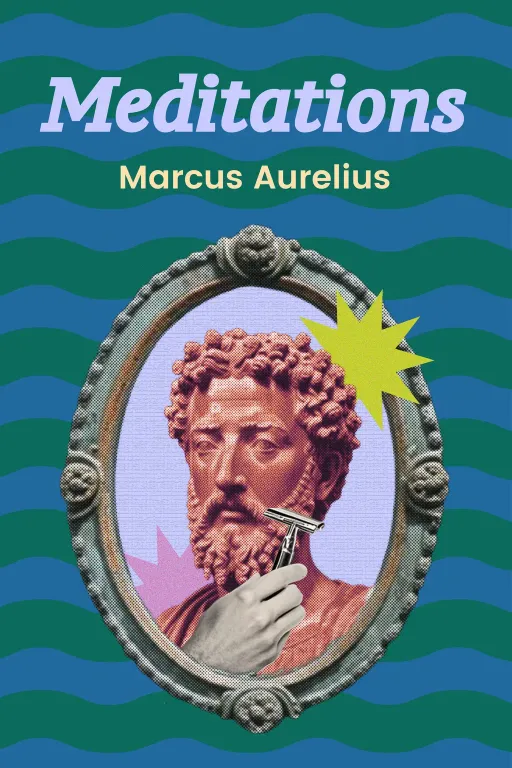
Socrates: Precisely. The Roman Emperor Marcus Aurelius ruled through plagues, constant warfare, and betrayal. His book,, wasn't written for us; it was his personal source code for maintaining sanity and purpose. You could almost call it an algorithm for the soul.
Chengcheng Su: An algorithm for the soul. I like that. It implies a logical, repeatable process for achieving a desired state, which is exactly what an INTJ mind like mine is drawn to. It’s about designing a system for your own mind.
Socrates: Exactly. And that's our goal today. We'll dive deep into this from two powerful perspectives. First, we'll explore the concept of the 'Inner Citadel'—how to build an unshakeable core of reason in an age of distraction. Then, we'll discuss a radical approach to problem-solving: how to transform the very obstacles that threaten our projects into the fuel for their success.
Chengcheng Su: Building the fortress, and then learning how to use it in battle. It sounds like a masterclass in leadership. I'm ready.
Deep Dive into Core Topic 1: The Inner Citadel: Mastering Your Directing Mind
SECTION
Socrates: Let's start, then, with that fortress. Marcus calls it the in Greek, which we can translate as the 'directing mind' or the 'ruling faculty'. It's the part of you that is pure reason, the observer of your thoughts, the final decision-maker. He writes, "Men seek retreats for themselves - in the country, by the sea, in the hills... But all this is quite unphilosophic, when it is open to you, at any time you want, to retreat into yourself." Chengcheng, what does that idea of an 'inner retreat' bring to mind for you?
Chengcheng Su: It immediately makes me think of the difference between a vacation and true mental clarity. You can go to the beach, but if you bring your anxieties, your project deadlines, your mental clutter with you, you haven't really retreated at all. The location has changed, but the internal chaos remains. The idea that you can access a state of calm and order internally, regardless of your physical location or external circumstances... that's a superpower for a project manager.
Socrates: It is a superpower. And Marcus believed it was a necessary one, especially for someone in his position. He constantly warned himself against being corrupted by his own power. There's a striking line where he says, "Take care not to be Caesarified, or dyed in purple." He knew the external role of 'Emperor' could stain his internal 'directing mind'.
Chengcheng Su: 'Dyed in purple.' That’s a brilliant metaphor. It’s about the role consuming the person.
Socrates: Exactly. Imagine being the most powerful person in the known world. Every person you meet is flattering you. Every whim can be met. The greatest danger isn't an assassin's knife; it's the slow, creeping corruption of your own judgment. Marcus's 'retreat' was his daily practice of reminding himself: "I am a man, a Roman, a ruler... but my mind, my directing mind, is my own. It must remain clear, undyed." So let me ask you, Chengcheng, in your world of marketing and project leadership, what's the modern equivalent of being 'dyed in purple'?
Chengcheng Su: That's a fantastic question. I think the most dangerous 'purple dye' today is data, specifically, vanity metrics. It's becoming a slave to the numbers. It's when the 'likes', the 'click-throughs', the 'quarterly growth percentage'—all this external validation—start to dictate your strategy instead of your first principles and the long-term brand vision. The 'directing mind' of a leader is the part that has to step back from the glowing dashboard and ask, "Are we doing this because it's strategically sound and builds real value, or because it gives us a temporary hit of good-looking data?"
Socrates: And the dashboard is only going to get more persuasive, isn't it? As we enter an age dominated by AI, that external pull becomes almost irresistible.
Chengcheng Su: It's the critical challenge. An AI can optimize for a flawed goal with terrifying efficiency. It can tell you that a certain type of clickbait content will increase engagement by 15% this week. It can't tell you that it will erode brand trust over the next five years. The AI can create a feedback loop of that 'purple dye' that's almost impossible for a team to escape. The leader's 'directing mind', as Marcus calls it, becomes the final, crucial human checkpoint. It's the ethical and strategic failsafe.
Socrates: So the 'Inner Citadel' isn't just for personal peace; it's a strategic necessity. It’s the only place from which a leader can make a judgment that an algorithm can't.
Chengcheng Su: Precisely. The AI provides the 'what'. The leader's directing mind must provide the 'why' and, most importantly, the 'should we'. Without that inner retreat to a place of clear principles, you're not a leader; you're just a manager of the machine's suggestions.
Deep Dive into Core Topic 2: The Obstacle as Fuel: Applying the Dichotomy of Control
SECTION
Socrates: And that ability to be a failsafe, to make those hard judgments, is tested most not in times of calm, but in moments of crisis. This brings us to the second, and perhaps most practical, Stoic idea: reframing obstacles. Marcus writes that a rational mind "turns any obstacle to its work into an aid for itself." He uses a powerful image: "a fire masters the things thrown into it... and grows stronger from them."
Chengcheng Su: The obstacle is the way. It's a concept that's become popular in modern business literature, but hearing it in the original context is powerful. It's not just a clever mindset hack; it's a fundamental law of nature he's observing.
Socrates: It is. And he had to live it. Let's look at the ultimate case study in project failure from his reign: the revolt of Avidius Cassius in AD 175. Imagine this, Chengcheng. You're Marcus, the Emperor. You are bogged down in a brutal, decade-long war on the northern frontier, fighting Germanic tribes in the freezing forests. It's exhausting, costly, and morale is low. Suddenly, you receive a message: your most trusted and brilliant general in the East, Avidius Cassius, has declared himself the new emperor.
Chengcheng Su: That's not just a project risk; that's a catastrophic failure. The system has completely broken.
Socrates: Completely. Cassius was a superstar, the hero of the Parthian war. He had the loyalty of all the eastern legions. The rumor he spread was that Marcus had died, and he was simply stepping in to stabilize the empire. So now, the entire eastern half of your world—Syria, Egypt, the breadbasket of Rome—is in open rebellion. This is a project failure of world-ending proportions. What's the first impulse?
Chengcheng Su: The first impulse is panic. Then anger. Then blame. You'd want to find out who was responsible, crush the rebellion, and make an example of them. You'd focus on the betrayal.
Socrates: And that is focusing on what you cannot control. Marcus couldn't control the rumor. He couldn't undo Cassius's ambition. He couldn't teleport his army across the empire. So, what did he do? He focused on his. He gathered his weary troops and gave a speech, not of rage, but of profound sadness. He lamented the loss of a friend and the tragedy of civil war. He openly expressed his desire for reconciliation, not bloodshed, hoping he could face Cassius and resolve it without more death. He reframed the entire event. It wasn't about him versus a traitor. It was a tragedy for Rome that he, as emperor, had a duty to resolve with minimal harm.
Chengcheng Su: He changed the narrative. He took control of the one thing he could: the meaning of the event.
Socrates: Exactly. And the story has a stunning conclusion. Before Marcus's army even arrived in the East, Cassius's own officers, hearing of Marcus's calm strength and his offer of clemency, and realizing their own position was untenable, assassinated Cassius. They cut off his head and sent it to Marcus as a sign of loyalty.
Chengcheng Su: And what did Marcus do?
Socrates: He refused to even look at it. He was reportedly saddened by it, because it denied him the chance to forgive his friend. He then ordered that Cassius's family and all the conspirators be treated with clemency. He turned the ultimate obstacle—a civil war—into the ultimate opportunity to demonstrate his core principles: justice, mercy, and duty. The fire of his directing mind consumed the obstacle and burned brighter. How does that resonate with managing a project that's going completely off the rails?
Chengcheng Su: It resonates profoundly. When a major marketing campaign fails or a product launch is a disaster, the initial impulse is exactly what I said: blame. "Who messed up? Which team dropped the ball?" But that's focusing on what's already happened—the past, which we can't control. The 'Marcus' approach is to immediately ask: "What does this failure now make possible?" It's an opportunity to rebuild a flawed process. It's a chance to strengthen team trust through a transparent, blame-free post-mortem. It's a gift of data that tells us what our customers want, not what we thought they wanted. The failure itself becomes the 'fuel' for the next, better iteration. It's the core of the Agile development mindset, really, but with a deep moral dimension.
Socrates: So it's not just about salvaging the project, but about strengthening the system and the people within it.
Chengcheng Su: Yes. You don't just fix the bug; you use the bug to make the entire codebase more robust. You use the crisis to forge a more resilient team. The obstacle literally becomes the path forward.
Synthesis & Takeaways
SECTION
Socrates: So we have these two powerful, interconnected ideas from a 2000-year-old journal. The 'directing mind' is the fortress we build in times of peace, a citadel of reason and principle.
Chengcheng Su: And the 'dichotomy of control'—this art of turning obstacles into fuel—is the strategy we deploy from that fortress in times of war, or in my case, during a difficult product launch.
Socrates: One is the internal operating system, the other is the crisis-response protocol.
Chengcheng Su: Exactly. You need both to be an effective, and I would argue, a virtuous leader. You need the stable core, and you need the flexible, adaptive strategy for dealing with the inevitable chaos of the world.
Socrates: So, for everyone listening, especially those in leadership roles, here is the challenge from Marcus Aurelius. The next time you face an unexpected setback—a critical bug, a sudden budget cut, a disappointing result—pause. Before you react, before you blame, retreat for a moment into that inner citadel. And from that place of calm, ask yourself that simple, powerful question: "What part of this is the fire, and what part is the fuel?" What is the virtuous, rational action this obstacle is now asking of me?
Chengcheng Su: The answer might just change everything. It might turn your biggest failure into your greatest strength.