

Unlocking Mathematical Intuition: Beyond Formulas
Golden Hook & Introduction
SECTION
Nova: Atlas, imagine you’re staring at a really complex mathematical problem, the kind that makes your brain feel like it’s trying to untangle a ball of yarn after a cat got to it. What's your first instinct?
Atlas: Oh, man. My first instinct? Probably to find the nearest formula sheet and just start plugging in numbers, hoping for the best. It’s all about the 'how' for me, usually.
Nova: Exactly! And that’s where most of us get stuck. But what if I told you that the real magic, the profound insights, happen you even touch a formula? What if the actual key to unlocking mathematical intuition isn't about calculation at all, but about seeing?
Atlas: Wait, seeing? Like, literally visualizing it? That sounds almost… mystical for math. I’m intrigued. You’re telling me there’s a secret handshake to math that doesn’t involve endless equations?
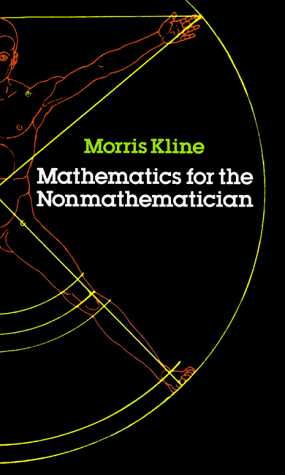
Nova: Well, not a secret handshake, but a profound way of thinking that we often overlook. Today, we're diving deep into that very idea, drawing inspiration from two incredible books: "Mathematics for the Nonmathematician" by Morris Kline and "Euler's Gem: The Polyhedron Formula and the Birth of Topology" by David S. Richeson.
Atlas: Morris Kline! I know that name. He was this incredibly influential historian of mathematics, right? He had this knack for making the evolution of mathematical thought feel like an epic saga. I remember hearing he wrote "Mathematics for the Nonmathematician" precisely because he felt so many people missed the beauty and the 'why' behind the numbers. It wasn't just about showing people how to do math, but why it mattered.
Nova: Absolutely. Kline was a master at showcasing the human story behind the equations, arguing that you couldn't truly understand math without understanding its historical and philosophical context. And Richeson's "Euler's Gem" takes a seemingly simple concept—Euler's formula for polyhedra—and uses it as a gateway into the entire field of topology. It's a brilliant example of how deep insights can spring from seemingly simple observations, showing how the abstract can become incredibly concrete through insight.
Atlas: That makes me wonder, then, if our usual approach to math—all formulas and rote memorization—is actually putting up a barrier to understanding. So, where do we even begin to break down that wall?
The Art of Abstract Thought
SECTION
Nova: We start by embracing what Kline called "the art of abstract thought." He argued that mathematics isn't just a toolbox of techniques; it's a way of understanding the world. For a lot of us, math class was about solving problems quickly. But Kline, and Richeson in his own way, invite us to slow down, to appreciate the journey of discovery.
Atlas: I can see that. For someone who’s always focused on getting to the answer, that’s a huge shift. It’s like saying, "Don't just drive to the destination; appreciate the scenery along the way." But how do you teach someone to appreciate the scenery when they're just trying not to get lost?
Nova: That’s the core of it, isn't it? Kline’s work, particularly, emphasizes that true mathematical understanding comes from grasping the and their historical development. He shows how concepts like calculus or geometry didn't just appear fully formed; they evolved over centuries, driven by human curiosity and necessity. It’s a conceptual journey, showing the 'why' behind the 'how.'
Atlas: So, it’s about context. It’s about the narrative. That’s something I think many aspiring scholars, those who really want mastery and not just grades, would latch onto. We want to grasp complex ideas, not just memorize them.
Nova: Precisely. And Richeson’s book, "Euler's Gem," is a perfect illustration of this. He doesn't just present Euler's formula—Vertices minus Edges plus Faces equals two—he takes you on a historical adventure. You learn about the context in which Euler was working, the types of problems he was trying to solve, and how this seemingly simple formula became a cornerstone of an entirely new branch of mathematics: topology.
Atlas: That’s fascinating. Because when you just see "V - E + F = 2", it’s just a dry equation. But when you understand that it came from grappling with something as tangible as the shape of a cube or a pyramid, and then realizing it applies to convex polyhedron, that suddenly feels like a profound insight.
Nova: It is! Richeson makes you feel like you're discovering it alongside Euler. He shows how you can look at something familiar, like a soccer ball or a crystal, and start to ask deeper questions about its fundamental structure, beyond its surface. That’s getting beyond formulas and into intuition.
Atlas: That’s a powerful distinction. It’s not about ignoring the formulas, but understanding where they come from and what fundamental truths they represent. It’s like understanding the engine of a car, not just how to drive it.
Your Mind's Eye for Math
SECTION
Nova: And this leads us to a deep question, especially for those who seek understanding and want to grasp complex ideas: How can you visualize abstract mathematical concepts attempting to solve them with formulas? How do you engage your mind's eye for math?
Atlas: That’s a tough one. My brain tends to jump straight to the symbolic. If it’s a geometry problem, I can draw a diagram, sure. But if it’s an algebra problem, or something more abstract, my mind just wants to see variables and operations. How do you visualize, say, a derivative?
Nova: That's where the art comes in. Kline and Richeson both, in their own ways, encourage us to create mental models. For a derivative, instead of just thinking of the formula for the slope of a tangent line, visualize a car speeding up, and the derivative as the instantaneous speed at any given moment. Or think of a graph and physically imagine zooming in closer and closer to a point until the curve looks like a straight line.
Atlas: So it's about finding a physical analogy, even for something that doesn't have an obvious physical form. That’s a different kind of problem-solving. My approach is thorough, I want mastery, but I often think that means more practice with formulas, not less.
Nova: It means practice. Think about Euler's formula again: V - E + F = 2. You can physically hold a cube, count its vertices, edges, and faces. You can deform that cube into a sphere, and the formula still holds. You can imagine stretching, bending, or squishing it, and those topological properties remain invariant. Richeson makes you that.
Atlas: That's a great example. You're physically manipulating the concept in your head. I imagine a lot of our listeners, especially those driven by ambition and caring about their future, are looking for ways to really own these complex topics. This visualization technique seems like a powerful tool for concept mapping, for untangling those big topics.
Nova: It absolutely is. Consider drawing diagrams, not just to represent the problem, but to explore the relationships between mathematical entities. Think about how ancient Greek mathematicians used geometric constructions to solve problems that we now solve with algebra. They were visualizing the entire process.
Atlas: So, for me, when I'm faced with a complex problem, instead of immediately reaching for the formula, I should pause and ask, "How can I see this? What mental picture can I draw? What diagram would help me understand the relationships first?"
Nova: Exactly. It's about building that intuitive bridge between the abstract symbols and the underlying reality they represent. It's about cultivating a "mind's eye" for math, where you can manipulate concepts visually, test ideas, and even discover new connections before formal methods take over. That's where innovation and true understanding lie.
Atlas: That’s actually really inspiring. It means math isn't just for people who are naturally good at crunching numbers. It's for anyone who can learn to see the patterns and the stories within the numbers.
Synthesis & Takeaways
SECTION
Nova: And that’s the profound takeaway from both Kline and Richeson. Math isn't just a series of isolated formulas to be memorized; it's a rich tapestry of human thought, discovery, and intuition. By understanding its history and by actively engaging our mind's eye to visualize its abstract concepts, we move beyond mere calculation to a much deeper, more satisfying mastery.
Atlas: It’s about embracing the journey, as you said. Every challenge becomes a step forward when you're seeking understanding, not just a quick answer. For anyone out there who feels intimidated by math, or who just wants to go beyond the surface, this idea of visualizing and understanding the 'why' is a game-changer. It’s what transforms a student into an aspiring scholar.
Nova: It truly is. It's about recognizing that mathematics is fundamentally an act of creative problem-solving and conceptual exploration. And the ability to visualize, to create mental models and diagrams, is arguably the most powerful tool in that exploration. It’s what helps you break down big tasks and find that one small win each day, building towards true mastery.
Atlas: So, the next time we're faced with a mathematical challenge, the first step isn't to open the textbook to the formulas page, but to close our eyes and imagine. To draw it out, literally or mentally, and let our intuition guide us. That feels like a powerful strategy for strategic study planning and concept mapping.
Nova: Think of it as cultivating your mathematical imagination. It’s a muscle that gets stronger with practice. And the payoff isn’t just better grades; it’s a deeper, richer understanding of the world around you.
Atlas: I love that. It’s about building a future where you’re not just solving problems, but truly understanding them.
Nova: This is Aibrary. Congratulations on your growth!