

The Weight of the Weightless: A Sociological Journey into the Material World
Golden Hook & Introduction
SECTION
Nova: Think about the device you're using to listen to this podcast right now. It feels light, clean, almost magical—like it exists entirely in some weightless, digital cloud. But what if I told you that to make just one tiny microchip inside it, we had to mine high-purity quartz, blast it with extreme heat, and run it through a global supply chain so complex that not a single human being on Earth knows how to build it from scratch? Today, we are pulling back that digital curtain. Welcome to the show! I'm Nova, and joining me today is sociologist and researcher, Asude Yıldırım. Asude, it is so wonderful to have you here.
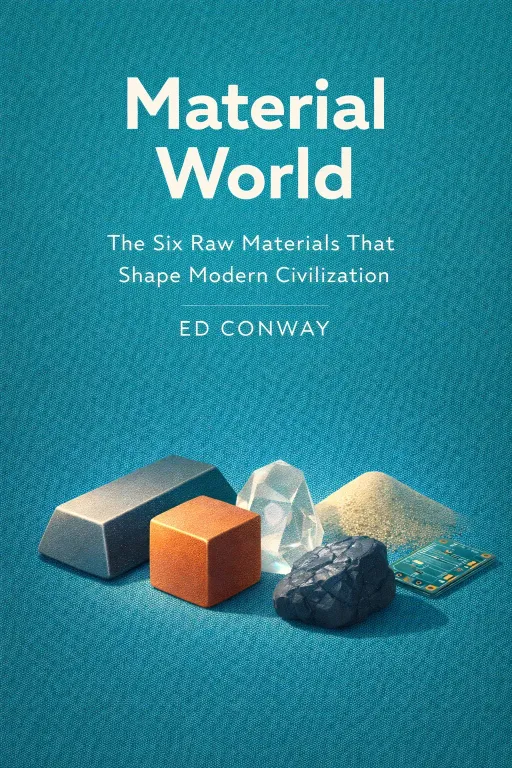
Asude Yıldırım: Thanks, Nova! It's fantastic to be here. You know, as a sociologist, I'm constantly fascinated by the things we see. We talk so much about the digital age, software, and artificial intelligence, as if our society has somehow detached itself from the earth. But Ed Conway's book,, completely shatters that illusion. It reminds us that our virtual lives are deeply anchored to physical, raw reality.
Nova: It really does! It's like we've developed this collective amnesia about where things come from. Today, we're going to tackle this material reality from three different angles. First, we'll look at how our virtual lives are built on physical sand and the hidden social crises behind it. Second, we'll explore the heavy, human labor behind iron and steel that literally structures our societies. And finally, we'll unpack the green energy transition's massive, overlooked material footprint. Ready to dive in, Asude?
Asude Yıldırım: Absolutely. Let's unearth these connections.
Deep Dive into Core Topic 1
SECTION
Nova: Let's start with sand. When most people think of sand, they think of relaxing on a beach. But Conway points out that sand is actually the literal foundation of modern civilization. We turn it into concrete to build our cities, and we refine it into silicon to power our computers. But there's a dark side to this. Have you heard about what's happening in the Mekong Delta in Vietnam?
Asude Yıldırım: Yes, the Mekong Delta case is a classic, tragic example of what sociologists call the externalization of environmental costs. Because of the global construction boom, there is an insatiable demand for concrete sand. Desert sand is too smooth and round because of wind erosion, so we have to mine river sand, which is angular and binds well. In the Mekong Delta, massive, often illegal dredging operations are sucking up millions of tonnes of sand from the riverbeds.
Nova: Exactly! And the physical consequences are devastating. The riverbeds are lowering, which causes the banks to collapse, taking homes and roads with them. Even worse, because the river flow is altered, saltwater from the ocean is intruding further inland, ruining agricultural land and freshwater supplies for millions of people.
Asude Yıldırım: It's a profound social justice issue. The urban elites in distant cities get their shiny new skyscrapers, while the local farmers and fishers in the delta lose their livelihoods and their homes. This is what happens when a material is treated as 'cheap' and 'infinite' by global markets. We ignore the social and ecological relationships that are disrupted at the point of extraction.
Nova: It's that classic disconnect between price and value that Conway talks about. And it's not just concrete. Think about silicon chips. The journey from a piece of quartz rock to a microchip is mind-blowing. Conway describes how we use the Czochralski process—which was actually discovered accidentally in 1916 by a Polish chemist who mistakenly dipped his pen into molten tin instead of ink! Today, that technique is used to grow these perfect, single-crystal silicon cylinders, or 'boules,' which are then sliced into wafers.
Asude Yıldırım: That story of Jan Czochralski is so fascinating, and honestly, a bit heartbreaking. He died in obscurity, yet his accidental discovery is what made the entire 'silicon age' possible. From a sociological perspective, this highlights how our highly advanced technological systems rest on historical contingencies and the unrecognized labor of past innovators. We think of tech giants like Apple or TSMC as the sole creators of our digital world, but they are standing on the shoulders of these quiet, material breakthroughs.
Nova: Right! And the level of purity required for these silicon wafers is just absurd. We're talking 99.9999999% purity. One dirty speck of dust can ruin an entire batch of microchips. That's why these fabrication plants, or 'fabs,' are the cleanest places on Earth.
Asude Yıldırım: It's a beautiful paradox, isn't it? To create a 'weightless' digital stream of ones and zeroes, we require the most extreme, hyper-controlled physical environments ever created by humanity. It shows that our digital freedom is actually highly disciplined and physically constrained.
Deep Dive into Core Topic 2
SECTION
Nova: That discipline and physical scale become even more apparent when we look at our second material: iron. Conway has this incredible chapter titled 'You Don't Have a Country,' which is a quote about the absolute necessity of steel for national sovereignty. He takes us inside the Port Talbot steelworks in Wales, and the way he describes it is just primal—like standing inside a volcano. The sheer heat, the noise, the liquid metal flowing.
Asude Yıldırım: That imagery is so powerful. It reminds us that despite all our talk of the service economy, heavy industry is still the skeletal system of our world. Conway's focus on Mariupol's Azovstal Iron and Steel Works during the 2022 Russian invasion really drove this home. Azovstal wasn't just a factory; it was a fortress, a symbol of national resilience, and the economic heart of an entire community.
Nova: Yes, the battle for Azovstal showed that steel is still the ultimate material of power and warfare. But it also represents how we've climbed what Conway calls the 'energy ladder.' Historically, we used wood to smelt iron, which led to massive deforestation. Then we transitioned to coal, which allowed us to mass-produce steel but at a massive environmental cost.
Asude Yıldırım: And this brings us to a key sociological concept: path dependency. Once a society builds its infrastructure around a specific energy source and material—like coal-fired steel production—it becomes incredibly difficult to change. The communities, the jobs, the political power structures, and the physical pipelines are all locked in. Port Talbot, for example, isn't just a place where steel is made; it's a community whose entire social identity is forged in those blast furnaces.
Nova: That's a great point. And yet, we are now asking these industries to completely reinvent themselves for the green transition. We talk about 'green steel' using hydrogen instead of coal, but the scale of energy required for that is just staggering. Conway points out that to run just one medium-sized chemical or steel plant on green hydrogen, you would need the entire electricity output of the world's largest offshore wind farm!
Asude Yıldırım: Wow. That really puts the scale of the challenge into perspective. It's easy to write policy goals on paper, but when you look at the physical reality—the actual tonnes of concrete, steel, and energy required—you realize that the transition is going to be incredibly material-intensive. It's not just about turning off the fossil fuel tap; it's about rebuilding the entire physical foundation of our civilization.
Deep Dive into Core Topic 3
SECTION
Nova: And that brings us perfectly to our third topic: the green paradox. We want to reduce our carbon emissions, which means moving to electric vehicles, wind turbines, and solar panels. But to build all this green infrastructure, we actually have to mine materials from the earth than ever before. Conway focuses heavily on copper and lithium. Copper is the nervous system of the electrical age, and lithium is the heart of the battery revolution.
Asude Yıldırım: This is the ultimate irony of our environmental goals. To save the atmosphere, we have to dig up the lithosphere. Conway visits the Chuquicamata copper mine in Chile—this gargantuan, open-pit mine that looks like a scar on the face of the earth. The sheer scale of extraction is hard to comprehend.
Nova: It really is. He mentions that to replace a single, small natural gas turbine with wind power, you need twenty large wind turbines. And those twenty turbines require thirty thousand tonnes of iron, fifty thousand tonnes of concrete, and over five hundred tonnes of copper! Compare that to the gas turbine, which needs only a fraction of those materials. One calculation in the book suggests that humanity will need to mine more copper in the next twenty-two years than we have in the entire past five thousand years of human history!
Asude Yıldırım: That statistic is mind-boggling, Nova. And as a sociologist, I immediately ask: is this mining going to happen, and is going to bear the cost? We are already seeing the emergence of what some call 'electrostates'—countries like Chile, Australia, and China that control the key minerals for the green transition, replacing the old 'petrostates' of the Middle East. This is shifting global power dynamics and creating new zones of resource conflict.
Nova: Absolutely. Look at the 'Lithium Triangle' in South America—Chile, Argentina, and Bolivia. Conway describes the Salar de Atacama, this incredibly beautiful, arid salt flat where lithium is extracted by evaporating brine. But this process consumes massive amounts of water in one of the driest places on Earth, threatening the water security of local indigenous communities.
Asude Yıldırım: Exactly. We are essentially trading one form of environmental degradation—carbon emissions—for another—localized ecological destruction and community displacement in the Global South. It's a classic case of environmental colonialism. The wealthy nations of the Global North get to drive clean, quiet electric vehicles, while the communities in Chile or the Democratic Republic of Congo deal with the toxic waste and water depletion of mining.
Nova: It's a heavy truth to swallow. And Conway even takes us to the next frontier: deep-sea mining. The Mid-Atlantic Ridge is rich in copper, cobalt, and nickel, but disturbing those pristine, poorly understood marine ecosystems could have catastrophic consequences. We are literally running out of places to dig on land, so we're looking to the bottom of the ocean.
Synthesis & Takeaways
SECTION
Asude Yıldırım: It really shows that there is no such thing as a free lunch when it comes to energy. Every technology has a material cost. But what I love about Conway's book is that he doesn't leave us in despair. He points to Wright's Law—the learning curve. The more we make of something, the cheaper and more efficient it becomes. We've seen this with solar panels and lithium-ion batteries, whose costs have plummeted by over ninety percent in recent decades.
Nova: Yes! Human ingenuity is a powerful force. And as Conway notes, we are also getting better at 'urban mining'—recycling the materials we've already extracted. Companies like Umicore are transitioning from traditional mining to recycling battery materials, creating a more circular economy.
Asude Yıldırım: That is where the hope lies. But to get there, we need a major shift in how we view the world. We need to move away from this illusion of 'weightlessness' and start mapping our material flows. We need to understand that every digital interaction, every green policy, has a physical footprint. As sociologists, we need to help make these invisible supply chains visible again, so we can make ethical, informed decisions about our future.
Nova: Well said, Asude. If there's one takeaway from our journey through the Material World today, it's that we are not detached from the earth—we are deeply, beautifully, and sometimes painfully entangled with it.
Asude Yıldırım: Beautifully put, Nova. Let's start paying attention to the 'stuff' that makes our world work.
Nova: Thank you so much for joining us today, Asude. Your sociological insights really brought this book to life. And to our listeners, next time you hold your smartphone, take a second to think about the sand, the copper, the lithium, and the thousands of hands that brought it to you. Until next time, keep questioning, keep learning, and stay curious!