

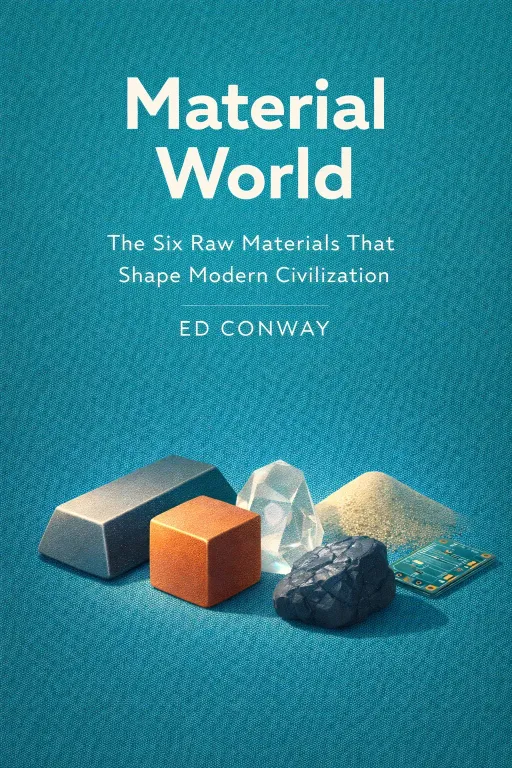
The Unseen Veins of Modern Medicine: Deconstructing the Material World
Golden Hook & Introduction
SECTION
Nova: What does a life-saving vaccine and a 5,000-tonne pile of blasted rock have in common? It sounds like a riddle, but the answer reveals a hidden reality about our modern world, one that’s explored brilliantly in Ed Conway’s book, "Material World."
Okoye Gloria: It’s a question that really stops you in your tracks. Because the answer, it turns out, is… everything.
Nova: Exactly! Welcome everyone. We’re so often told we live in a digital, dematerialized age of apps and clouds. But Conway argues we’ve never been more dependent on physical stuff, on the raw materials dug and blasted from the earth. And today, we're incredibly lucky to have healthcare researcher Okoye Gloria with us to explore this. Okoye, welcome!
Okoye Gloria: Thanks for having me, Nova. It's a fascinating topic, and one that resonates deeply with the world of medicine.
Nova: I can only imagine. Today we'll dive deep into this from two powerful perspectives. First, we'll shatter the illusion of a 'dematerialized' world by uncovering the complex journey of materials required for even basic medical supplies. Then, we'll confront a difficult paradox: how the very materials that advance medicine and green energy come at a staggering environmental cost. So Okoye, in your world of healthcare and research, you're surrounded by high-tech equipment, advanced diagnostics. Do you ever stop to think about what it's all… made of?
Okoye Gloria: Honestly, not as much as I should, and that's what's so powerful about this book. You're focused on the data, the patient outcome, the biological process. You see a rack of glass vials, and you think of them in terms of the experiment, not in terms of the sand and the extreme heat it took to create them. You take the material itself for granted.
Deep Dive into Core Topic 1: The Hidden Material Foundation of Modern Medicine
SECTION
Nova: You just hit on the perfect example. Conway argues that we suffer from a kind of collective amnesia about where things come from. He uses this amazing case study from the COVID-19 pandemic that I think will sound very familiar to you. It’s about borosilicate glass.
Okoye Gloria: Ah, yes. The gold standard for any lab. Pyrex is the famous brand name.
Nova: Exactly! So, when the vaccines were being developed at incredible speed, a panic suddenly rippled through governments and pharmaceutical companies. It wasn't about the vaccine formula itself, but about the vials to put it in. They realized there might not be enough borosilicate glass in the world to meet the demand.
Okoye Gloria: I remember those discussions. It seems so mundane, but a shortage would have been catastrophic.
Nova: Right? And here's why. This isn't just any glass. It’s made by adding boron to the mix, which makes it incredibly resistant to thermal shock and chemically inert. You can take it from a freezer to room temperature without it shattering, and it won't react with the sensitive vaccine inside. It’s an unsung hero. But the supply chain is so specialized and tight that a sudden, massive surge in demand almost broke it. A global vaccination campaign was nearly bottlenecked by, essentially, a special kind of sand.
Okoye Gloria: That’s a perfect illustration of the point. In a research hospital, we go through thousands of disposable items a day—plastic petri dishes, syringes, IV bags, all derived from petrochemicals, from oil. And countless glass vials and beakers. We depend on their sterility and stability, but we're completely disconnected from the global industrial ballet that has to happen perfectly for a box of them to show up at our supply dock.
Nova: An industrial ballet, I love that. The book uses an older analogy, an essay called "I, Pencil," which describes how no single person on Earth knows how to make a simple pencil from scratch. You need the logger who cuts the cedar, the miner for the graphite in Sri Lanka, the chemist for the lacquer... it's a web of millions.
Okoye Gloria: And that's just for a pencil. It makes me wonder, if the supply chain for something as 'simple' as a glass vial is that fragile, what does that imply for the vastly more complex components in an MRI machine or a robotic surgery system? Those depend on hyper-pure silicon chips, specialized metal alloys, and kilometers of copper wiring. A disruption in any one of those materials could have enormous consequences for patient care.
Nova: That's a brilliant and slightly terrifying point, Okoye. It shows how this isn't an abstract economic issue; it's a matter of public health and supply chain resilience. And your question leads us right into the book's most challenging idea. We absolutely need these materials, especially for progress in medicine. But getting them… well, that's a whole other story. Conway takes us to a place he calls 'The Hole'.
Deep Dive into Core Topic 2: The Paradox of Progress: Extraction vs. Innovation
SECTION
Okoye Gloria: 'The Hole' doesn't sound very inviting.
Nova: It’s not. It’s the Chuquicamata copper mine in Chile, one of the largest open-pit mines on Earth. It's a literal hole in the ground so vast it can be seen from space. For over a hundred years, humanity has been digging there, relentlessly, for copper. Conway describes these trucks the size of three-story buildings hauling out rock, 24/7. And for every tonne of copper you get, you create hundreds of tonnes of waste rock, or tailings, which are often laced with toxic chemicals.
Okoye Gloria: And copper is essential. It's the foundation of our entire electrical grid. Every light, every computer, every piece of medical equipment in a hospital only works because of it.
Nova: Precisely. The book calls it 'Dr. Copper' because it's so sensitive to the health of the global economy. But here's the paradox. To build a 'green' future—with electric cars, wind turbines, and solar panels—we need to electrify everything. And that means we will need to mine more copper in the next two decades than has been mined in all of human history. The transition to clean energy is incredibly material-intensive.
Okoye Gloria: Wow. That is a staggering thought. And it creates such a difficult tension, especially from a healthcare perspective. On one hand, copper is a miracle material for us. Beyond just wiring, its antimicrobial properties are a huge focus in hospital design to combat infection. We're seeing copper-infused bed rails, doorknobs, and surfaces that can kill bacteria on contact.
Nova: So it literally saves lives in the hospital.
Okoye Gloria: It does. It actively helps prevent hospital-acquired infections, which are a major problem. So here's the dilemma: we need more copper to make our hospitals safer and to power the advanced diagnostic tools that save lives. But to get it, we have to support these massive mining operations that create these environmental wounds on the planet. As a researcher who is focused on improving human health, that's a really difficult equation to balance. It’s a conflict between two different 'goods'.
Nova: A conflict between two goods. That’s the perfect way to put it. Conway doesn't offer an easy answer, because there isn't one. His goal is just to make us aware of the trade-offs. We can't have the incredible benefits of modern medicine or a green transition without the gritty, destructive, and awe-inspiring reality of the material world. We can't have the cure without the mine.
Okoye Gloria: It forces you to think systemically. The innovation in my lab is directly connected to a miner in Chile. It’s one single, global system.
Synthesis & Takeaways
SECTION
Nova: So, as we wrap up, it feels like we've journeyed from the microscopic world of a vaccine to the colossal scale of a mountain-sized mine. We've seen that our modern world, and especially the life-saving field of medicine, rests on this hidden material foundation. And we've confronted the paradox that the very progress we crave comes at a profound material cost.
Okoye Gloria: It really changes how you see the world around you. You start to see the history and the hidden journey in everything. That steel scalpel is iron and carbon, forged in fire. That plastic syringe is ancient sunlight and plankton, transformed from oil. It’s humbling.
Nova: It is. So, what’s the big takeaway for you, as someone on the front lines of innovation?
Okoye Gloria: The takeaway for me isn't despair, but awareness. It's about asking better questions. For so long, innovation has been about function and cost. Does it work? Can we make it cheaper? Now, I think we have to add a third dimension. What is its material footprint? As we design the next generation of medical AI or a new diagnostic tool, maybe we also need to ask, 'What is the true material cost, and can we design it more sustainably from the very beginning?'
Nova: I love that. So it's about adding a new layer to the design process itself.
Okoye Gloria: Exactly. It’s about adding the 'material map' to our innovation roadmap. If we can see the whole system, from the mine to the hospital bed, maybe we can start making smarter, more sustainable choices. And that feels like a truly powerful and necessary step forward.
Nova: A material map for the innovation roadmap. That is the perfect place to end. Okoye Gloria, thank you so much for helping us connect these incredible dots today.
Okoye Gloria: It was my pleasure, Nova. A truly eye-opening conversation.