

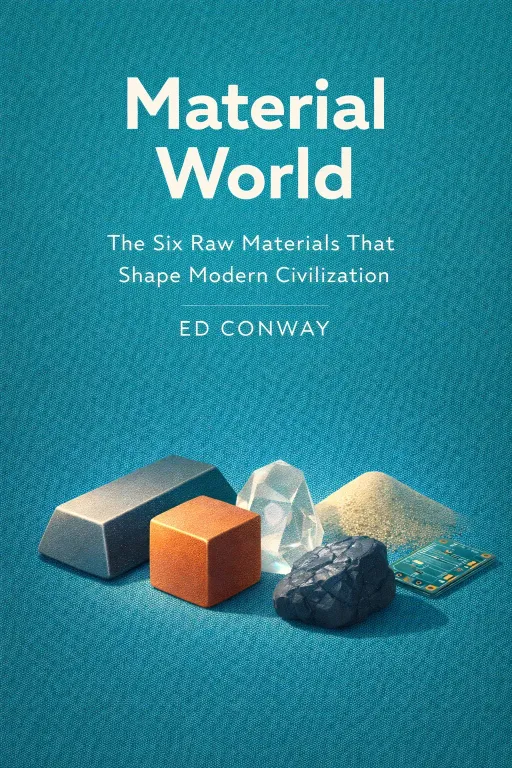
The Great Material Illusion
Golden Hook & Introduction
SECTION
Christopher: Your smartphone isn't digital. It's a piece of a mountain. The 'cloud' isn't in the sky; it's in a massive, physical warehouse cooled by a river's worth of water. Lucas: Whoa, hold on. That’s a heavy start. A piece of a mountain? Christopher: A big piece. We're told we live in this weightless, dematerialized world, but here's the shocker: in the last decade alone, humanity has dug, blasted, and mined more material from the Earth's crust than in all of human history up to 1950. Lucas: That can't be right. More in ten years than in all of history before my parents were born? That sounds completely backward. Christopher: It feels backward, but that staggering reality is the subject of a book that completely rewired how I see the world. It’s called Material World: A Substantial Story of Our Past and Future by Ed Conway. Lucas: Ed Conway... isn't he the economics and data editor from Sky News? I wouldn't have pegged him for a book about rocks and minerals. Christopher: Exactly! And that's what makes it so brilliant. He comes at it from a data and economics perspective, following the numbers. And what he uncovers is that the real story of our civilization isn't in spreadsheets; it's in sand, salt, and steel. The book has been widely acclaimed for making this invisible world visible. Lucas: Okay, I'm intrigued. An economics journalist writing about geology. So where does he even start to unpack this? It feels huge.
The Great Material Illusion: Why Our Digital World is Deceptively Physical
SECTION
Christopher: He starts with something we all think we understand: gold. He was puzzled by UK economic data showing Britain as a massive gold exporter, despite having no gold mines. To solve the riddle, he flies to one of the biggest sources on the planet: the Cortez mine in the Nevada desert. Lucas: Right, to see where it actually comes from. Christopher: And what he sees there is just breathtaking. He describes standing on the edge of a pit so vast it warps your sense of scale. The trucks driving around in it are bigger than three-story buildings, with tires the size of a double-decker bus. He's there to watch a scheduled detonation. Lucas: So they're literally blowing up a mountain. Christopher: Literally. A countdown happens, and then a whole section of the mountain face ripples and collapses into rubble. And he explains the process that follows. They scoop up this rock, crush it, grind it into a fine dust, and then douse it in a cyanide solution to leach out the microscopic flecks of gold. Lucas: Cyanide? That sounds… unpleasant. Christopher: It's incredibly toxic. And the scale of it is what breaks your brain. Conway does the math. To get enough gold for one standard, 400-ounce gold bar—the kind you see in heist movies—they have to dig, blast, and process about 5,000 tonnes of earth. Lucas: Wait, say that again. Five thousand tonnes? I have no frame of reference for that. Christopher: He gives a perfect one. It’s the same weight as ten fully-laden Airbus A380 super-jumbos. The world's largest passenger planes. Ten of them. For one bar of gold. Lucas: That is absolutely insane. Ten jumbo jets for a single gold bar. And while he's watching this, he looks down at his own hand... Christopher: Exactly. He looks at his wedding ring and has this profound, gut-wrenching realization that this beautiful symbol of his love was born from this incredible, brutal violence. Blasting a sacred mountain of the Western Shoshone people, processing it with poison, all for this tiny, almost trivial object. Lucas: Wow. That’s a powerful image. But it makes me think… okay, gold is a luxury. Most of us could live without it. If that's what it takes for something we don't really need, what about the materials we actually can't live without? Christopher: That is the exact question that launches the entire book. He realizes our entire civilization rests on a handful of other, far more important materials. He focuses on six of them: sand, salt, iron, copper, oil, and lithium. These are the unsung heroes, the fabric of our world. Lucas: Sand and salt? They sound so… common. So boring. Christopher: And that’s his point! We think they're boring because we've gotten so good at making them cheap and abundant. But take sand. Without it, you have no concrete for buildings, no glass for windows or screens, and most importantly, no silicon for computer chips. The entire digital revolution is built on sand. Lucas: So my laptop is basically just a very, very, very fancy sandcastle. Christopher: A very fancy, very pure sandcastle, yes! He brings up this famous essay from the 1950s called 'I, Pencil'. It details how no single person on Earth knows how to make something as simple as a pencil. The wood is from a cedar tree in Oregon, the graphite is from Sri Lanka, the eraser is from Malaysian rubber trees, the little metal bit is brass made from copper and zinc mined in two other countries. Millions of people collaborating across the globe, without even knowing it, just to make a pencil. Lucas: And a smartphone must be like 'I, Pencil' on steroids. Christopher: On a thousand different kinds of steroids. The supply chains are so complex and interconnected that we've become completely blind to them. We saw it during the pandemic. Suddenly there was a panic that we wouldn't have enough borosilicate glass—the stuff in Pyrex dishes—to make vials for the vaccines. A global health crisis was nearly derailed by a shortage of a material most people have never even heard of. Lucas: It’s like the internet isn't a 'cloud' at all. It's a giant, physical machine of wires, servers, and power plants that we just conveniently choose not to see. Christopher: That's the great material illusion. We've wrapped our world in a layer of abstraction—apps, services, the digital economy—and forgotten about the colossal physical infrastructure underneath. But when one piece of that infrastructure breaks, like the supply of CO2 for fizzy drinks in the UK, the whole system shudders.
The Green Paradox: To Save the Earth, We Must Dig It Up
SECTION
Lucas: Okay, I get the dependence on old-school stuff like iron and oil. It makes sense that the industrial revolution needed that. But surely the future is different? With green tech, solar panels, electric cars... we're moving away from all that heavy, dirty stuff, right? Christopher: This is where Conway drops the book's most counter-intuitive and, honestly, most unsettling idea. He calls it the paradox of the green transition. To build our clean, green, renewable future... we are going to have to engage in the biggest extraction and mining boom in the history of humanity. Lucas: Hold on. That feels completely backward. How can building green stuff be so... dirty? You’re saying to save the Earth, we have to dig it up more than ever before? Christopher: That's the paradox. Let's just take one offshore wind turbine. A single one. What do you think it's made of? Lucas: I don't know... fiberglass for the blades? Some steel? Christopher: Let's break it down. The foundation, the giant monopile drilled into the seabed, is about 800 tonnes of steel. That's the weight of three jumbo jets right there. The tower and the nacelle, where the generator sits, are more steel. The blades themselves are mostly fiberglass, which is made from glass strings coated in polymer resin. That resin comes from petrochemicals. Lucas: Petrochemicals? So, from oil and gas. Christopher: From oil and gas. The blades are also reinforced with carbon fiber, which is made using chemicals derived from propylene, benzene, and ammonia. And then there's the generator itself, which needs immense amounts of copper wiring to turn motion into electricity. And all of this sits on a foundation that requires about 50,000 tonnes of concrete to stabilize. Lucas: My head is spinning. So to build one 'clean' energy source, we're using steel made with coal, plastics made from oil, and a mountain of concrete, which has a massive carbon footprint. That feels like a circular firing squad. Christopher: It's the messy reality. And it's not a 'gotcha' to discredit green energy. It's a fundamental challenge we have to face. Conway cites a calculation that to replace just a small, 100-megawatt natural gas power plant with wind power, you need about 30,000 tonnes of iron, 50,000 tonnes of concrete, and nearly a thousand tonnes of non-recyclable plastics for the blades. The gas plant it replaces needs a fraction of that. Lucas: So the material footprint of green energy is actually bigger than the fossil fuel equivalent? Christopher: In the construction phase, yes, by an enormous margin. And it gets even more intense when you look at the metals. One analyst calculated that for the world to hit its climate goals, we will need to mine more copper in the next 22 years than has been mined in the entire 5,000-year history of humanity. Lucas: That number is just not computable in my brain. More copper in my lifetime than in all of human history combined? How is that even possible? Christopher: Because everything electric runs on copper. Electric cars use three to four times more copper than a gasoline car. Wind and solar farms need it by the tonne for wiring and components. And it's not just copper. It's lithium, cobalt, nickel, rare earth elements. The demand is going to be astronomical. Lucas: This connects back to what you said earlier about making things cheap. We got good at making cars and phones, and now we're getting good at making solar panels and batteries cheaper. Christopher: Exactly. That's a principle called Wright's Law, or the learning curve. For every doubling of production, the cost falls by a predictable amount. It’s why solar power is now cheaper than coal. But that beautiful, virtuous circle of innovation only works if you have a firehose of raw materials to feed it. In 2022, for the first time in decades, the price of lithium-ion batteries actually went up because of fears about the supply of raw lithium. The learning curve hit a wall. A physical wall.
Synthesis & Takeaways
SECTION
Lucas: Okay, so let me see if I have this right. We're living in a material world, far more than we admit. Our digital lives are an illusion built on a physical, and often brutal, reality of extraction. And our clean, green future depends on doubling down on that extraction on a scale that is almost unimaginable. Christopher: That's the core of it. It's a sobering, complex picture. Lucas: So what's the big takeaway here? Are we just doomed to dig forever until the planet is a hollow shell? It feels a bit hopeless. Christopher: It could be, but that’s not Conway’s final message. The lesson isn't despair, but a call for a new kind of awareness. For centuries, our maps have been about political borders or economic flows, measured in things like GDP. He argues we need a new map—a map of the Material World. We need to understand where our stuff comes from, the real cost of it, and the fragile supply chains that connect it all. Lucas: So it’s about making the invisible, visible. Christopher: Precisely. The challenge isn't to stop building or innovating. Humanity is incredible at that. The challenge is to get radically smarter and more honest about what it takes. It means valuing recycling not as a feel-good activity, but as a critical source of 'urban mining'. It means seeing a miner in Chile or a factory worker in China not as a distant cog, but as an essential partner in our own survival. Lucas: It’s a shift in perspective from consumption to stewardship. Christopher: A massive one. Conway leaves us with this idea: we are brilliant at solving material problems when we have to. We figured out how to make steel from iron, chips from sand, and power from the atom. The real question is, can we start valuing the materials themselves, and the world they come from, before a crisis forces our hand? Lucas: That’s a powerful thought. It makes you look at your phone, your car, even the glass you're drinking from completely differently. I think for me, it's the concrete. The idea that we've made so much of it that the weight of human-made stuff now exceeds all living biomass on the planet. I'll never look at a sidewalk the same way. Christopher: We'd love to hear from our listeners. After hearing this, what everyday object will you never see the same way again? Let us know. Lucas: This is Aibrary, signing off.