

The Psychology of Peak Performance
Golden Hook & Introduction
SECTION
Nova: Most people spend their entire lives trying to fire their own emotions. They treat anxiety like a toxic employee that needs to be escorted out of the building by security. But the real secret to peak performance is realizing that you need to start treating those negative emotions like the IT department. They are not the problem. They are the notification that a system is crashing.
Atlas: That is a wildly different way to look at a panic attack or a bad mood. Usually, when I feel that spike of stress, my first instinct is to suppress it, ignore it, or just power through it until I burn out. You are saying I have been misreading the dashboard the whole time?
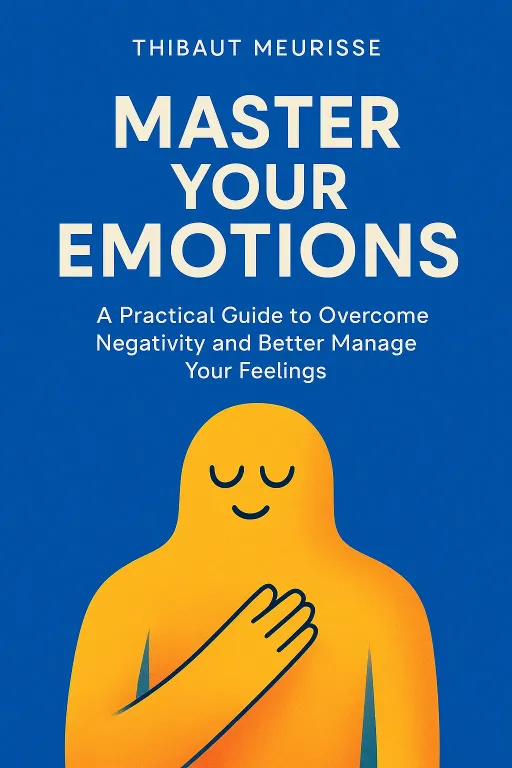
Nova: Exactly. And that is the central thesis of Thibaut Meurisse’s work in Master Your Emotions. He argues that our emotions are biological signals, not permanent states of being. When we try to fight them, we are essentially fighting the messenger. But when we combine that insight with the physical strategy Mel Robbins outlines in The High 5 Habit, we get a complete, actionable system for maintaining cognitive performance under pressure.
Atlas: I have heard of Mel Robbins. She is the one who talks about high-fiving yourself in the mirror, right? On the surface, that sounds a bit like an infomercial trick. How does that actually help someone who is trying to lead a team or make high-stakes decisions?
Nova: It sounds deceptively simple, but the neuroscience behind it is fascinating. We are going to deconstruct how to stop treating your emotions as enemies and start using them as the ultimate performance data.
The Biological Signal
SECTION
Atlas: Let’s start with the emotions themselves. If I am sitting at my desk, the clock is ticking, the inbox is overflowing, and I feel that familiar tightness in my chest, you are telling me that is a signal. What is it signaling?
Nova: Think of it as a low-battery notification on your phone. When you feel that tightness, that is your nervous system alerting you to a gap. It is telling you that your current reality does not match your expectations, or that you are perceiving a threat. Thibaut Meurisse makes a very strong point that emotions are transient. They are energy in motion. The mistake we make is we attach a narrative to them. We say, I feel anxious, therefore I am an anxious person, or this situation is a disaster.
Atlas: Right. The narrative is where the trouble starts. I feel the stress, and then I tell myself a story about how I am failing or how this project is doomed. That story is what keeps the emotion alive, isn't it?
Nova: That is precisely it. The emotion is the signal. The story is the static that prevents you from hearing the signal clearly. Meurisse emphasizes that we have the power to observe the emotion without becoming the emotion. If you can pause and ask, what is this signal trying to tell me? you suddenly shift from being a victim of your feelings to being an analyst of your own experience.
Atlas: That sounds great in theory. But when you are in the middle of a high-pressure meeting, you do not have time to sit there and perform a deep-dive analysis of your emotional state. You have to perform. You have to lead. Is there a way to use that signal without stopping the meeting to meditate?
Nova: That is the perfect question. And that is where the distinction between a reactive person and a strategic architect comes in. A reactive person feels the signal, creates a negative story, and then acts out of that story. A strategic architect feels the signal, acknowledges it as data, and then executes a tactical override.
Atlas: Tactical override. I like that. It sounds like something from a flight simulator. You are saying the emotion is the turbulence, but the pilot needs to keep the plane level regardless.
Nova: Exactly. But you cannot just ignore the turbulence. You have to acknowledge it. If you try to suppress it, it just gets louder. Meurisse’s approach is about acceptance. You acknowledge the signal, you decode the data, and then you pivot to action.
Atlas: So, if I am in that meeting, and I feel that tightness, I acknowledge it. I say to myself, okay, this is a signal that I am worried about the outcome of this conversation. That is the data. Now, what do I do with it?
Nova: You have identified the core of the problem. Most people stop at the acknowledgment. They just sit there with the awareness, which is actually just another form of rumination. You need an intervention. And this is where Mel Robbins comes in.
The Physical Override
SECTION
Atlas: Let’s talk about that intervention. Because I am still hung up on the idea that physical gestures can change a mental state. How does a simple movement, like a high-five or a pat on the back, actually quiet the inner critic?
Nova: It comes down to a concept called proprioception, combined with a neural circuit break. When you are stuck in a negative loop, your brain is firing in a specific, repetitive pattern. It is like a record player with a needle stuck in a scratch. You can’t just tell the record to play a different song. You have to lift the needle.
Atlas: And the physical action is the needle lift.
Nova: Precisely. Mel Robbins argues that when you perform a gesture of self-validation—like looking in the mirror and giving yourself a high-five, or even just a firm, deliberate physical action—you are forcing your brain to switch channels. It is physically impossible to maintain a high-level state of self-criticism while simultaneously performing an action that the brain associates with celebration and support.
Atlas: That sounds like basic biology. You are essentially hacking the feedback loop. But does it work in a corporate environment? I can't exactly start high-fiving the mirror in the middle of a boardroom.
Nova: You are right, you cannot. But you can adapt the principle. The High 5 Habit is not about the mirror; it is about the of validation. It is about disrupting the negative loop with a deliberate, physical, positive intervention. If you are in a boardroom and you feel the anxiety spike, you don't need to do a dramatic gesture. You need to do something that anchors you. Maybe it is simply clasping your hands together firmly, or taking a deep, deliberate breath where you physically square your shoulders.
Atlas: So, it is about the intent of the gesture. You are taking that moment to signal to yourself, I am on my own side.
Nova: Yes. And that is the missing piece for most high-performers. We are so used to being our own harshest critics. We analyze our mistakes, we audit our performance, we constantly look for the gap. We rarely pause to validate our own effort. When you do that, you trigger a dopamine release. And dopamine is the fuel for cognitive performance. It clears the static.
Atlas: I am starting to see the connection. Meurisse says the emotion is a signal. Robbins says the physical action is the override. If I combine them, the process is: I feel the stress, I acknowledge the signal as data, and then I use a physical action to reset my nervous system so I can process that data clearly.
Nova: You just designed the blueprint. That is exactly how you turn a chaotic emotional state into a performance asset.
The Architect's Blueprint
SECTION
Atlas: Let’s get into the weeds of this. I want to build a system for this. If I am the Strategic Architect, I want a protocol. How do I track this? How do I make this a non-negotiable part of my day?
Nova: It starts with an emotional audit. Most people are completely blind to their own triggers. They go through the day, get hit by a wave of frustration, and have no idea why. To master this, you need to treat your emotional landscape like a data set.
Atlas: So, I am tracking my triggers. What does that look like? Am I writing this down in a journal?
Nova: Yes, but keep it simple. You don't need a complex system. Just a quick log. Identify the moment you felt the spike. What was the trigger? Was it an email? A specific person? A deadline? And then, what was the signal? Was it fear of failure? Was it a feeling of being overwhelmed?
Atlas: That sounds like I am creating a map of my own vulnerabilities. That is actually quite powerful because once you see the pattern, you can anticipate it.
Nova: Exactly. Once you know that Monday morning meetings about budget cuts always trigger a specific type of anxiety, you can prepare for it. You don't wait until the meeting starts to manage your state. You go into the meeting with your High 5 protocol already primed.
Atlas: It is proactive instead of reactive. I like that. But what about the moments where you are caught off guard? You are walking down the hall, someone drops a problem in your lap, and you feel that immediate tightness. How do you apply the protocol then?
Nova: That is where the immediate self-validation comes in. You need a micro-habit. When you feel that tightness, you have maybe three seconds before your brain starts spinning the negative narrative. In those three seconds, you have to execute the physical override.
Atlas: Three seconds. That is the window.
Nova: It is. If you miss that window, the narrative takes over. The story becomes, I cannot handle this, or this is going to be a disaster. But if you use those three seconds to perform your physical anchor—maybe it is a subtle hand press, or a deliberate straightening of your posture—you are effectively telling your brain, I am present, I am capable, and I am choosing how to respond.
Atlas: It is almost like a reset button. And because you have been tracking your triggers, you are not surprised when you feel that tightness. You recognize it. You say, ah, there is the signal. Here is the override.
Nova: You have mastered the system. You have taken the biological signal, stripped away the catastrophic story, and used a physical intervention to regain your cognitive bandwidth. This is how you sustain high performance over the long haul. You are not suppressing the human experience; you are managing it.
Synthesis & Takeaways
SECTION
Atlas: This is fascinating because it changes the definition of peak performance. We usually think of peak performance as being in a state of flow, or being devoid of negative emotions. But what you are describing is more like a high-level operating system. It is about managing the inputs and the outputs effectively.
Nova: You hit the nail on the head. Peak performance is not the absence of negative emotions. It is the presence of an effective management system for them. It is the realization that you are the architect of your own internal environment. You are not a victim of your biology. You are the operator of it.
Atlas: I think about the listeners who are out there, maybe they are leading teams, or they are in the middle of a career transition. They feel that pressure every single day. If they take one thing from this, it should be that their emotions are not flaws. They are data points.
Nova: And that physical validation is not a weakness. It is a biological tool. We are wired to respond to physical cues. When we give ourselves that validation, we are literally rewiring our brain to be more resilient.
Atlas: I am definitely going to start tracking my triggers. I want to see the map. I want to know where the landmines are so I can walk around them instead of stepping on them every single time.
Nova: That is the commitment of a strategic architect. You are treating your future self with respect by building these systems today. You are making an appointment with your own growth. And that, in the long run, is how you sustain your energy for the journey ahead.
Atlas: It sounds like we have a lot of work to do. But I feel better equipped to handle the turbulence now.
Nova: The turbulence is just part of the flight. As long as you know how to read the gauges and keep your hands on the controls, you will get where you are going.
Atlas: I love that. A quick reminder for everyone listening: you do not need to read a hundred books to get results. You need to master the few that give you the blueprint you actually need. Focus on the quality of the insight, not the quantity of the pages.
Nova: And start that 20-minute daily reading habit. It is your non-negotiable appointment with your future self.
Atlas: Absolutely. Thank you for walking me through this. It is time to go test the system.
Nova: It is time to master the emotions. This is Aibrary. Congratulations on your growth!









