

Overcoming Self Sabotage and Emotional Mastery
Golden Hook & Introduction
SECTION
Nova: Imagine you are running a race, but for some reason, you have decided to tie your own shoelaces together. You want to win, you are training hard, and you have the best gear, yet you keep tripping over your own feet. That is the paradox of self-sabotage. You are the runner, the coach, and the person tying the laces.
Atlas: That is a frustrating image. It feels like the ultimate lack of logic, doesn't it? We act as our own worst enemy while simultaneously trying to be our own best friend. It creates this loop of confusion where you wonder why your life does not look like the plan you drew up.
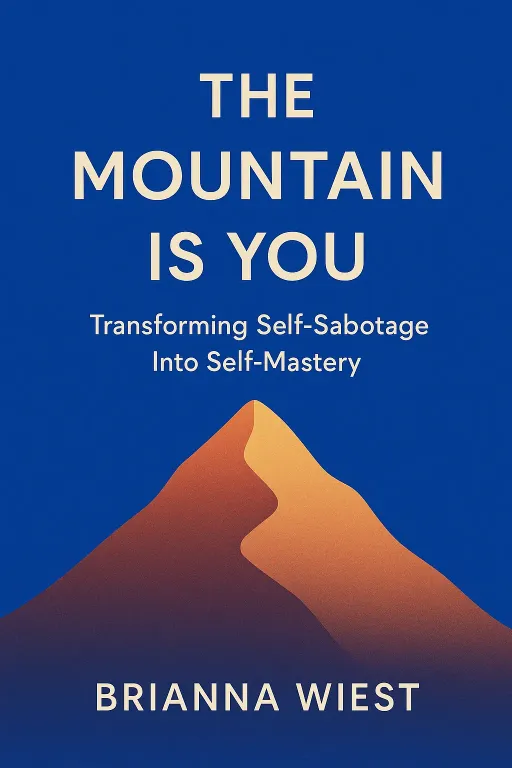
Nova: Exactly. Today, we are dismantling that loop. We are diving into two powerful frameworks that explain exactly why this happens and how to stop it. We are looking at The Mountain Is You by Brianna Wiest, which reframes self-sabotage as a subconscious bodyguard, and Master Your Emotions by Thibaut Meurisse, which gives us the technical manual for emotional regulation.
Atlas: I have heard people talk about both of these books in the context of personal development. Wiest, in particular, has gained a massive following because she avoids the standard toxic positivity advice. She dives right into the messy, uncomfortable reality of why we resist change. Meurisse takes a more systematic, almost engineering-like approach to the mind, which I think our listeners who appreciate structure and efficiency will really value.
Nova: That is the perfect way to frame it. Wiest is the diagnostician, finding the hidden wound, and Meurisse is the architect, helping you build a more stable structure for your emotional life. We are going to connect these two to help you stop the sabotage and start the mastery.
The Paradox of the Saboteur
SECTION
Atlas: Let’s start with the sabotage part. I find the premise of Wiest’s work fascinating. Most people think self-sabotage is just laziness or a lack of willpower. But you are suggesting it is actually a defense mechanism. How can destroying my own progress be a form of protection?
Nova: Think of your subconscious mind as a bodyguard whose only job is to keep you safe. This bodyguard does not care if you are happy, successful, or wealthy. It only cares that you stay in the environment it knows. When you try to push past your current level of success—when you try to grow—you enter the unknown. To your subconscious, the unknown is dangerous. It is a threat. So, the bodyguard steps in. It creates resistance. It makes you procrastinate, or pick a fight with your partner, or overeat, or skip that workout.
Atlas: That changes the entire narrative. If it is a bodyguard, then I am not fighting a lack of character; I am fighting a biological imperative to stay comfortable. That makes the sabotage feel less like a moral failing and more like a system error.
Nova: Precisely. It is a system error. You are running an outdated operating system that thinks you are still living in a cave where stepping out of the tribe means death. Now, apply that to the modern world. You want to launch that business, or ask for that raise, or finish that project. Your conscious mind wants the growth. Your subconscious mind sees the stress of that new responsibility and says, Wait, this is new, and new is risky. Let’s go back to the couch and watch a show instead.
Atlas: I can see how that plays out. It explains why we feel this internal tug-of-war. But how do we actually identify the bodyguard? If the resistance is happening in the subconscious, it is by definition hidden from me. How do I audit a process I cannot see?
Nova: You look at the evidence. Your behavior is the data. When you find yourself procrastinating on a task that you know is important for your future, ask yourself, what is the fear hidden beneath this resistance? Is it the fear of failing? Or is it actually the fear of succeeding and having to deal with the pressure that comes with it? Wiest argues that we often sabotage ourselves to avoid the pain of the unknown. We prefer a familiar pain over an unfamiliar success.
Atlas: That hits hard. The idea that we prefer familiar pain is a tough pill to swallow. It means that staying in a stagnant situation is actually a choice, even if it feels like we are trapped. If I am the one choosing the familiar pain to avoid the risk of the unknown, then I am also the one holding the key to the exit.
Nova: You are the gatekeeper. The mountain you are climbing is not an external obstacle; it is your own resistance. The way to overcome it is not to fight the bodyguard, but to negotiate with it. You have to acknowledge the fear. You have to say, I see you, I know you are trying to keep me safe, but we are moving forward now. You have to prove to your subconscious that the new level of success is not a threat, but a new, safer baseline.
Emotional Regulation and Cognitive Associations
SECTION
Atlas: Negotiation sounds like a much better strategy than brute force. But let’s say I negotiate with the bodyguard and I start moving forward. I am in the arena, I am doing the work, and now the stress hits. The stakes are high. This is where I imagine Meurisse’s work on emotional regulation comes into play. Because even if I am not sabotaging myself, I am still feeling the heat of the pressure.
Nova: You have bridged the gap perfectly. Once you stop the internal sabotage, you still have to deal with the external reality of your emotions. Meurisse points out that emotions are not facts. This is the most important distinction for anyone trying to build a high-performance life. You feel angry, or anxious, or overwhelmed, and your brain immediately interprets that as a signal that something is wrong. You might think, I feel anxious, therefore there is a danger. But Meurisse suggests that emotion is just data. It is a signal, not a command.
Atlas: I like that distinction. It is the difference between a warning light on your dashboard and the engine actually exploding. The light is just information. You do not have to pull over and abandon the car just because a light flickered.
Nova: Exactly. And most people treat their emotions like commands. They feel overwhelmed, so they stop working. They feel fear, so they avoid the conversation. Meurisse teaches a systematic approach to reprogram these associations. He talks about how we develop cognitive associations over time. If you had a stressful childhood where every time your parents were angry, you were in danger, your brain creates a permanent link: Anger equals Danger. So, as an adult, if your boss gets angry, your brain triggers a fight-or-flight response, even if you are perfectly safe.
Atlas: That explains the overreaction. I have seen this in corporate environments. Someone gets a piece of critical feedback, and they react as if they have been physically attacked. It is not about the feedback; it is about the neural pathway that was laid down twenty years ago.
Nova: That is the core of it. We are running these outdated scripts. Meurisse argues that you can rewire those connections. You can consciously choose to create a new association. When you feel that surge of anxiety, instead of letting it dictate your actions, you label it. You say, This is anxiety. It is a physiological response to a high-stakes situation. It is not a sign that I am failing; it is a sign that I am growing.
Atlas: That sounds like a cognitive reframe. It sounds simple, but I imagine it is difficult to do in the heat of the moment. How do we actually implement that? When my heart is racing and my palms are sweating, that is not the time I usually want to sit down and analyze my cognitive associations.
Nova: You are right, it is not easy. That is why the practice happens outside the moment. You build the capacity for regulation when things are calm. You practice identifying your triggers. You write down the situations that typically cause you to spiral. Then, you design your response in advance. You create an if-then plan. If I feel overwhelmed by a project, then I will take five minutes to breathe and break the task into three micro-steps. You are essentially pre-programming your reaction so that when the stressor hits, you have a blueprint to follow rather than just reacting on autopilot.
Atlas: That appeals to the architect in me. It is about building a system so that you do not have to rely on willpower when you are tired or stressed. You are automating your emotional intelligence.
Nova: That is exactly what it is. You are building an emotional infrastructure. You are moving from a reactive state, where your environment dictates your internal world, to a proactive state, where you dictate how you interact with your environment. It is the difference between being a leaf in the wind and being the captain of the ship.
Synthesis & The Path Forward
SECTION
Atlas: It feels like we are connecting two very powerful tools. Wiest helps us identify the internal resistance, the bodyguard that keeps us small. Meurisse helps us build the tools to manage the emotional fallout of stepping into the unknown. If I put these together, the process looks like this: I identify the sabotage, I reassure the bodyguard, I step into the discomfort, and then I use emotional regulation to stay in the driver's seat.
Nova: That is a brilliant synthesis. You have turned it into a workflow. And remember the takeaway we mentioned earlier? The tiny step? It is all about starting that audit. Tonight, write down one recurring behavior that stalls your progress. Do not judge it. Just observe it. Ask yourself, what hidden fear is this behavior protecting me from? Is it protecting me from the fear of being seen? The fear of being judged? The fear of the unknown?
Atlas: I think for many people, that exercise alone will be a revelation. We spend so much time fighting the symptom, the procrastination or the distraction, that we never look at the root cause. If you can identify the root, you can stop fighting the symptom and start addressing the need.
Nova: And once you address the need, the sabotage loses its purpose. The bodyguard can finally stand down because you have created a new, safer way to handle the situation. You are not just pushing through; you are evolving.
Atlas: This has been a great deep dive. It feels like we have moved from abstract concepts to a concrete plan of action. For our listeners who are looking to build a future that is both meaningful and wealthy, this kind of emotional mastery is not a luxury; it is a fundamental requirement. You cannot build a skyscraper on a shifting foundation.
Nova: That is a perfect final analogy. You have to stabilize the ground before you start building the tower. We have the blueprint now. It is just a matter of doing the work.
Atlas: I am looking forward to putting this into practice. It is not about changing who you are; it is about upgrading the tools you use to interact with your own life.
Nova: Well said. And for everyone listening, take that tiny step tonight. Audit your behavior, find the fear, and start the process of reprogramming your response. You are capable of so much more than your current comfort zone allows.
Atlas: We will be back next time with another deep dive into the systems and habits that shape our success. Until then, keep building.
Nova: This is Aibrary. Congratulations on your growth!









