

Emotional Agility and Acceptance
Golden Hook & Introduction
SECTION
Nova: Trying to force yourself to think positively during a high-stress crisis is actually a fast track to making yourself feel worse.
Atlas: Hold on, that sounds completely backwards. We are constantly told to look on the bright side, especially when things are going sideways at work. Are you saying that positive thinking is a trap?
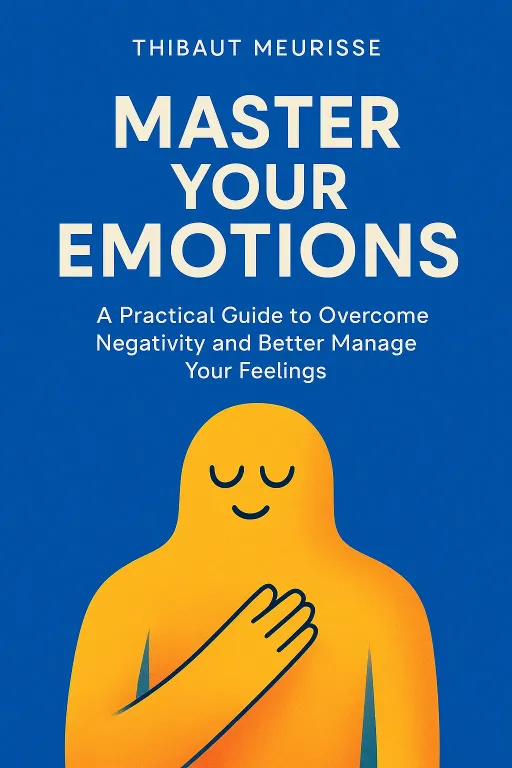
Nova: It is exactly that, and it is actually the central argument of some fascinating work in modern psychology. Today, we are diving into two powerhouse books that completely flip the script on how we handle our inner worlds. We have Master Your Emotions by Thibaut Meurisse and The Happiness Trap by Russ Harris.
Atlas: I have heard of these. Russ Harris has that incredible background as a medical doctor who got so frustrated with just prescribing medication for anxiety and depression that he retrained as a psychotherapist. He wanted to find what actually works in the long run.
Nova: Yes, and Thibaut Meurisse has this wonderfully practical approach. He built a massive global following by leaving his corporate job in Japan to write incredibly direct, step-by-step guides on emotional regulation. Both of these authors are focused on what is practical, not just what sounds nice on paper.
Atlas: That is perfect for anyone trying to find mental clarity while navigating a demanding career. So, where do we actually start when our emotions feel like they are taking over the driver's seat?
Deconstructing the Emotional Loop
SECTION
Nova: We start by looking under the hood at how an emotional loop actually forms. Thibaut Meurisse argues that we often treat emotions as these mysterious, unpredictable storms. In reality, they are highly systematic. An emotion is a combination of a physical sensation in your body and a cognitive story in your mind.
Atlas: That makes sense, but how do they start looping?
Nova: It begins with a trigger, which can be physiological or cognitive. Let us say you are sitting at your desk and you suddenly get an urgent email from your manager asking to meet immediately. Instantly, your body reacts. Your heart rate spikes, your chest tightens, and your breathing becomes shallow. That is the physiological trigger.
Atlas: And then the mind steps in to explain why the body is panicking.
Nova: Exactly. Your brain detects the physical tension and immediately starts writing a narrative to justify it. It says, I must be in trouble, or what if I made a massive mistake on that project? This narrative then feeds back into your body, releasing more adrenaline and cortisol, which makes your chest feel even tighter.
Atlas: Wow, so the physical feeling creates the story, and the story intensifies the physical feeling. It is a self-reinforcing cycle.
Nova: It is a closed loop. Meurisse explains that if you do not interrupt this cycle, you can spend hours, or even days, trapped in a state of chronic stress. The breakthrough moment comes when we learn to separate the physical sensation from the mental story.
Atlas: That sounds great in theory, but when you are in the middle of a high-pressure situation, it is incredibly hard to think clearly enough to separate them. How do we actually catch ourselves before the loop takes over?
Nova: The key factor is identifying your specific physical triggers. We all have a signature physical response to stress. Some people feel a pit in their stomach, others get a sudden tension in their shoulders, and some feel a flush of heat. Meurisse suggests that we must become active observers of our physical bodies. When you notice that physical signature, you treat it as a warning light on a dashboard, rather than an absolute truth about your reality.
Atlas: It is like realizing your check engine light is on, instead of assuming the entire car is exploding.
Nova: That is a perfect analogy. The physical sensation is just information. It is your body preparing for action. The danger arises when we let the mind turn that physical preparation into a catastrophic story.
Atlas: I can see how this applies to our listeners who are managing high-stakes projects or leading teams. If you can recognize that a tight chest is just adrenaline, you can stop yourself from sending that defensive, reactive email.
Nova: Yes, you reclaim your agency. Instead of being lived by your emotions, you start to manage them. But to really break the cycle, we have to look at how we handle the difficult thoughts that feed these loops, which brings us to the work of Russ Harris.
The Struggle Switch and Cognitive Defusion
SECTION
Atlas: Right, Russ Harris and The Happiness Trap. You mentioned earlier that trying to force positive thoughts can backfire. Why is that?
Nova: Harris introduces a concept called the struggle switch. Imagine that at the back of your mind, there is a physical switch. When you experience a difficult emotion, like anxiety or self-doubt, you have a choice. If your struggle switch is on, it means you decide that this emotion is unacceptable and you must fight it, hide it, or force it away.
Atlas: Which is what most of us do. We tell ourselves to calm down, or we try to replace the anxious thought with a positive one.
Nova: And that is where the trap snaps shut. When you fight the anxiety, you get anxious about being anxious. You think, why am I feeling this way? I should be stronger than this. Now you have the original anxiety, plus a layer of guilt, a layer of anger, and a layer of self-criticism.
Atlas: That sounds exhausting. It is like trying to fight your way out of quicksand.
Nova: That is the exact metaphor Harris uses. The more violently you thrash around in quicksand, the faster you sink. The solution is to stop struggling, lie flat, and maximize your surface area. In terms of emotions, this means turning the struggle switch off. You allow the anxiety to be there without fighting it.
Atlas: But wait, does turning the struggle switch off mean we just give up and let our negative emotions dictate our lives?
Nova: Look at it this way. There is a massive difference between accepting the presence of an emotion and letting it run the show. Harris teaches a technique called cognitive defusion to help us make this distinction. When we are fused with a thought, we believe the thought is the absolute truth. We are looking through the thought, like a pair of colored glasses.
Atlas: So if I have the thought, I am not cut out for this role, and I am fused with it, I treat that thought as an undeniable fact.
Nova: Yes, you behave as if it is a physical reality. Cognitive defusion is the process of stepping back and looking at the thought, rather than looking through it. You realize that a thought is nothing more than a temporary arrangement of words and pictures passing through your mind.
Atlas: How do we actually do that when the thought feels so loud and convincing?
Nova: Harris offers a incredibly simple language shift. Instead of saying, I am incompetent, you say, I am having the thought that I am incompetent.
Atlas: That is interesting. Let me try to feel the difference. I am incompetent feels like a heavy weight. I am having the thought that I am incompetent feels like there is some space there.
Nova: It creates immediate distance. You can go even further. You can say, I notice I am having the thought that I am incompetent. Suddenly, you are the observer of the thought, not the victim of it. The thought has not changed, but its power over you has completely dissolved.
Atlas: I love that. It is not about trying to delete the thought or argue with it. You are just acknowledging its existence and choosing not to engage in a wrestling match with it.
Nova: Exactly. You are letting the thought pass through, like a cloud in the sky. The sky does not try to fight the cloud; it just provides the space for the cloud to exist and eventually drift away.
Synthesis & Takeaways
SECTION
Atlas: This is highly liberating, but I want to bring this down to earth for our listeners. If someone is sitting at their desk right now, feeling overwhelmed by a mountain of work and a creeping sense of panic, what is the immediate, practical step they can take?
Nova: We can synthesize the best of both frameworks into a single, tiny habit that takes less than sixty seconds. The next time you feel that surge of work-related stress, you do not fight it. Instead, you perform a two-step micro-intervention. First, you name the emotion silently to yourself using that defusion language. You say, I am noticing the feeling of anxiety, or I am noticing the feeling of overwhelm.
Atlas: That immediately breaks the cognitive loop because you are stepping back to observe it. What is the second step?
Nova: Immediately follow that mental naming by taking three slow, deep breaths. You breathe in slowly through your nose, and exhale even more slowly through your mouth, letting your shoulders drop.
Atlas: Why three breaths specifically?
Nova: This is where we target the physiological trigger. Deep, slow breathing, especially with a prolonged exhalation, directly stimulates your vagus nerve. This sends a physical signal to your brain that you are safe, which activates your parasympathetic nervous system and dampens the adrenaline response.
Atlas: That is brilliant. The first step, naming the emotion, handles the cognitive trigger by defusing the story. The second step, the three breaths, handles the physiological trigger by calming the physical body. You are attacking the emotional loop from both sides simultaneously.
Nova: You are. And because it only takes a minute, it is something you can easily protect time for, even in the most demanding schedule. It is a highly efficient way to regain your footing.
Atlas: This really elevates our understanding of self-growth. It shows that emotional agility is not about achieving some permanent state of artificial happiness. It is about building the capacity to sit with discomfort and still take meaningful action.
Nova: That is the deeper truth of these works. The goal of emotional agility is to free up your energy. When you stop wasting your cognitive power fighting your inner weather, you can redirect that energy toward what actually matters, which is making a meaningful impact in your life and career.
Atlas: What a powerful place to land.
Nova: This is Aibrary. Congratulations on your growth!









