Deconstructing Authority and Emotional Friction
Golden Hook & Introduction
SECTION
Nova: Sixty-five percent. That is the number that should keep every leader, manager, and builder awake at night. That was the percentage of participants in a landmark study who were willing to deliver what they believed to be a lethal electric shock to a stranger, simply because a person in a lab coat told them to.
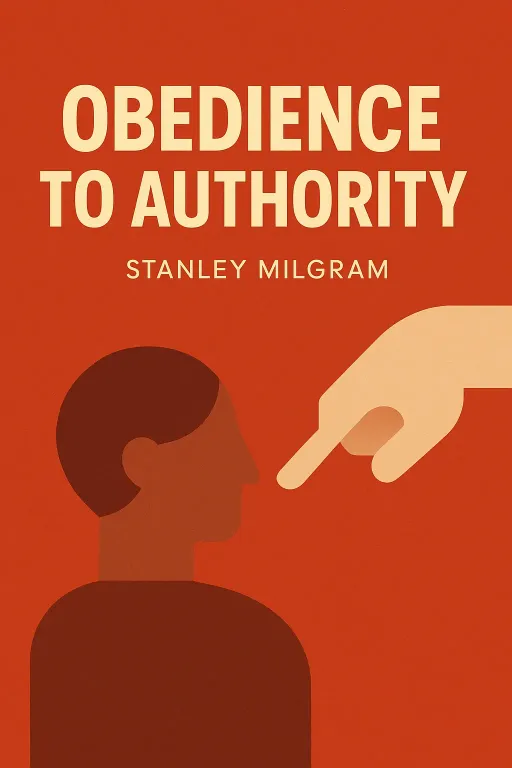
Atlas: That is a terrifying statistic. It sounds like something out of a dystopian novel, but it is actually the core finding from Stanley Milgram in his book, Obedience to Authority. And honestly, it is the kind of data point that makes you question how much of your own independent thinking is actually just compliance with a system.
Nova: Exactly. It is the ultimate reality check on human nature. But the question is, why? Why do we abdicate our moral agency the second someone with a title or a uniform walks into the room? Today, we are going to unpack that. We are also going to pair it with the work of Thibaut Meurisse in Master Your Emotions. Because if Milgram explains why we follow, Meurisse gives us the manual on how to stop being slaves to our own automatic psychological responses.
Atlas: I love that pairing. We are essentially looking at the external pressure of authority and the internal pressure of our own emotional loops. If we can master both, we might actually be able to build something that isn't just efficient, but also fundamentally human.
The Architecture of Blind Obedience
SECTION
Nova: Let’s start with Milgram. When he published Obedience to Authority, he wasn't just writing a book; he was documenting a fundamental vulnerability in the human operating system. He set up this scenario where a participant, the teacher, was instructed to administer increasingly painful electric shocks to a learner every time they got a question wrong.
Atlas: And just to be clear for anyone listening, there was no actual shock. The learner was an actor. But the person delivering the shocks did not know that.
Nova: Right. The teacher believed they were causing real pain. And the person in the lab coat, the authority figure, just kept saying, the experiment requires that you continue. That is it. No threats, no promises of reward, just a calm assertion of authority.
Atlas: It is wild that it worked. I mean, we like to think we are moral agents. We like to think that if we were in that room, we would stand up and walk out the second the learner started screaming. But the data says otherwise. Why are we so bad at saying no?
Nova: It comes down to what Milgram called the agentic state. When we enter a hierarchy, we stop viewing ourselves as the authors of our own actions. We start viewing ourselves as agents carrying out the will of someone else. We offload the moral responsibility to the person at the top of the chain.
Atlas: That is exactly what happens in tech teams, right? I see this all the time. A lead engineer or a CTO makes a decision that everyone in the room knows is technically flawed. But because that person has the title, everyone just nods and starts coding. They turn off their own critical thinking because they have shifted into that agentic state. They are just following orders.
Nova: That is the perfect analogy. It is a psychological buffer. By shifting the responsibility to the leader, the team member feels safe from the consequences of failure. If the project crashes, it is the leader's fault, not theirs. It is a defensive mechanism, but it is also a systemic failure waiting to happen.
Atlas: So, how do we break out of that? Because once you are in that mindset, you are not really thinking anymore. You are just executing. It is almost like a trance.
Dismantling the Internal Loop
SECTION
Nova: That is where we need to bring in Thibaut Meurisse. Because even if you know about Milgram, you still have to deal with your own internal emotional responses. In Master Your Emotions, Meurisse argues that we are constantly running these automated emotional loops.
Atlas: Break that down for me. What does he mean by a loop?
Nova: Think of it as a four-step sequence. Trigger, story, emotion, action. Something happens, that is the trigger. You tell yourself a story about what it means. That story creates an emotion. And that emotion dictates your action.
Atlas: Okay, let’s apply that to the team dynamic. My manager, who is technically the authority figure, rejects my proposal for a new architecture. That is the trigger.
Nova: Right. Now, what is the story you tell yourself?
Atlas: My story is, they don't value my expertise. They are ignoring my input because they want to control everything.
Nova: And what is the emotion that follows that story?
Atlas: Frustration. Resentment. Maybe a bit of hopelessness.
Nova: And what is your action?
Atlas: I shut down. I stop contributing. I just do the bare minimum to get the job done. I enter that agentic state we were talking about, but with a side of bitterness.
Nova: Exactly. You have just confirmed the loop. And the problem is, most people never pause to inspect the story. They just react to the emotion. Meurisse’s point is that you have to dismantle the cognitive distortions in that story. You have to ask yourself, is it true that they don't value my expertise? Or is it possible they are under pressure from a stakeholder I don't see?
Atlas: That is a massive shift. Instead of being a victim of the hierarchy, you are taking ownership of your internal state. But here is the friction point. If I am the leader, and I am the one creating the trigger for my team, how do I stop myself from being the guy in the lab coat that everyone is blindly obeying?
The Psychologically Safe Firewall
SECTION
Nova: That is the million-dollar question for any leader. You have to create what I call a psychologically safe firewall. You need to design your team so that dissent is not just allowed; it is a structural requirement.
Atlas: How do you do that without losing control? Because if you encourage everyone to challenge every decision, you might end up with total paralysis.
Nova: It is not about chaos. It is about shifting the definition of authority. In a healthy system, authority is not about being the smartest person in the room. It is about being the person who creates the best environment for the smartest people to collaborate. You have to explicitly tell your team, my decision is a starting hypothesis, not a final command.
Atlas: I love that framing. It turns the hierarchy on its head. Instead of the leader being the source of truth, the leader becomes the facilitator of the best truth.
Nova: Precisely. And you have to use Meurisse’s framework to manage your own reactions when someone challenges you. When an engineer pushes back on your architecture, your ego is going to flare up. That is a trigger. Your story is, they are attacking my competence. The emotion is defensiveness. If you act on that, you shut them down.
Atlas: And the moment you shut them down, you have reinforced the Milgram experiment. You have just told them, your role here is to obey, not to think.
Nova: Exactly. So, you have to catch that loop. You pause. You rewrite the story: they are not attacking me; they are trying to protect the system from a potential failure. That shifts the emotion from defensiveness to curiosity. And then your action changes. You ask, that is an interesting perspective, tell me more about why you think this will fail.
Atlas: That is powerful. You are essentially hacking the hierarchy. You are using emotional regulation to neutralize the toxic effects of authority.
Nova: And think about the impact on the team. If you do that consistently, your engineers stop feeling like agents carrying out orders and start feeling like owners of the product. They lose that fear of systemic failure because they know they have permission to raise the alarm.
Atlas: It also builds resilience. If the team is used to challenging the leader, they are going to be much better at challenging their own assumptions. They aren't just following orders; they are building a robust system that can withstand scrutiny.
Nova: That is the key. You are moving from a fragile hierarchy to an antifragile network. You are replacing blind obedience with active, constructive engagement.
Synthesis & Takeaways
SECTION
Atlas: This is such a fascinating convergence. We started with Milgram, who showed us that we have a terrifying capacity to turn off our brains when we are told to, and we moved to Meurisse, who shows us that we can turn our brains back on by managing our internal emotional loops.
Nova: And the synthesis is the responsibility of the leader. You are not just managing code or processes; you are managing the psychological state of the humans in the room. If you want to avoid systemic failures, you cannot rely on people to just follow orders. You have to build a culture where dissent is the highest form of loyalty.
Atlas: It really comes down to this: are you leading to be obeyed, or are you leading to be challenged? If you want true impact, you have to choose the latter. You have to act as the firewall that protects the team from the gravitational pull of blind authority.
Nova: And for anyone listening who feels like they are stuck in a system that demands blind obedience, remember Meurisse’s lesson. You might not control the system, but you control your emotional loop. You can choose to stay curious, you can choose to ask the hard questions, and you can choose to be the voice that prevents the next systemic failure.
Atlas: That is a great note to end on. It is not just about the leader's responsibility; it is about the individual's power. We are not just agents in a lab experiment. We are architects of our own environment.
Nova: Absolutely. It is about creating that space for truth, regardless of where you sit in the hierarchy. Thank you for joining us in this exploration of how we can build better systems by understanding our own human nature. This is Aibrary. Congratulations on your growth!