

Conquering the Mind and Defeating Self-Sabotage
Golden Hook & Introduction
SECTION
Nova: Your brain is actively lying to you about why you are stressed, and you are paying for that lie with your daily peace of mind.
Atlas: That sounds like a massive wake-up call for anyone trying to navigate a high-pressure week without losing their sanity.
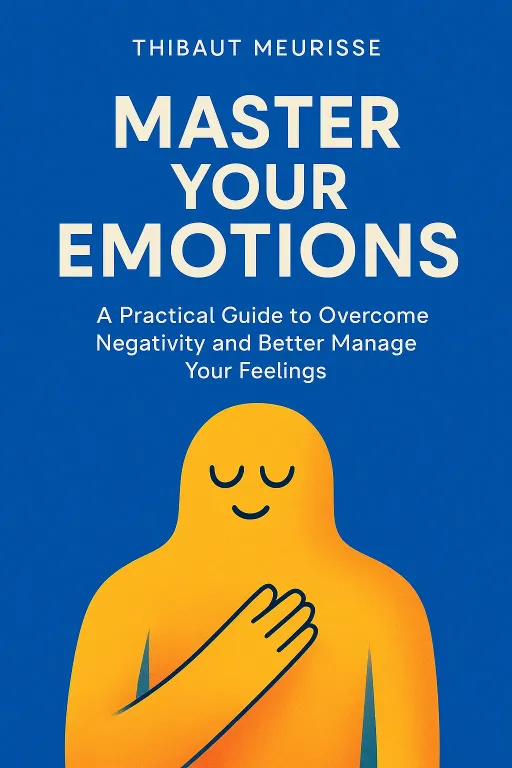
Nova: It absolutely is, and today we are diving into how to reclaim that sanity by looking at two incredibly powerful books. We have Master Your Emotions by Thibaut Meurisse, alongside The Mountain Is You by Brianna Wiest. Meurisse actually wrote his book after realizing his own chronic mental exhaustion was entirely self-generated, which led him to build a global following of readers looking for highly practical psychological toolkits.
Atlas: I can definitely relate to that feeling of self-generated exhaustion. It is like we are our own worst enemies sometimes, constantly running on a treadmill of stress that we built ourselves.
Nova: Exactly, and that is where these two authors meet. They both suggest that our biggest obstacles are not the external challenges we face, but the internal systems we use to process them. Today, we are going to unpack how to dismantle those systems. We will explore how to separate our physical feelings from the stories we tell ourselves, and we will reveal why our worst habits of self-sabotage are actually desperate, secret attempts to protect ourselves.
The 90-Second Chemical Wave
SECTION
Nova: Let us start with a concept from Thibaut Meurisse that completely changes how we view stress. He introduces this idea that an emotion, at its absolute core, is nothing more than a temporary physical sensation in the body. It is a biological event, not a permanent state of being.
Atlas: That sounds a bit abstract. When someone is furious or incredibly anxious, it does not feel like a simple biological event. It feels like an absolute, undeniable reality.
Nova: That is the trap. Neuroscientists have actually tracked this, and the physical lifespan of an emotional trigger, the actual chemical surge running through your bloodstream, lasts for about ninety seconds. That is it. Ninety seconds from the moment the trigger occurs to the moment the chemicals completely dissipate from your system.
Atlas: Hold on, ninety seconds? If the chemical reaction is that short, why do some of us stay angry or anxious for hours, or even days, after something happens?
Nova: That is the million-dollar question. What actually happens is that we feed the emotion. The chemical surge peaks and begins to fade, but our conscious mind steps in and builds a massive, elaborate narrative around it. We start telling ourselves stories about why we are angry, who is to blame, what this means for our future, and how unfair the situation is. That mental narrative triggers a fresh wave of chemicals, which triggers more thoughts, and suddenly you are trapped in a self-sustaining loop of suffering.
Atlas: Oh, I know that feeling of being caught in a loop. It is like your mind is running a simulation of the worst-case scenario on repeat. Can you give us a concrete example of how this plays out in real life?
Nova: Think about a high-stakes professional scenario. Let us take Sarah, a senior manager who is preparing for a major presentation. Ten minutes before she goes on stage, she receives an email from her director saying, we need to completely restructure the third quarter projections. Instantly, Sarah feels a physical reaction. Her chest tightens, her palms sweat, and her face flushes warm.
Atlas: That is the ninety-second chemical wave hitting her system.
Nova: Exactly. That is the biological response to the unexpected news. Now, if Sarah lets her mind take over, the narrative machine starts spinning. She tells herself, this director does not trust my leadership, they are trying to make me look bad in front of the board, this presentation is going to be a disaster, and my career here is effectively over.
Atlas: Wow, that escalated incredibly fast, but honestly, that sounds like a very typical reaction when the stakes are that high.
Nova: It is incredibly common. And because she believes that story, her body stays flooded with adrenaline and cortisol. She walks onto that stage feeling defensive, distracted, and completely overwhelmed. The quality of her presentation suffers, not because of the director's email, but because of the mental structure she built around her physical stress.
Atlas: Let me check if I got this right. The real issue is that Sarah is treating her physical sensations, the tight chest and the sweaty palms, as proof that her catastrophic thoughts are true.
Nova: You hit the nail on the head. Meurisse argues that suffering only occurs when we attach these narratives to our physical sensations. The physical sensation itself is neutral energy passing through the body. The pain comes from the story.
Atlas: That makes a lot of sense, but practically speaking, how do you actually stop that narrative machine when you are in the heat of the moment? It feels almost impossible to just switch off your thoughts when your body is screaming that there is an emergency.
Nova: It requires a highly deliberate, physical intervention. The next time you feel an intense emotional trigger, you have to initiate a ninety-second pause. You do not try to argue with your thoughts, and you do not try to fix the problem immediately. Instead, you direct your entire focus to the physical sensations in your body. You literally write down or mentally label what you are experiencing physically, completely separate from the story.
Atlas: So, instead of thinking, my career is over, Sarah would focus on saying to herself, I am experiencing a tight sensation in my chest, my heart rate is elevated, and my hands are cold.
Nova: Precisely. By shifting her focus to the raw physical data, she does two things. First, she keeps her prefrontal cortex engaged, which prevents the emotional center of her brain from completely taking over. Second, she allows that initial chemical wave to run its ninety-second course and dissolve without refueling it with new anxious thoughts. She is treating the emotion like a passing storm cloud rather than a permanent change in the weather.
Atlas: That is a powerful shift. It turns a chaotic emotional crisis into a manageable physical event. But what about those deeper, recurring patterns where we seem to get in our own way over and over again? The times when it is not just a passing emotional wave, but a systematic habit of holding ourselves back?
Nova: That transition brings us directly to Brianna Wiest's work in The Mountain Is You. Because once we learn to manage the immediate emotional waves, we have to look at the deeper structures of self-sabotage that we build over months and years.
The Hidden Purpose of Self-Sabotage
SECTION
Nova: Wiest introduces a perspective on self-sabotage that is highly counterintuitive. She suggests that self-sabotage is not actually an act of self-destruction. What is really happening is that self-sabotage is a subconscious coping mechanism. It is a highly organized, internal attempt to meet a need that we are refusing to address consciously.
Atlas: That sounds a bit paradoxical. How can holding myself back or delaying my own success be a way of meeting a need?
Nova: Look at it this way. Your subconscious mind prioritizes safety and predictability above everything else, including your happiness and your career growth. If you have a deep, unaddressed fear of failure, or even a fear of the responsibilities that come with success, your subconscious will find a way to keep you in your comfort zone, even if that comfort zone is making you miserable.
Atlas: Oh, I see. So the self-sabotaging behavior is actually a shield. It is protecting us from something we find even more terrifying than staying where we are.
Nova: Exactly. Let us look at a case study that illustrates this perfectly. Consider David, a highly talented creative director who has been vocal about wanting to start his own agency. He has the contacts, the skills, and the financial runway to do it. Yet, every time he sits down to write his business plan, he finds himself cleaning his apartment, organizing his digital files, or taking on low-paying freelance work that drains his energy. He tells everyone that he is simply too busy to get started.
Atlas: That sounds like classic procrastination. Most people would look at David and say he just lacks discipline or motivation.
Nova: That is the surface-level assumption. But if we look deeper, we find a hidden conflict. David grew up in a family where his father was a highly successful, workaholic entrepreneur who was never home and eventually went through a bitter divorce. Subconsciously, David associates running his own business with the destruction of his personal relationships and ultimate loneliness.
Atlas: Wow, that is a massive emotional association. So his subconscious sees starting the agency as a direct threat to his safety and happiness.
Nova: Precisely. His conscious mind wants the agency, but his subconscious is screaming that starting this business will ruin his life. So, his subconscious employs procrastination as a protective tool. By keeping him busy with minor tasks, his subconscious successfully meets his need for safety and relationship preservation, while allowing him to maintain the comforting illusion that he still wants to start his business someday. He is not lazy; he is actively protecting himself from a future he secretly fears.
Atlas: That is an incredibly compassionate way to look at bad habits. It shifts the conversation from, what is wrong with me, to, what am I actually trying to protect myself from?
Nova: That shift in perspective is everything. Wiest argues that we cannot overcome self-sabotage by simply trying to force ourselves to be more disciplined. If you try to bulldoze through your defenses without understanding why they are there, your subconscious will simply find a new, more creative way to stop you. You have to identify the underlying need and find a conscious, healthy way to meet it.
Atlas: Right, so if David does not address that deep-seated fear of becoming an absent workaholic like his father, no amount of productivity apps or time-management strategies will ever make him write that business plan.
Nova: Absolutely. He needs to consciously redefine what success looks like for him. He has to realize that he can build a business on his own terms, setting strict boundaries around his working hours to protect his relationships. Once his subconscious understands that success does not equal isolation, the need for the self-sabotaging shield disappears.
Atlas: That makes me wonder about how we can start identifying these hidden patterns in our own lives. Many of us have blind spots when it comes to our own behavior. How do we shine a light on these subconscious shields?
Nova: Wiest suggests looking directly at your recurring frustrations. If you consistently find yourself in the same difficult situation, whether it is always feeling overwhelmed by your workload, constantly running into communication breakdowns with your team, or repeatedly delaying critical projects, that is your starting point. You have to ask yourself, what is the payoff of this situation? What does staying in this frustrating place prevent me from having to face?
Atlas: That is a tough question to answer honestly. It requires a lot of vulnerability to admit that a situation we complain about might actually be serving us in some secret way.
Nova: It is incredibly difficult, but it is the only way to achieve genuine mental clarity. If you are always overwhelmed by your workload, perhaps the payoff is that you have a perfect excuse for why you cannot take on higher-level strategic responsibilities that terrify you. If you are constantly experiencing communication breakdowns, perhaps it keeps people at a distance, protecting you from the vulnerability of close collaboration.
Atlas: I can see how that would resonate with anyone who is trying to step into a larger leadership role. The stakes get higher, the exposure increases, and suddenly all those old subconscious defense mechanisms start firing at once.
Nova: That is exactly when the mountain appears. The mountain is not an external obstacle; it is the accumulated weight of our own unaddressed fears and coping mechanisms. Scaling that mountain means doing the deep, often uncomfortable work of aligning our subconscious needs with our conscious goals.
Synthesis & Takeaways
SECTION
Atlas: This brings us back to that daily practice we mentioned earlier. It seems like the immediate tool from Thibaut Meurisse, the ninety-second pause, is actually the gateway to doing this deeper work that Brianna Wiest talks about.
Nova: They are beautifully connected. You cannot identify your deep subconscious patterns if you are constantly swept away by the daily storm of your reactive emotions. You have to build the capacity to sit with your discomfort first.
Atlas: That makes a lot of sense. If you can pause for ninety seconds when you feel that surge of anxiety or frustration, you create a small gap of silence. And it is in that gap where you can actually start asking, what is the story I am telling myself right now, and what is the deeper need I am trying to protect?
Nova: That is the exact sequence. It is a highly practical path to emotional intelligence. By separating the physical sensation from the mental narrative, you stop wasting your energy on manufactured suffering. You free up that mental capacity to focus on tangible results and genuine growth.
Atlas: Let us talk about how our listeners can start implementing this today. We want something concrete that fits into a demanding schedule.
Nova: We have a very clear, two-part action plan. First, the next time you feel an intense emotional trigger, whether it is an annoying email, a difficult meeting, or a sudden setback, commit to a ninety-second pause. Do absolutely nothing for ninety seconds. Do not type, do not speak, and do not make a decision. Simply write down the physical sensations you are feeling in your body, separating them completely from the mental story.
Atlas: I love that. It is a physical circuit breaker for your stress. What is the second part of the plan?
Nova: The second part is about protecting your time. Schedule fifteen minutes of quiet time daily. Use this time exclusively for self-reflection, without any digital distractions. Ask yourself that critical question, what recurring frustration did I face today, and what am I secretly trying to protect myself from? Protect this fifteen-minute window fiercely. It is your dedicated space for mental clarity and strategic self-growth.
Atlas: That feels incredibly doable, even for the busiest professional. It is about taking small, deliberate steps that lead to massive shifts in how we lead ourselves and others.
Nova: It really is. When you master your emotions and understand your internal defense mechanisms, you stop reacting to the world and start choosing how you want to show up in it. That is the essence of true resilience and impactful leadership.
Atlas: This has been an incredibly eye-opening conversation. Thank you for walking us through these powerful concepts, Nova.
Nova: It has been an absolute pleasure, Atlas.
Atlas: This is Aibrary. Congratulations on your growth!









