

The Hidden Architect: How Your Inner Narratives Build Your Reality
Golden Hook & Introduction
SECTION
Nova: Okay, Atlas, imagine you're at a very exclusive, very intellectual party, and someone asks you for your five-word review of 'The Hidden Architect: How Your Inner Narratives Build Your Reality.' What do you say?
Atlas: Oh, man, that's a high-pressure party! I'd have to go with: "Mind-bending, paradigm-shifting, utterly, profoundly, humbling."
Nova: Mind-bending, paradigm-shifting, utterly, profoundly, humbling. Wow. That's a lot packed into five words. But you know what? It's pretty spot-on for the book we're diving into today. We're exploring 'The Hidden Architect: How Your Inner Narratives Build Your Reality,' a fascinating dive into the invisible forces that shape our lives. It's a work that, while perhaps not a bestseller in the traditional sense, has been widely acclaimed by thinkers across disciplines for its audacious interdisciplinary approach, challenging many conventional academic silos by synthesizing psychology, philosophy, and even neuroscience to offer a truly holistic view of human perception.
Atlas: That’s a great way to put it. I know I picked it up because the idea of 'hidden architects' just resonated with something I’ve always felt but couldn’t quite articulate. We all think we're seeing reality, right? Like, objectively. But this book makes a pretty compelling case that we're actually just living inside our own heads, in a way.
Nova: Exactly! It kicks off with this incredibly insightful concept they call 'The Blind Spot.' It's the idea that our minds are constantly filtering and interpreting reality, not just observing it. We're doing it through these deeply ingrained narratives. And the kicker is, most of the time, we're completely unaware of them.
Atlas: Really? So, we're not just seeing the world as it is, we're seeing the world as?
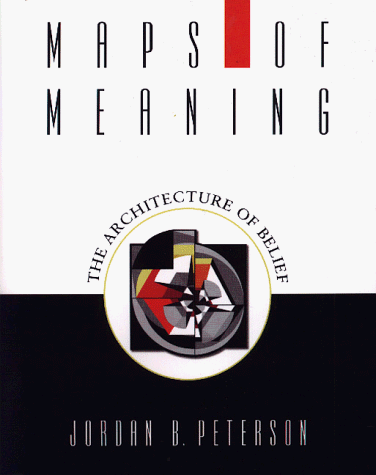
Nova: Precisely. And this isn't just fluffy philosophy. It's rooted in some profound work, like that of Jordan B. Peterson, who explores in his 'Maps of Meaning' how ancient myths and stories aren't just quaint tales. They are, in fact, fundamental frameworks. They are the operating systems our brains use to create meaning, to structure our understanding of existence, and to, quite literally, guide our actions and perceptions.
Atlas: That’s fascinating. So, he’s saying these old stories, like from mythology, they’re not just, I don’t know, entertainment? They’re like instruction manuals for life?
Nova: Absolutely. Think of them as foundational blueprints. Our brains are wired to create meaning, and these 'maps' provide the terrain. For example, the hero's journey narrative—the idea of confronting chaos, overcoming a dragon, and returning with a boon—it’s not just a story. It's a cognitive template that influences how we perceive challenges in our own lives. If your internal narrative is that life is a series of dragons to be slain, your reality will reflect that struggle and triumph. If it's a narrative of passive victimhood, well, that becomes your reality too.
Atlas: Wow. That’s kind of heartbreaking, actually. So, if someone's internal narrative is something like, "I'm not good enough," or "I'm destined to struggle," they're literally building a reality around that belief, even if they don't consciously realize it?
Nova: That’s the profound and sometimes painful truth of it. Let me give you an example. Imagine Sarah, a highly talented artist. From childhood, she absorbed a subtle narrative from her family that 'true artists always suffer for their art' and 'money corrupts creative purity.' Now, consciously, Sarah desperately wants to succeed, but unconsciously, this deep-seated narrative acts as a hidden architect. She might consistently self-sabotage opportunities for financial stability, perhaps by undervaluing her work, avoiding marketing, or even unconsciously picking arguments with potential patrons.
Atlas: Oh, I've been there. I totally know that feeling. It's like you're driving with the brakes on, but you don't even realize your foot's on the pedal.
Nova: Exactly! The cause is this unexamined narrative, the process is unconscious self-sabotage, and the outcome is a reality where Sarah is perpetually struggling financially, reinforcing her belief that 'true artists suffer.' She's literally creating a reality that aligns with her internal story, even though it's not what she consciously desires. And this is particularly poignant for anyone trying to break generational cycles. Atlas, think about how these narratives, if unexamined, can be inadvertently passed down.
Atlas: Right, like how trauma can be passed down. It’s not just about what happened, but the we tell ourselves about what happened, and how that shapes our children's stories too. So, if we don't consciously address these hidden blueprints, we're essentially just replicating patterns, even if we desperately want to change them.
The Brain's Two Storytellers: Left vs. Right Hemisphere in Shaping Perception
SECTION
Nova: And speaking of how we process reality and those blueprints, our very brains have two distinct ways of telling stories, two different architects at play. This brings us beautifully to the work of Iain McGilchrist and his groundbreaking book, 'The Master and His Emissary.'
Atlas: Oh, I like that title. What's the gist? Is it like, good brain, bad brain?
Nova: Not at all! It's far more nuanced and profound. McGilchrist, a psychiatrist and literary scholar, explores the profound differences between the brain's two hemispheres. He argues that the left hemisphere, which he calls 'the Emissary,' is excellent at narrow, focused attention, decontextualized analysis, breaking things down into parts. It's brilliant for logic, language, and manipulating tools. But the right hemisphere, 'the Master,' is about broad, sustained, vigilant attention. It sees the whole picture, understands context, nuance, and connection.
Atlas: So, the left brain is like the specialist, and the right brain is the generalist?
Nova: In a way, yes. The left brain is fantastic for taking things apart, for categorization, for creating abstract models. But it often loses sight of the living, breathing context from which those parts came. The right brain, conversely, is the one that understands the, the implicit, the emotional tone. McGilchrist's core argument is that modern society has increasingly over-emphasized and over-relied on the left hemisphere's narrow, analytical focus.
Atlas: Okay, but isn't being analytical good? We need to solve problems, right? We need logic and language.
Nova: Absolutely, the left hemisphere is indispensable. The problem arises when the Emissary, the left hemisphere, starts to believe it the Master, the whole. When it becomes dominant, we start to miss the broader, more integrated understanding offered by the right hemisphere. We become brilliant at manipulating parts but forget how they fit into the living whole. This leads to a fragmented view of reality, where we see things as isolated data points rather than interconnected systems.
Atlas: That makes me wonder, how does this connect back to those internal narratives we were just talking about? If my left brain is dominating, is it telling me a different story than my right brain?
Nova: Brilliant question, Atlas! It absolutely does. If your left hemisphere is overly dominant, your internal narratives might become overly rigid, overly analytical, and lack nuance or empathy. You might have a narrative that says, "Everything must be quantifiable," or "Feelings are illogical." You'd be missing the rich, contextual information the right hemisphere provides.
Atlas: Can you give an example of how that plays out in real life?
Nova: Of course. Imagine a child struggling with anxiety. A left-hemisphere dominant approach to this might focus solely on diagnosing the specific symptoms, labeling it, and prescribing a behavioral modification plan. It's efficient, it's analytical, it breaks the problem into manageable parts. But it might miss the broader context.
Atlas: Like, what’s happening at home, or with their friends, or what deeper fears they might have?
Nova: Exactly! A right-hemisphere integrated approach, however, would step back. It would see the child as a whole, nestled within their family, school, and community. It would consider their emotional landscape, their unique temperament, the subtle cues they're giving. It would ask: What is this anxiety? What is the? The narrative here shifts from 'a broken child to be fixed' to 'a complex individual responding to their environment.' The outcome of the first approach might be symptom suppression, while the second aims for holistic understanding and profound healing.
Atlas: That’s actually really inspiring. So, it's not that the left brain is 'bad,' but it's about the? And how does regaining this balance help someone heal from trauma or protect their children from inheriting limiting narratives?
Nova: It’s precisely about balance. McGilchrist says the Emissary should the Master, not usurp it. By cultivating a more integrated perspective—by allowing the right hemisphere to provide the broad, nuanced context—we can actually and those limiting internal narratives. We can see the interconnectedness, the deeper meaning, and the broader possibilities beyond the left brain's narrow definitions. This allows us to break free from rigid, inherited patterns and consciously craft new, empowering stories for ourselves and for future generations.
Synthesis & Takeaways
SECTION
Nova: So, what we've really explored today is how our internal narratives, whether they come from ancient myths or personal experiences, are the invisible architects of our reality. And how the very structure of our brain, particularly the balance between its two hemispheres, dictates how we perceive and construct those narratives.
Atlas: It’s like we’re not just reading a book, we’re writing it, and our brain is both the pen and the paper. That gives me chills.
Nova: It truly is. The profound insight here is that recognizing the powerful influence of our internal narratives and understanding the brain's interpretative bias is the first, essential step toward consciously reshaping our reality. It's about moving from being a passive recipient of stories to becoming the active, responsible author of our own lives. It's about finding deeper meaning, fostering profound healing, and creating a more integrated, compassionate world.
Atlas: That’s such a hopeful way to look at it. It takes this big, abstract idea and makes it feel like something we can actually. So, for our listeners today, what core stories do you tell yourself about your life and purpose? And how might those stories be both guiding and limiting you?
Nova: This is Aibrary. Congratulations on your growth!