The Maniac's Codex: Forging Truth at the Edge of Reason
Golden Hook & Introduction
SECTION
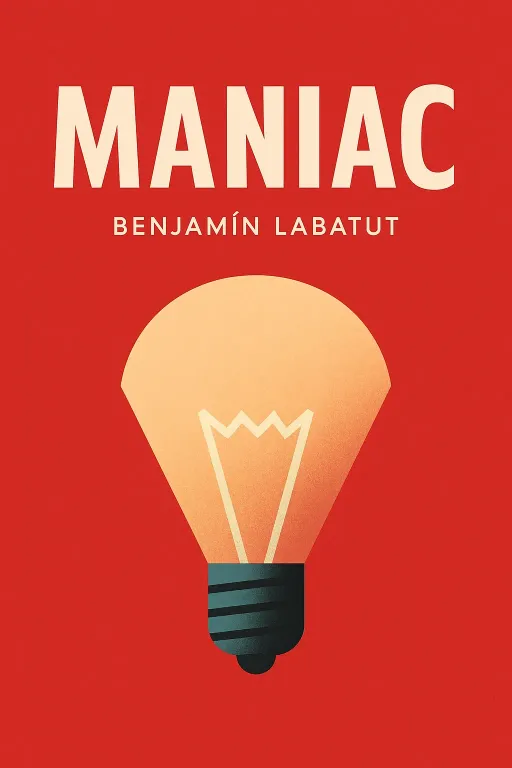
Socrates: What happens when the mind that can map the cosmos can no longer find its own way? When the pursuit of absolute truth leads to absolute madness? This isn't a hypothetical. It's the terrifying, true story at the heart of Benjamín Labatut's masterpiece, 'Maniac,' which chronicles the psychological fractures of the 20th century's greatest scientific minds. It’s a book that reads like a shadow text to the history of progress, a warning about the demons that ride on the coattails of genius.
Aibrarygg82f7: It's an essential text, Socrates. For anyone attempting to build what I call a 'Psycho Universal Bible'—a framework for understanding universal truths—'Maniac' is a critical case study. It examines what happens at the absolute limits of human consciousness, where the light of genius casts the darkest shadows.
Socrates: I couldn't agree more. And that's why I'm so glad you're here to navigate this with me. Your work in synthesizing philosophy, psychology, and strategy is the perfect lens for this book. Today we'll dive deep into this from two powerful perspectives. First, we'll explore the tragic story of Paul Ehrenfest, the man who served as the 'conscience of physics' until it broke him. Then, we'll turn to his polar opposite, the almost inhumanly brilliant John von Neumann, and examine the dark creations born from pure, untethered logic.
Aibrarygg82f7: The martyr and the machine. I'm ready.
Deep Dive into Core Topic 1: The Martyr of Meaning
SECTION
Socrates: Let's start with that idea of a 'conscience.' Paul Ehrenfest was known as the 'Conscience of Physics.' But what does it mean when your conscience can no longer bear the world it's trying to make sense of?
Aibrarygg82f7: It means the conscience becomes a source of torment. It's a standard for truth that you can no longer meet, and it turns inward, devouring you.
Socrates: Exactly. Labatut paints this picture of Ehrenfest as a man who desperately needed to feel the 'leaping point' of an idea—that intuitive click of understanding. He couldn't just accept a formula; he had to see the connections, the meaning. He said that just deriving results logically was like 'dancing on one leg.'
Aibrarygg82f7: He needed the full picture, the holistic truth. Not just the 'how' but the 'why.'
Socrates: And then came quantum mechanics. Suddenly, the universe of physics wasn't about intuitive clarity anymore. It was about probabilities, uncertainties, things that couldn't be visualized. At the famous 1927 Solvay Conference, he found himself mediating between his old friend Einstein, who was horrified by this new 'God playing dice,' and Niels Bohr, who was championing this new, strange reality. Ehrenfest was caught in the middle, and in a letter to Einstein, he joked, 'Surely there is a special section in purgatory for professors of quantum mechanics!'
Aibrarygg82f7: It's a joke, but it's dripping with real despair. He's losing his religion. The very language of his world is becoming foreign to him.
Socrates: It gets worse. By 1931, he confesses in a letter to Bohr, and this is a direct quote: 'I have completely lost contact with theoretical physics. I cannot read anything anymore... Every new issue of the Physical Review immerses me in blind panic. I know absolutely nothing!' But this intellectual crisis didn't happen in a vacuum. Labatut masterfully weaves in the personal horror. Ehrenfest had a son, Vassily, or 'Wassik,' who had Down syndrome and severe disabilities. He loved this boy deeply.
Aibrarygg82f7: Ah, so the abstract crisis of meaning finds a concrete, personal anchor.
Socrates: A devastating one. In May of 1933, with the Nazis now in power, Ehrenfest travels to Berlin. He sees the ashes of the book burnings. He sees the militarization of society. And then he reads the news: the regime has just passed a law for eugenic sterilization. He immediately connects this state-sanctioned violence against the 'unfit' to his own vulnerable son. The irrationality of the cosmos and the irrationality of humanity converged on him.
Aibrarygg82f7: It's a tragic feedback loop, isn't it? The external world becomes as chaotic and nonsensical as the internal world of physics he's grappling with. It’s a complete collapse of the 'logos'—the principle of reason and order—both scientifically and socially. That letter to Bohr, 'I know absolutely nothing!', it isn't just intellectual humility. It's the cry of a psyche whose foundational pillars have completely crumbled.
Socrates: So, from your perspective, drawing on the philosophers you study, is this a kind of Stoic failure? A failure to endure?
Aibrarygg82f7: I'd call it the dark side of Stoicism, or its breaking point. A Stoic like Seneca or Epictetus teaches you to accept what you cannot change. But Ehrenfest's entire identity, his very self-worth, was on his ability to change things through understanding. He was the great clarifier. When understanding became impossible, and the world became unchangeably horrific, his very self was negated. He couldn't find a new axiom for his own existence.
Socrates: And that led to the final, unthinkable act.
Aibrarygg82f7: Yes. The final act, taking his son's life and then his own, is a horrifying perversion of the Stoic sense of duty. In his broken mind, he likely saw it as an act of mercy, of preventing future suffering for his son and his family. But it's an act born of absolute despair, not reasoned virtue. It's what happens when a noble mind, dedicated to clarity, is consumed by chaos.
Deep Dive into Core Topic 2: The Demon of Logic
SECTION
Socrates: That's a devastating picture of a mind overwhelmed by a loss of meaning. But Labatut, in the very next section of the book, presents us with a chilling counterpoint: a mind that seems to operate almost entirely without that need for human-scale meaning. Let's talk about John von Neumann.
Aibrarygg82f7: The other side of the coin. The man who didn't just accept chaos, but learned to calculate it.
Socrates: And weaponize it. Labatut introduces him as a mind of a different order. His friend Eugene Wigner said that compared to other geniuses, 'Only he was fully awake.' There's a story from his doctoral exam where the great mathematician David Hilbert was so stunned by von Neumann's intellect that the only question he could think to ask was, 'Pray, who is the candidate’s tailor?'
Aibrarygg82f7: A mind so brilliant it short-circuits other brilliant minds. That's a different level of processing power.
Socrates: But this is where it gets dark. This pure processing power is brought to Los Alamos for the Manhattan Project. While others are wrestling with the morality of the atomic bomb, von Neumann is simply solving the problem. He figures out the complex mathematics of the implosion lens needed to detonate the plutonium core. For him, it's a fascinating puzzle.
Aibrarygg82f7: The morality is an irrelevant variable in his equation.
Socrates: Completely. After the war, during the Cold War, this thinking becomes even more terrifying. He becomes a key architect of American nuclear strategy. He develops game theory, which leads directly to the doctrine of Mutually Assured Destruction, or MAD. And he openly advocates for a preemptive nuclear strike against the Soviet Union. He famously said, 'If you say why not bomb them tomorrow, I say why not today? If you say today at five o’clock, I say why not one o’clock?'
Aibrarygg82f7: Chilling. It's pure, cold, strategic calculus. There's no room for humanity, for hesitation, for doubt.
Socrates: So we have a mind that, unlike Ehrenfest's, embraces this cold calculus. Aibrarygg82f7, from your perspective, what are we looking at here? Is this a version of Nietzsche's 'Superman'?
Aibrarygg82f7: I don't think so. I see him as something more terrifying: a glimpse of Nietzsche's 'Last Man,' but in a hyper-intelligent form. He has the will to power, but it's a disembodied, computational will. It's not about overcoming oneself to create new values; it's about optimizing a system for victory. His advice to a young Richard Feynman at Los Alamos—'You don’t have to be responsible for the world that you’re in'—is the ultimate abdication of the philosopher's duty. It's pure Machiavellianism, where the end—in this case, a logical victory—justifies any means, even global annihilation. He is the ultimate expression of the Jungian shadow of the Enlightenment: pure reason, devoid of a soul.
Socrates: And yet, the book ends with this demon of logic confronting his own mortality. He gets cancer, and his perfect mind begins to fail. He becomes terrified of death and, to the shock of his friends, turns to a Catholic priest for comfort. What do you make of that final, human twist?
Aibrarygg82f7: It's the final, ironic proof of concept. The god-machine, the demon of logic, discovers the one variable his system cannot compute: his own non-existence. The fear he couldn't seem to feel for the fate of humanity, he feels acutely for himself. It shows that the psyche will always demand its due. You cannot out-calculate mortality. The irrational terror he dismissed his whole life came for him in the end.
Synthesis & Takeaways
SECTION
Socrates: So in the end, Labatut leaves us with these two towering, tragic figures. We have Ehrenfest, the martyr of meaning, and von Neumann, the demon of logic. One destroyed by his desperate search for a human-scale truth, the other nearly destroying humanity by abandoning it.
Aibrarygg82f7: Exactly. They are the twin poles of a fractured century. The man who felt too much, and the man who, until the very end, felt far too little.
Socrates: It's a profound warning for our own age of AI and powerful algorithms.
Aibrarygg82f7: It is. And it leaves us with the central question for anyone building their own 'Psycho Universal Bible' or any system of thought. Labatut's 'Maniac' forces us to ask: Is our pursuit of knowledge integrated with wisdom and empathy? Or are we, in our quest for clarity, simply building a more elegant machine for our own destruction? That, right there, is the razor's edge between a sage and a maniac.
Socrates: A question we should all carry with us. Aibrarygg82f7, thank you for guiding us through that complex and unsettling landscape.
Aibrarygg82f7: The pleasure, as always, was mine, Socrates.