

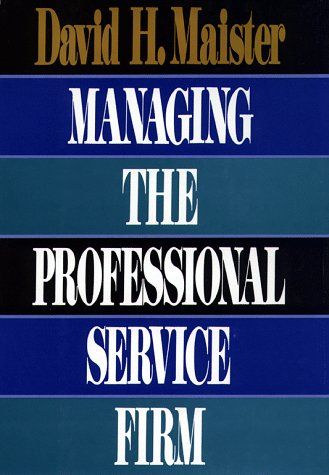
Managing the professional service firm
Introduction: The Unmanageable Genius
Introduction: The Unmanageable Genius
Nova: Welcome to 'The Blueprint,' the show where we dissect the foundational texts that shape modern business. Today, we’re diving into a book that is practically scripture for anyone running a law firm, a consulting agency, an accounting practice, or even a high-end creative shop: David H. Maister’s 'Managing the Professional Service Firm.'
Nova: : That title sounds incredibly dry, Nova, but I have a feeling this book is anything but. What makes Maister’s work so essential, especially when we talk about firms full of highly educated, fiercely independent professionals?
Nova: That’s the million-dollar question, and it’s the core tension Maister addresses. Unlike a factory where you manage widgets, in a Professional Service Firm, or PSF, your primary assets walk out the door every evening. Maister argues that the very things that make these professionals brilliant—their customization, their deep expertise, their autonomy—are the things that make managing them a nightmare. He wrote this book to provide the management playbook for this unique environment.
Nova: : So, it’s about taming the brilliant but unruly expert? I can already picture the friction. I imagine the partners in these firms often think, 'I’m too smart to need management theory.' What was the central problem he was trying to solve for them?
Nova: Exactly. The central problem is that the skills that make someone a great lawyer or consultant often do not make them a great manager or firm leader. Maister compiled decades of observation to show that PSFs are fundamentally different from product businesses. They can’t rely on mass production; they rely on customized delivery. He distilled this complexity into a few core, non-negotiable truths. The first, and perhaps most famous, is the necessity of balancing three competing, yet equally vital, missions. This is where we start.
Nova: : A balancing act, I like that. It sounds like a high-wire performance where if you lean too far toward one side, the whole structure collapses. Tell us about these three pillars that hold up the entire professional enterprise.
Nova: Let’s unpack that tightrope walk. This is the foundation of the entire book, and if a firm gets this wrong, nothing else matters. We’re talking about Client Service, People, and Profit. And they must be held in equilibrium. Get ready, because we’re going deep into the Maister mandate.
Key Insight 1: The Three Non-Negotiable Missions
The Holy Trinity: Balancing Service, People, and Profit
Nova: Maister states unequivocally: Every professional service firm has the same mission. It’s a trinity: 1. Deliver outstanding client service. 2. Provide fulfilling careers and professional satisfaction for its people. 3. Achieve financial success. The key word here is 'balance.' You cannot sacrifice one for the other long-term.
Nova: : That sounds simple on paper, but in reality, doesn't client service often demand more hours, which cuts into the 'fulfilling careers' part? If a client demands a 2 AM deliverable, the career satisfaction takes a hit, and that might mean the partner has to bill more hours to compensate, squeezing profit margins.
Nova: You’ve hit the nail on the head regarding the tension. Maister is keenly aware of this. He points out that if you focus only on profit, you burn out your people and alienate your clients. If you focus only on people, you go bankrupt. The magic is in the structure that allows these three to reinforce each other. For instance, fulfilling careers lead to better work, which leads to better client service, which justifies higher fees, leading to better profit.
Nova: : So, the fulfillment isn't just about ping-pong tables and free lunch; it’s about the quality of the work itself and the respect shown to the professional. What about the financial side? How does Maister define success in a partnership structure?
Nova: He’s very specific here. For many PSFs, especially law and accounting firms, profitability is often measured as 'profit per partner.' This metric forces leadership to think about leverage and efficiency, not just top-line revenue. If you have 100 lawyers but only 10 partners, and the profit per partner is low, it signals a massive problem in how value is being captured and distributed, or perhaps too many resources are being spent on non-billable activities that don't serve the other two pillars.
Nova: : 'Profit per partner'—that’s a sharp metric. It immediately shifts the focus from merely growing the headcount to growing the each senior leader generates. It forces difficult conversations about who is truly contributing to the client service and people satisfaction pillars.
Nova: Precisely. And this leads directly to the second major concept: what exactly is the 'inventory' of a professional service firm? It’s not widgets. It’s not even just 'time.' Maister insists that the inventory is twofold: the firm’s and its. You must constantly manage both.
Nova: : I’ve heard this idea before, but let’s dig in. If I’m a top M&A lawyer, my skill is my inventory. But if I leave, the firm loses that skill. How does Maister suggest we manage that inventory better than just hoping the lawyer stays?
Nova: He suggests a proactive approach to skill development and, crucially, relationship ownership. A firm that only relies on one rainmaker partner having a personal relationship with a client is incredibly fragile. Maister advocates for building relationships that are owned by the, not just the individual. This means involving junior partners and associates in key client interactions early on, ensuring continuity. If that star partner retires tomorrow, the client shouldn't feel like they just lost their only contact; they should feel like they’ve lost a valued colleague, but the firm relationship remains intact.
Nova: : That’s a profound shift in mindset—from 'my client' to 'the firm’s client.' It requires a level of internal collaboration that often runs counter to the competitive nature of partnership structures. It sounds like this balancing act requires a very specific type of leadership, one that prioritizes the collective health over individual glory.
Nova: It absolutely does. And this leads us perfectly into the next challenge: how do these skills evolve over time? Because a skill that is cutting-edge today becomes commoditized tomorrow. This brings us to Maister’s framework for the lifecycle of a service offering, often called the 3Es.
Key Insight 2: Managing the Evolution of Service Offerings
The 3Es Lifecycle: Expertise, Experience, and Efficiency
Nova: Maister observed that any specific service line—say, handling initial public offerings, or perhaps complex tax structuring—doesn't stay the same forever. It moves through a predictable lifecycle, which he characterized as Expertise, Experience, and finally, Efficiency. This is crucial for pricing and staffing.
Nova: : Let’s map that out. When a service is brand new, it must be Expertise, right? Only a few people in the world can do it, and they charge a premium.
Nova: Precisely. Stage one: Expertise. This is where the firm is pioneering. The people doing the work are the thought leaders, the ones writing the papers, setting the precedents. They are scarce, and the firm can charge the highest rates because the client is paying for the very creation of the solution. This is the high-margin, high-risk phase.
Nova: : And what happens when that expertise becomes more common? When other firms start catching up, or when the market matures?
Nova: That’s Stage two: Experience. The firm now has a solid track record. They aren't inventing the wheel anymore, but they are executing flawlessly based on dozens, maybe hundreds, of previous engagements. The scarcity shifts from the itself to the that knowledge reliably. Rates might stabilize or slightly decrease, but volume and reliability increase.
Nova: : I see the danger already. If a firm stays too long in the Expertise phase, they might be overcharging for something that is now standard practice elsewhere. Or, conversely, if they rush into the Experience phase too soon, they might undercut their own value proposition.
Nova: That’s the management trap! The real challenge comes in Stage three: Efficiency. As the service becomes routine—think standard contract review or basic audit procedures—the market demands lower prices. The only way to maintain profitability here is through extreme efficiency, often achieved through leverage: using less expensive, more junior staff, or even technology, to handle the bulk of the work. The senior experts should be moving on to the next 'Expertise' area.
Nova: : So, the partner who built their reputation on being the absolute best at IPOs needs to recognize when that service has become 'efficient' and transition themselves to mentoring the next generation of IPO experts, while they focus on, say, navigating complex international regulatory mergers. It requires a conscious, almost painful, letting go of the past.
Nova: It requires humility and foresight. Maister notes that many firms fail because they try to charge 'Expertise' rates for 'Efficiency' work. The client, now educated by the market, sees the inflated price tag and walks to the firm that has successfully leveraged its junior talent to deliver that same service reliably and cheaply. The firm that clings to the old model sees its margins erode to nothing.
Nova: : This lifecycle concept is brilliant because it forces management to constantly look ahead. It’s not just about managing the present workload; it’s about actively cultivating the next high-margin service line before the current one becomes commoditized. It’s a constant state of planned obsolescence for your current revenue streams.
Nova: Exactly. And this constant need for reinvention and skill renewal brings us to the most volatile element in the PSF equation: the people themselves. If the firm’s inventory is its people, how do you manage the 'people crisis' that Maister frequently references? This is where the leadership style must fundamentally change from command-and-control to support-and-enable.
Key Insight 3: Managing the Firm's Most Valuable Asset
The People Crisis and Servant Leadership
Nova: Maister dedicates significant attention to what he calls the 'people crisis.' In a knowledge-based firm, the talent is the product. If your best people are unhappy, they leave, and they take valuable client relationships and institutional knowledge with them. This is far more damaging than a temporary dip in revenue.
Nova: : I’ve seen this firsthand. A star consultant leaves, and suddenly three major clients follow them to their new venture. It’s devastating. What is Maister’s prescription for retaining this high-value, high-ego inventory?
Nova: His prescription centers on a management philosophy he champions: Servant Leadership. This is a radical departure from the traditional hierarchical model common in older professional firms. A servant leader doesn't just delegate; they actively work to support their team members so the team can better serve the client.
Nova: : So, instead of the partner saying, 'Get this done by Friday,' the partner says, 'What do you need from me—access to data, budget approval, introductions—to ensure you can deliver this complex project flawlessly by Friday?'
Nova: Precisely. The leader’s job shifts from being the primary doer to being the primary remover of obstacles. They are asking, 'How can I make your job easier so you can focus your expertise on the client?' This builds immense loyalty. When professionals feel their leaders are genuinely invested in their success and well-being, they are far less likely to look elsewhere, even if a competitor offers a slightly higher salary.
Nova: : That makes sense for job satisfaction, but what about the structure of compensation and career paths? In many firms, the only path upward is partnership, which is incredibly exclusive. Doesn't that create a bottleneck of frustrated mid-level managers who see no future?
Nova: Maister strongly advocated for creating multiple career tracks. Not everyone wants to be a rainmaking partner, and frankly, not everyone has the temperament for it. Some of the firm’s greatest technical minds are terrible at business development or firm politics. The firm needs a robust 'Technical Partner' or 'Principal' track—a non-equity, highly compensated role that allows them to continue practicing at the highest level, mentoring others, and focusing on the and phases, without needing to compete for the limited equity partner slots.
Nova: : That’s a massive structural change for traditional firms built on the equity partnership model. It acknowledges that value creation isn't monolithic. You have value creators who are great at client work, and value creators who are great at firm governance and business development. Trying to force everyone into the same mold is organizational suicide.
Nova: It is. And this ties back to the first pillar: client service. Maister stresses that the firm must be disciplined about who it serves. He warns against taking on clients or projects that don't align with the firm’s core strengths or that demand unsustainable levels of effort. He famously suggests that firms should be willing to say 'no' to work that forces them to compromise their three pillars. Saying no to a bad client is often the best form of marketing for attracting good clients.
Nova: : Saying no to revenue? That takes serious leadership conviction. It means you trust the long-term health derived from balance over the short-term sugar rush of a big, messy contract.
Nova: It does. And this conviction must permeate the entire firm culture. It’s about building a culture of trust, where professionals trust their leaders to manage the business side, allowing them to focus on their craft, and where clients trust the firm to deliver consistently, regardless of which specific individual is assigned to the file.
Key Insight 4: Governance and Growth Strategy
The Partnership Dilemma and Marketing to the Existing Client
Nova: We’ve talked about the three pillars and the people. Let’s pivot slightly to governance and growth, specifically how Maister views marketing in a world where the best marketing tool is the work you’ve already done. He has strong opinions on how partnerships should govern themselves to support growth.
Nova: : I’m eager to hear about governance. Partnerships are notorious for being slow, consensus-driven, and often paralyzed by internal politics. How does Maister suggest structuring decision-making to keep up with the market cycles we discussed earlier?
Nova: He advocates for clarity in roles and accountability, even within a partnership. While consensus is valued, decision-making authority needs to be clearly delegated, especially for operational matters. But perhaps more revolutionary for many firms was his view on marketing. He argues that for PSFs, marketing is fundamentally different from selling widgets. You don't 'sell' a complex legal strategy; you build trust until the client you to execute it.
Nova: : So, what does that look like in practice? Is it just about having a nice website and a good brochure?
Nova: Not at all. Maister emphasizes that the most effective marketing is marketing to your client base. He points out that it is exponentially easier and cheaper to sell a new service to a client who already trusts you than it is to acquire a brand new client from scratch. This requires proactive account management, not passive waiting for the phone to ring.
Nova: : That means the partner responsible for the relationship needs to be constantly thinking, 'What other problems does this client have that we are uniquely qualified to solve?' It’s about expanding the scope of service within the existing relationship.
Nova: Exactly. It’s about being a trusted advisor, not just a hired gun for a single problem. Furthermore, he stresses that marketing efforts must be consistent. A firm that markets aggressively one quarter and then goes silent for six months sends a signal of instability. Consistency builds the perception of reliability, which is the bedrock of trust in professional services.
Nova: : That consistency must also apply to quality. If the firm is trying to balance the three pillars, how do you ensure that the junior associate handling a routine task delivers the same level of firm quality as the senior partner handling the flagship engagement?
Nova: That circles back to systems and training—the efficiency part of the 3Es. You need standardized processes for quality control, clear delegation protocols, and rigorous post-engagement reviews. The firm must treat its internal processes with the same rigor it treats its client deliverables. If the internal process is chaotic, the external delivery will eventually reflect that chaos, shattering the client’s trust and undermining the entire mission.
Nova: : It sounds like Maister is essentially saying that managing a professional service firm is less about managing and more about managing the that enable those people to perform at their best, all while keeping the three core missions in perfect alignment. It’s a holistic management philosophy, not just a collection of tips.
Conclusion: The Enduring Legacy of Maister's Mandate
Conclusion: The Enduring Legacy of Maister's Mandate
Nova: We’ve covered a tremendous amount of ground today, exploring the foundational text that redefined how we think about law firms, consultancies, and specialized service providers. If we had to boil down the enduring legacy of 'Managing the Professional Service Firm,' what are the three things listeners absolutely must take away?
Nova: : I think the most powerful takeaway is the mandate for balance. The Holy Trinity—Client Service, People, and Profit—isn't a suggestion; it’s a survival requirement. Any firm that optimizes for just one or two of those elements is setting itself up for a slow, painful decline. The tension is the point, and managing that tension is the job.
Nova: I agree completely. And my second key takeaway is the realization that the firm’s inventory is fragile: skills and relationships. This demands that leaders proactively manage relationship ownership away from individuals and toward the firm entity, and that they must constantly manage the 3E lifecycle—Expertise, Experience, Efficiency—to ensure they are always cultivating the next high-value service before the current one becomes a commodity.
Nova: : And finally, the leadership model. The shift to Servant Leadership is non-negotiable for retaining top talent. If you are a leader in a PSF, your primary function is to clear the path for your experts, not to dictate every step they take. That respect fosters the loyalty needed to weather the inevitable storms.
Nova: Absolutely. Maister’s work is a timeless reminder that while the is technical, the is deeply human. It requires discipline, foresight, and a commitment to serving those who serve the client. It’s a challenging but incredibly rewarding blueprint for building an institution that lasts.
Nova: : It certainly gives us a lot to chew on regarding our own professional structures. It’s about building a sustainable ecosystem, not just maximizing quarterly earnings. A fantastic deep dive into a true classic.
Nova: Indeed. Thank you for joining us on this exploration of David Maister’s essential guide. We hope this has given you new tools to manage the brilliant minds around you.
Nova: This is Aibrary. Congratulations on your growth!