

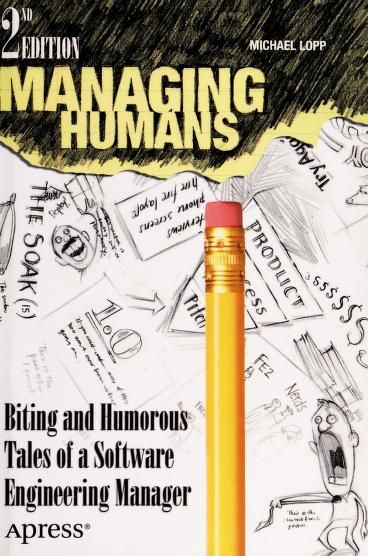
Managing Humans
Introduction
Nova: Picture this: you're a brilliant software engineer. You can debug a race condition at 2 a. m., you can architect systems that scale to millions of users, and you can explain monads without breaking a sweat. Then one day, someone taps you on the shoulder and says, "Congratulations, you're now a manager." And suddenly, none of those skills matter. Welcome to the world Michael Lopp captures in his cult classic, "Managing Humans: Biting and Humorous Tales of a Software Engineering Manager."
Nova: : That transition from engineer to manager is brutal. I've seen friends go through it. One day they're writing code, the next they're mediating arguments about which text editor is superior. What makes Lopp's book different from every other management book out there?
Nova: That's exactly the right question. Michael Lopp, who writes under the pseudonym Rands on his legendary blog "Rands in Repose," spent decades managing engineering teams at places like Apple, Pinterest, Palantir, and Slack. But here's what makes his book special: it's not a dry textbook filled with frameworks and jargon. It's a collection of essays drawn from real trenches. The subtitle says it all: "Biting and Humorous Tales of a Software Engineering Manager." First published in 2007 and now in its third edition from 2021, this book has become required reading in Silicon Valley.
Nova: : So it's basically a war memoir from the front lines of tech management?
Nova: Exactly. And the war is not against competitors or deadlines. The war is against misunderstanding, miscommunication, and the sheer chaos of human beings trying to build things together. Lopp's central insight is deceptively simple: managing humans is fundamentally different from managing machines, and most engineers who become managers learn this the hard way. Today we're going to unpack the key lessons from this book that have shaped how an entire generation of tech leaders thinks about management.
Key Insight 1
The Nerd Handbook and Understanding Your Team
Nova: Let's start with one of Lopp's most famous contributions: "The Nerd Handbook." This essay is practically legendary in tech circles. Lopp argues that if you're going to manage engineers, you need to understand how their brains work. And he doesn't mean this in a superficial, stereotypical way. He means understanding the deep wiring.
Nova: : Okay, I have to ask. What's actually in this so-called Nerd Handbook? Is it just a list of stereotypes?
Nova: It's much deeper than that. Lopp describes the nerd's brain as a "rage machine" that's constantly processing information, looking for patterns, and getting frustrated when things don't make sense. He talks about how engineers have an elaborate "trickle list" in their heads, a constantly reprioritized queue of everything they need to do. When you interrupt an engineer, you're not just breaking their focus. You're scrambling that entire list, and it takes them significant time to rebuild it.
Nova: : That explains so much about why developers get so annoyed by random Slack messages.
Nova: Exactly! And Lopp goes further. He describes how engineers often have a "cave" — a mental and sometimes physical space where they do their deepest work. He talks about how they process social situations differently, often replaying conversations afterward to understand what actually happened. The handbook covers everything from how they argue, to why they're obsessed with efficiency, to the specific ways they show they care about people, which often doesn't look like traditional emotional expression.
Nova: : So the message for managers is: don't try to turn your engineers into something they're not?
Nova: Precisely. Lopp's argument is that great management starts with radical understanding. You don't manage an engineer the same way you manage a salesperson. You need to understand their motivations, their communication style, their need for deep focus, and their relationship with problem-solving. One of his most quoted lines is that engineers don't hate people, they hate inefficiency. And a lot of what looks like antisocial behavior is actually just an allergic reaction to processes that don't make sense.
Nova: : That's a really compassionate framing. But does he also talk about the different types of engineers? Because not all engineers are the same.
Nova: Great point. Lopp actually has a whole taxonomy. He talks about "free electrons" — those rare, brilliant engineers who operate best with total autonomy and can't be managed in traditional ways. He contrasts "incrementalists" who build carefully, step by step, with "completionists" who need to see the whole picture and get things done fast. Understanding which type you're dealing with completely changes how you should manage that person. Give a completionist too many small tasks and they'll go crazy. Give an incrementalist a massive, vague project and they'll freeze.
Key Insight 2
The One-on-One: Update, Vent, and Disaster
Nova: If there's one thing from "Managing Humans" that has become standard practice across the entire tech industry, it's Lopp's framework for one-on-one meetings. He argues that the 1:1 is the single most important tool a manager has, and he provides a brilliantly simple structure for it.
Nova: : I've been in terrible one-on-ones. The kind where the manager just asks "so, what's up?" and then checks their phone. What does Lopp say a good one looks like?
Nova: Lopp's framework is three words: update, vent, and disaster. The meeting starts with the update. This is the tactical stuff: what are you working on, what's blocking you, what's the status. But here's the key — Lopp says this should only take about fifteen minutes. The update is necessary but it's not where the real value lives.
Nova: : Then comes the vent?
Nova: Yes. The vent is where the engineer gets to talk about whatever is bothering them. And Lopp is very specific: the manager's job here is to shut up and listen. Don't solve problems. Don't offer advice. Just listen. He says that most managers are terrible at this because they're wired to fix things. But the vent isn't about fixing. It's about creating a space where someone feels heard.
Nova: : That must be hard for engineering managers who spent their whole careers fixing things.
Nova: It's incredibly hard. Lopp calls this the transition from "the craft" to "the business." When you're an engineer, your value comes from solving technical problems. When you're a manager, your value comes from creating an environment where other people can solve technical problems. It's a completely different skill set, and Lopp is very honest about how painful this transition can be.
Nova: : And the third part, disaster?
Nova: The disaster is the most important part. Lopp says that in every one-on-one, you should explicitly ask: "Is there anything that's a disaster right now?" The word "disaster" is deliberate. It's strong enough to cut through the natural tendency to downplay problems. And here's what Lopp has learned: if you don't ask this question, you won't hear about the disaster until it's too late. Engineers, especially, tend to think they can fix things themselves. By the time they tell you there's a problem, it's often already a crisis.
Nova: : So the one-on-one is really an early warning system?
Nova: That's one function, yes. But Lopp also sees it as the primary relationship-building tool. He says that trust is built in these meetings, one conversation at a time. If you're not having regular, structured one-on-ones, you're not really managing. You're just administrating. And he's brutal about this: if you cancel one-on-ones because you're too busy, you're telling your reports that they're not important. The one-on-one is sacred.
Key Insight 3
Shields Down, Bored People Quit, and the Scream Test
Nova: Let's talk about some of Lopp's most memorable concepts. There's a chapter called "Shields Down" that I think about constantly. Lopp describes a moment in every employee's journey where they mentally check out. Their shields go down. They stop fighting for the company, for the team, for the mission. And once those shields are down, it's almost impossible to get them back up.
Nova: : What causes the shields to drop?
Nova: Lopp says it's rarely one big thing. It's usually an accumulation of small disappointments. A promotion that didn't happen. A project that got canceled. A meeting where they weren't heard. A promise that was broken. Each one is small, but together they add up to a fundamental loss of trust. And here's the terrifying part: as a manager, you often don't notice until it's too late. The person is still showing up, still doing their work, but they've already decided to leave. They're just working out the logistics.
Nova: : That's chilling. How do you prevent it?
Nova: Lopp's answer is vigilance. Pay attention to small changes in behavior. Is someone who used to speak up in meetings suddenly quiet? Is someone who used to care about quality suddenly shipping sloppy work? These are the early warning signs. And this connects to another Lopp classic: "Bored People Quit." He argues that boredom is the silent killer of engineering teams. Engineers need to be challenged. They need to be learning. If they're doing the same thing day after day, they will leave, no matter how good the salary is.
Nova: : That resonates. I've left jobs where I was perfectly comfortable but just... bored.
Nova: Exactly. And Lopp says managers often miss this because they think, "Well, they're not complaining, so everything must be fine." But for knowledge workers, especially engineers, the absence of complaints can actually be a warning sign. It might mean they've stopped caring enough to complain.
Nova: : What about the scream test? That sounds dramatic.
Nova: The scream test is one of Lopp's more provocative ideas. The concept is simple: if you want to know whether something is truly important, stop doing it and see who screams. If nobody screams, it wasn't important. This applies to meetings, processes, reports, all the bureaucratic overhead that accumulates in organizations. Lopp argues that most companies are drowning in things that nobody actually needs, but everyone is too afraid to stop doing.
Nova: : That's terrifying and liberating at the same time. Just stop doing things and see what happens?
Nova: Lopp would say: yes, but be smart about it. Don't scream-test your payroll system. But that weekly status meeting that everyone hates and nobody reads the notes from? Scream test it. That report that takes three hours to compile and goes to a distribution list of people who never respond? Scream test it. The scream test is really about organizational courage. It's about being willing to question assumptions and eliminate waste, even when it's uncomfortable.
Key Insight 4
The Pond, Culture, and the Art of Organizational Design
Nova: One of Lopp's most powerful metaphors is "the pond." He describes every organization as a pond, and every new hire is like dropping a stone into that pond. The ripples affect everything. A single new person changes team dynamics, communication patterns, decision-making processes. And most companies completely underestimate this.
Nova: : So hiring is even more consequential than we think?
Nova: Much more. Lopp argues that most hiring processes focus entirely on skills and experience, but the real question is: how will this person change the pond? Will they amplify existing cultural strengths or introduce new tensions? Will they make other people better or will they create friction? He says that a brilliant jerk — someone who's technically exceptional but toxic — can destroy a team faster than you can imagine. The ripples from a bad hire can last for years.
Nova: : How does Lopp think about culture more broadly?
Nova: Lopp is deeply skeptical of culture as a top-down initiative. He doesn't believe you can design culture in a PowerPoint deck. Culture, he says, is what actually happens, not what you say should happen. It's the sum of every decision, every conversation, every meeting. And it changes every time someone joins or leaves. His advice to managers is to pay attention to the real culture, not the aspirational one. Watch how decisions actually get made. Notice who people go to for advice. Observe what behaviors get rewarded and punished.
Nova: : That feels more anthropological than managerial.
Nova: That's a great way to put it. Lopp essentially argues that good managers need to be amateur anthropologists. They need to study their teams the way a researcher would study a community. What are the rituals? Who holds informal power? What stories do people tell? What are the taboos? All of this is the real culture, and you can't change it until you understand it.
Nova: : Does he offer any practical advice for shaping culture once you understand it?
Nova: He does, and it's refreshingly simple. He says culture is shaped primarily through three things: who you hire, who you fire, and what you celebrate. Everything else is commentary. If you hire curious people, you get a culture of learning. If you fire people who hoard information, you get a culture of transparency. If you celebrate careful, thoughtful work rather than heroic all-nighters, you get a culture of sustainability. The manager's job is to be intentional about these three levers.
Nova: : That's so clear. Hire, fire, celebrate. Three levers.
Nova: And Lopp would add: use them consciously. Most managers drift through hiring, avoid firing at all costs, and celebrate whatever happens to go well. That's not culture building. That's culture happening to you.
Key Insight 5
Managing Up, Managing Yourself, and the Long Game
Nova: One of the things that makes "Managing Humans" stand out is that Lopp doesn't just talk about managing down. He devotes significant attention to managing up — how to work with your own boss — and managing yourself. He's very honest about the emotional toll of management.
Nova: : That's refreshing. Most management books act like managers are robots who just execute frameworks perfectly.
Nova: Exactly. Lopp talks openly about the loneliness of management. About lying awake at night worrying about a team member who's struggling. About the moment when you have to fire someone and how it stays with you. About the impostor syndrome that never really goes away. He calls management "the job where you're always wrong" because no decision makes everyone happy, and you're constantly second-guessing yourself.
Nova: : How does he suggest dealing with that?
Nova: A few ways. First, he emphasizes the importance of having your own support system. Find other managers you can talk to honestly. Second, he talks about the "rule of threes" for communication: if you've said something important, say it three times, in three different ways, before you can assume people have heard it. This reduces the frustration of feeling like nobody listens to you.
Nova: : Three times, three ways. That's practical.
Nova: Third, and this is maybe his most counterintuitive advice: care less. Not in a cynical way, but in a sustainable way. Lopp argues that many new managers burn out because they care too much about everything. They treat every decision like it's life or death. His advice is to develop a sense of proportion. Most decisions are reversible. Most mistakes are survivable. The team will be fine. Save your emotional energy for the things that truly matter.
Nova: : That's actually really freeing. But doesn't it risk becoming complacent?
Nova: Lopp draws a distinction between caring about the right things and caring about everything. He says great managers develop what he calls "strategic apathy" — the ability to not care about things that don't matter, so they can care deeply about the things that do. The manager who freaks out about every missed deadline and every small mistake is exhausting to work for and burns out quickly. The manager who stays calm, picks their battles, and focuses on what's truly important builds a resilient team.
Nova: : What about managing up? What does Lopp say about dealing with your own boss?
Nova: His core advice is: never surprise your boss. Bad news should travel faster than good news. He also says that your relationship with your boss is your responsibility, not theirs. Don't wait for them to manage you. Manage them. Tell them what you need. Tell them how you like to receive feedback. Tell them what you're worried about. Most bosses are drowning in their own problems and will be grateful for an employee who makes the relationship easy.
Nova: : So it's almost like you need to train your boss?
Nova: Lopp would probably say "train" is too strong, but "educate" is exactly right. Your boss can't read your mind. If you need more context to do your best work, ask for it. If you need them to stop CCing you on every email, tell them. The alternative is silently building resentment, and we already know where that leads: shields down.
Conclusion
Nova: So here's what we've learned from Michael Lopp's "Managing Humans." First, understand your people deeply. Read the Nerd Handbook. Learn how their brains work. Second, make one-on-ones sacred. Update, vent, disaster. Every time. Third, watch for the warning signs: shields dropping, boredom creeping in. Fourth, think of your organization as a pond where every hire creates ripples. Shape culture through who you hire, who you fire, and what you celebrate. And finally, take care of yourself. Management is hard. Find your people. Pick your battles. Care about the right things.
Nova: : What strikes me most is how human all of this is. For a book about managing software engineers, it's really about understanding people. Not processes, not frameworks, not methodologies. Just people.
Nova: That's exactly Lopp's thesis. The title isn't "Managing Software Engineering." It's "Managing Humans." The technology changes constantly. The languages, the frameworks, the platforms — all of it will be different in five years. But humans? Humans are the same beautiful, complicated, frustrating, wonderful creatures they've always been. And learning to work with them, to lead them, to bring out their best — that's the real craft.
Nova: : If someone reads this book and takes away just one thing, what should it be?
Nova: I think it's this: your job as a manager is not to have the best ideas or make all the decisions. Your job is to create an environment where the best ideas can emerge from anyone, and the best decisions get made collectively. Lopp calls this "building the machine that builds the machine." You're not the hero. You're the person who makes it possible for heroes to do their best work. That's a humbling shift for a lot of former engineers, but it's also what makes management deeply meaningful.
Nova: : Nova, this has been fantastic. I feel like I need to go read this book immediately and then have a very honest conversation with my manager.
Nova: That might be the highest compliment we could pay to Michael Lopp's work. "Managing Humans" is available now in its third edition, updated for the remote-work era. And if you want more, his blog "Rands in Repose" is still going strong after more than two decades. It's a masterclass in thinking deeply about the craft of management.
Nova: : This is Aibrary. Congratulations on your growth!