

The Unshakeable You: A Guide to Self-Loyalty and Fearless Authenticity
Golden Hook & Introduction
SECTION
Dr. Celeste Vega: Shawaga, let me ask you something. If you talked to your friends the way you sometimes talk to yourself… would you have any friends left?
Shawaga: Oof. That is a tough question. Probably not. I don't think anyone would stick around for that.
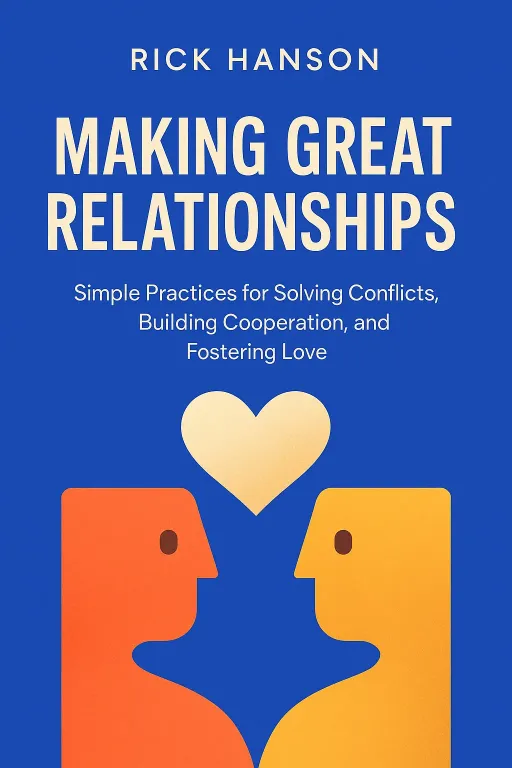
Dr. Celeste Vega: Right? That little voice that says 'you're not smart enough,' or 'you messed that up again,' or 'why did you say that?' It's a brutal question, but it gets right to the heart of Rick Hanson's book,. He argues the most important relationship you'll ever have is with yourself, and it starts with a radical idea: self-loyalty.
Shawaga: I love that. Self-loyalty. It sounds so much more active and powerful than just self-love.
Dr. Celeste Vega: It is! And that's our mission today. We're going to unpack this using the book's incredible wisdom, especially for someone like you, Shawaga, who's so interested in building a strong mindset and self-confidence. Today we'll dive deep into this from two perspectives. First, we'll explore what it truly means to become your own biggest ally, moving beyond just bubble baths and into the real work of self-loyalty.
Shawaga: Okay, I'm ready for the real work.
Dr. Celeste Vega: Then, we'll discuss the fearless art of speaking your truth, and how to handle the haters when you do.
Deep Dive into Core Topic 1: Becoming Your Own Biggest Ally
SECTION
Dr. Celeste Vega: So let's start with that first idea, becoming your own ally. In the book's introduction, Hanson tells this beautiful story about two wolves. Have you heard it?
Shawaga: I don't think so, tell me.
Dr. Celeste Vega: An elder is talking to a younger person, who asks, 'How have you become so happy and wise and loved?' And the elder replies, 'It’s because I know that there are two wolves in my heart, a wolf of love and a wolf of hate. And I know that everything depends on which one I feed each day.'
Shawaga: Wow. That's so powerful. It's like curating your own mental playlist. You can choose to play the self-critical tracks on repeat, or you can consciously choose the ones that build you up. It makes me think of mindset, which I'm so interested in. It's not about pretending the 'wolf of hate' isn't there, but actively choosing not to give it the microphone.
Dr. Celeste Vega: You just perfectly described the neuroscience of it! Hanson, who is a neuropsychologist, explains that every time you 'feed' one of those wolves—every time you indulge a self-critical thought or practice a moment of self-compassion—you are literally strengthening the neural pathways for that way of thinking. You're training your brain.
Shawaga: So it’s a habit. A mental habit. That makes so much sense.
Dr. Celeste Vega: Exactly! And he gives us a tool for this in Chapter 1, 'Be Loyal to Yourself.' The core practice is astonishingly simple: treat yourself with the same encouragement, support, and respect you would give to a dear friend. How often do we actually do that?
Shawaga: Almost never, right? It feels like a total double standard. If my friend was nervous about a job interview, I'd be her biggest cheerleader. I'd say, 'You are so qualified for this! You've got this! They'd be lucky to have you!'
Dr. Celeste Vega: And to yourself?
Shawaga: To myself, it's more like, 'Don't mess this up. Don't say something stupid. I hope they don't realize you're an imposter.' It's completely different. The book is asking us to apply the same rules of friendship to ourselves.
Dr. Celeste Vega: It's a radical act of self-respect. And it builds on another key idea from Chapter 8, which is 'Know You’re a Good Person.' Hanson makes this crucial distinction: you need to separate your, which can sometimes be flawed or mistaken, from your fundamental, which is inherently good. You might do a bad thing, but that doesn't make you a bad person.
Shawaga: That's a huge relief to hear, honestly. Because I think we all carry around a list of our mistakes, and that inner critic—that wolf of hate—loves to read that list back to us. But separating the 'doing' from the 'being' gives you space to learn and grow without drowning in shame.
Dr. Celeste Vega: It's the foundation of resilience. When you know, deep down, that you are a good person trying your best, you can face challenges without them shattering your self-worth. You have a secure home base inside yourself.
Shawaga: A secure home base. I love that. That's the goal, isn't it? To have that unshakeable core.
Deep Dive into Core Topic 2: The Fearless Art of Speaking Your Truth
SECTION
Dr. Celeste Vega: It is the goal. And once you've built that foundation of self-loyalty, that secure home base, it gives you the strength for the next, often scarier, step: standing up for yourself and speaking your truth. Which, as you know, can feel like you're inviting criticism.
Shawaga: Oh, one hundred percent. Especially I think for young women. We're often socialized to be agreeable, to not make waves. Speaking up can feel like a betrayal of that unspoken rule.
Dr. Celeste Vega: And Hanson addresses this head-on in Chapter 23, with a title that is just so liberating: 'Relax, You’re Going to Be Criticized.' He says criticism is an unavoidable fact of life, like weather. It's going to happen. The goal isn't to avoid it, because you can't. The goal is to handle it wisely.
Shawaga: This is the Taylor Swift part of the conversation! Her entire career is a masterclass in this. I mean, think about it. She gets criticized for —her dating life, her lyrics, her business decisions, what she wears, how she breathes!
Dr. Celeste Vega: It's true.
Shawaga: But instead of hiding or quitting, she uses it. She writes songs about it, like 'Shake It Off' or 'Look What You Made Me Do.' She re-records her entire back catalog to own her truth and her art. She doesn't let the criticism stop her from creating or from being herself. She feels like the living embodiment of that chapter title.
Dr. Celeste Vega: That is a perfect modern example! Hanson would say she's 'sorting the criticism.' He gives a framework for it. First, you ask: is it true? Is there a grain of truth in what's being said? Second: is it helpful? Will focusing on this help me grow? If the answer to both is no, you let it go. It's just noise. If there's something to learn, you learn it. But you don't let the noise derail your train.
Shawaga: And this connects back to the first point, right? You can only 'sort the criticism' effectively if you have that strong sense of self-loyalty. If you're not your own ally, any criticism can feel like a fatal blow.
Dr. Celeste Vega: Precisely. It all links together. This then connects to Chapter 31, 'Say What’s True.' Hanson argues that authenticity is the ultimate antidote to the fear of criticism. When you're speaking from your heart, from a place that is genuinely true for you, you're less dependent on how it's received.
Shawaga: So it's a two-part process. The internal work of self-loyalty gives you the 'ground' to stand on, like he says in Chapter 26, 'Find Your Ground.' And then from that stable ground, you can speak your truth without being so terrified of the pushback. You're not seeking approval anymore, you're just expressing what's real for you. It changes the entire motivation.
Dr. Celeste Vega: You've nailed it. And it's important to note, speaking your truth isn't about being aggressive or starting fights. Hanson emphasizes using a 'softer tone' and speaking from the heart. It's about being clear, honest, and authentic, not combative. It's the quiet strength of confidence, not the loud noise of arrogance.
Shawaga: That's a really important distinction. It’s not about winning an argument; it’s about honoring yourself.
Synthesis & Takeaways
SECTION
Dr. Celeste Vega: Exactly. And that's the beautiful cycle the book lays out. You befriend yourself, which builds the confidence to speak your truth. And speaking your truth, even when it's scary, reinforces your sense of self-worth and your loyalty to yourself. It all comes back to that first, simple choice: which wolf will you feed today?
Shawaga: It really reframes the whole idea of self-care and personal development. It's not just about face masks and journaling, though those can be great. It's about the tough, moment-to-moment, daily work of choosing to be loyal to yourself. And the book makes it clear that this is the ultimate source of motivation and real, lasting confidence.
Dr. Celeste Vega: It truly is. So for everyone listening, especially those of you who, like Shawaga, are focused on building a better mindset, here's a small challenge from the book. It's a practice from Chapter 2 called 'Let Be, Let Go, Let In.'
Shawaga: I'm listening.
Dr. Celeste Vega: The next time that inner critic pipes up, that wolf of hate starts howling, just pause. Don't fight it. First, just. Acknowledge the thought is there without judgment. 'Ah, there's that thought again.' Second, gently. Imagine it's a cloud passing in the sky. You don't have to cling to it. And third, and this is the most important part, the opposite. Let in a feeling of strength, a moment of self-compassion, or just the simple fact that you are a good person trying your best.
Shawaga: Let be, let go, let in. It's simple, but not easy.
Dr. Celeste Vega: Not easy at all. But it's a small, concrete act of feeding the wolf of love. And as Rick Hanson shows us, those small acts, repeated over time, are what build an unshakeable you.









