

Beyond the Product: Why Self-Love is Your Startup's Most Critical Feature
Golden Hook & Introduction
SECTION
Orion: As an early-stage founder, you're obsessed with your product's operating system, your team's workflow, your growth metrics. But what about the most critical OS of all—the one running between your ears? What happens when that system crashes under the weight of failure, fear, and self-doubt?
13681804126: It’s a question I think every founder asks themselves, usually at three in the morning. It’s the ultimate single point of failure.
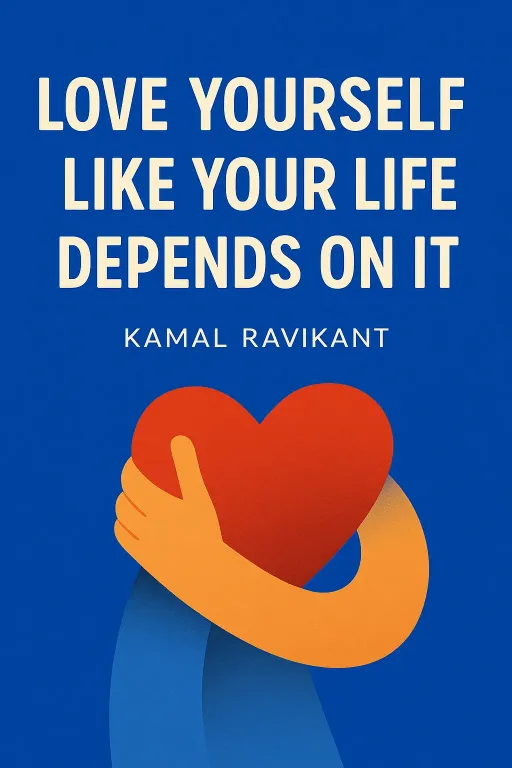
Orion: Exactly. And one Silicon Valley CEO, Kamal Ravikant, hit that exact point. After his company failed, he didn't write a business book. He wrote a survival manual for the mind, a short, intense guide called 'Love Yourself Like Your Life Depends on It'. And today, we're going to treat this book like a founder's toolkit. I'm Orion, and with me is 13681804126, an early-stage founder who lives and breathes the world of product growth and team building. Welcome!
13681804126: Thanks for having me, Orion. I'm excited to dig in. This topic is so critical and so often overlooked.
Orion: I agree. So, we'll dive deep into this from two perspectives. First, we'll deconstruct the core practice of 'Love Yourself' as a practical operating system for founder resilience. Then, we'll reframe fear not as an obstacle, but as a strategic compass for making critical business and life decisions.
Deep Dive into Core Topic 1: The Self-Love 'Operating System'
SECTION
Orion: So, let's start with that crash. Kamal Ravikant wasn't just having a bad day; he was at his absolute lowest. His company had failed, a friend had passed away, a relationship had just ended. He describes being in bed, just consumed by what he calls a state of deep misery and pain.
13681804126: A place many founders can unfortunately relate to, even if the causes are different. The feeling of everything collapsing at once is… familiar.
Orion: Right. And in a moment of sheer desperation, he gets up, goes to his notebook, and writes a vow. It's intense. He writes, "This day, I vow to myself to love myself, to treat myself as someone I love truly and deeply—in my thoughts, my actions, the choices I make, each moment I am conscious, I make the decision I LOVE MYSELF." He says there was no middle ground; it was either go all-in on this, or risk complete self-destruction.
13681804126: That's the pivot. Not a business pivot, but a personal one. It’s a conscious, forceful decision to change the core metric of your life from external success to internal well-being.
Orion: A perfect way to put it. And his first 'app' in this new operating system was a simple mental loop. He just started repeating the phrase 'I love myself' over and over again, silently, constantly. His logic was that our minds are filled with thought loops anyway, most of them negative and unproductive. His idea was to consciously install a new, positive one until it became the default program.
13681804126: That's such a powerful reframe. As founders, we're constantly running loops of 'What if we run out of cash?' or 'Did that investor hate our pitch?' or 'Is this new feature a total dud?' It's a default state of anxiety. The idea of intentionally overwriting that with a single, powerful, positive loop... it's like deploying a hotfix for your own brain.
Orion: A hotfix! I love that. And he found it wasn't just about the words, but the. He realized he had to consciously the feeling of love to the words for the transformation to really take hold. How do you see that applying to something like team building? Can a leader's internal 'loop' really affect the team?
13681804126: Oh, absolutely. It’s everything. Your team mirrors your energy, your mindset. If your internal loop is one of fear and scarcity, you'll micromanage, you'll be overly risk-averse, and you'll create a culture of anxiety where no one feels safe to fail or experiment. People will feel that.
Orion: And the opposite?
13681804126: If your foundational loop is one of self-worth and, as the book says, love, you're more likely to trust your team. You'll empower them, you'll celebrate small wins, you'll handle failures with grace. You lead from a place of abundance, not deficit. It directly impacts how you show up in every single one-on-one, every product review, and every all-hands meeting. Your internal OS sets the culture for the entire company.
Orion: So this practice isn't just self-care, it's a leadership strategy.
13681804126: It's the foundational leadership strategy. You can't build a great team or a great product on a shaky personal foundation. It will eventually crumble.
Deep Dive into Core Topic 2: Fear as a Feature, Not a Bug
SECTION
Orion: And that ability to show up from a place of strength, not fear, leads directly to our second point. Ravikant argues that once you have this foundation, your relationship with fear completely changes. He has this mantra that he repeats: "If it scares me, there is magic on the other side."
13681804126: That’s a thought that would give most founders a heart attack. Fear is usually a signal to retreat, to de-risk, to play it safe.
Orion: But he reframes it as a signpost. And he developed a tool for it. When he's faced with a difficult or scary situation, he asks himself a simple question: "If I loved myself truly and deeply, what would I do?"
13681804126: Hmm. That’s a very different question from 'What's the most logical thing to do?' or 'What's the most profitable thing to do?'
Orion: Exactly. He gives the example of publishing this very book. He was a Silicon Valley guy, a former CEO. He was terrified that writing a book about self-love would make him a laughingstock and ruin his career. He hesitated. But then he asked himself the question. And the answer was clear: a person who loves themselves shares their truth, regardless of the outcome. So he published.
13681804126: And it clearly didn't ruin his career; we're talking about it now. It defined a new one.
Orion: It created, in his words, "so much magic." To illustrate this idea of stepping through fear, he tells this incredible story about Richard Bandler, the co-creator of NLP. Bandler was asked to help an executive in a mental institution who was completely debilitated by hallucinations of snakes.
13681804126: Okay, you have my attention.
Orion: Instead of trying to convince the man the snakes weren't real, Bandler did something wild. He went to a pet store, rented a bunch of rubber snakes, and even borrowed some live cobras and a python. He filled the man's shower room with all these snakes—real, rubber, and of course, the man's own hallucinated ones.
13681804126: That is… an unconventional approach.
Orion: To say the least. He wheeled the terrified man in and said, "Tell me which ones are real and which ones aren’t, and I’ll wheel you out." After the initial panic, the man was forced to really look. And he said, "Easy, hallucinated snakes are see-through." He had known the difference all along, but his fear had blinded him. The point is, fear often creates these 'see-through' illusions. The 'One Question' Ravikant uses helps you see them for what they are and gives you the courage to step through them.
13681804126: Wow. The 'hallucinated snakes' is the perfect metaphor for startup life. Your fear tells you, 'If you launch this MVP, everyone will hate it and the company will die.' That's a hallucinated snake. It feels so real, so solid, but it's an illusion of a worst-case scenario.
Orion: So how does the question help you see that it's 'see-through'?
13681804126: The reality is, you'll get feedback, you'll iterate, you'll learn. The question—'If I loved myself, what would I do?'—forces you to act from a place of growth, not a place of fear. A founder who loves themselves and their mission launches the MVP to learn; they don't hide in fear of judgment. It shifts the goal from 'avoiding pain' to 'seeking growth.'
Orion: So it becomes a practical decision-making tool for product growth?
13681804126: Completely. It's a filter for any major decision. 'Should we make this difficult hire?' 'Should we pivot away from our original idea?' 'Should we have this tough conversation with a co-founder?' Ask the question. The answer that comes from a place of self-love and self-respect is almost always the one that leads to the long-term health and growth of the company, even if it's the scarier, more difficult option in the short term. It prioritizes truth over comfort.
Synthesis & Takeaways
SECTION
Orion: So, what we've really unpacked here are two powerful ideas for any founder, or really, anyone in a high-pressure environment. First, that building an internal 'operating system' through a simple, repeatable practice of self-love is a core strategy for resilience. It's not a soft skill; it's a hard-edged practice.
13681804126: It’s your personal infrastructure. It has to be solid.
Orion: And second, that reframing fear as a compass and using a simple question as a filter can lead to braver, better, more authentic decisions.
13681804126: Exactly. And the best part is, it doesn't have to be this massive, life-altering overhaul overnight. My challenge to every founder listening is to just run a small experiment. An A/B test on your own mindset.
Orion: I like that. What's the experiment?
13681804126: For the next seven days, pick one tiny thing from this. Maybe it's asking that 'One Question' before your first big decision of the day. Or maybe it's the 'Ten Breaths' practice Ravikant mentions—just ten deep breaths where you repeat 'I love myself.' Track it. Put an 'X' on a calendar. See if that small 'hotfix' to your own OS doesn't change the way you show up for your team and for yourself. I think you'll be surprised by the results.
Orion: A simple practice, a simple question, and a simple experiment. It sounds like a powerful place to start. 13681804126, thank you for these incredible insights.
13681804126: My pleasure, Orion. This was a great conversation.









