

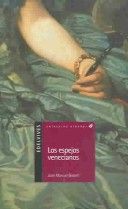
Reflections of Deceit: Unmasking the Secrets of The Venetian Mirrors
Golden Hook & Introduction
SECTION
Prof. Eleanor Hart: Have you ever looked in an old mirror and felt a strange chill? A feeling that it's seen more than just your face? What if a mirror didn't just reflect the present, but held a permanent, ghostly image of the last person who died in front of it? This isn't just a spooky thought; it's the terrifying premise at the heart of Joan Manuel Gisbert's novel,, or.
Toria: It's an idea that gets under your skin immediately. The thought that an everyday object could be a window to something so final.
Prof. Eleanor Hart: It really does. And today, we're going to unravel this gothic mystery. I'm Professor Eleanor Hart, and I'm so pleased to be joined by Toria, a sharp and curious secondary student who brings the perfect analytical lens to this story. Welcome, Toria.
Toria: Thanks for having me, Eleanor. I’m excited. This book feels like a puzzle waiting to be solved.
Prof. Eleanor Hart: It certainly is. And together, we'll dive deep into this from three perspectives. First, we'll explore the anatomy of a great mystery and how our young protagonist begins to follow the clues. Then, we'll discuss the book's haunting central concept of mirrors that defy reality. And finally, we'll focus on the story's powerful moral question: when does the pursuit of knowledge become dangerous?
Toria: I'm ready. Let's head to Venice. Or, Padua, to be precise.
Deep Dive into Core Topic 1: The Anatomy of a Mystery: Following the Clues
SECTION
Prof. Eleanor Hart: Precisely. So, Toria, let's set the scene. The story centers on a young, ambitious student named Giovanni. It's the late 18th century, and he has just arrived in Padua from his home in Venice to study literature and languages at the city's prestigious university. He's staying with his aunt, a kindly but somewhat nervous woman.
Toria: And he’s full of that energy you have when you first start a new chapter in your life. He’s eager to learn, to explore, to make his mark.
Prof. Eleanor Hart: Exactly. But almost immediately, his aunt gives him a strange warning. She tells him to focus on his official studies and to stay away from a certain private institution known as the Stravaganti Academy. She's vague, but her fear is palpable.
Toria: It's such a great setup. As a student, you're taught to ask questions and be curious. So when an authority figure immediately tells you 'don't go there, don't ask about that,' it's like a magnet. It's the one place you to investigate. It's reverse psychology 101.
Prof. Eleanor Hart: It is! And Gisbert, the author, plays on that perfectly. Giovanni isn't a superhero; he's just intellectually curious. He soon encounters some students from this very academy. They're… odd. They all wear identical, somber clothing, they move about in a group, and they seem pale, withdrawn, and almost lifeless. They never speak to outsiders.
Toria: The uniformity is what I found so creepy. It's not just that they're part of a club; it's that they seem to have lost their individuality. It suggests a loss of identity, which is a really unsettling idea. It’s not just that they're hiding something, but that something has been taken them.
Prof. Eleanor Hart: That's a brilliant observation. It’s a visual clue that something is fundamentally wrong. Giovanni tries to ask about the academy, but he's met with silence or fear. The university professors pretend it doesn't exist. The townspeople whisper about its founder, a Professor Lazzaro Spallanzani, but no one knows what he actually teaches there. The entire institution is a black hole of information.
Toria: And for an analytical mind like Giovanni's, a vacuum of information is a problem that needs to be solved. He starts piecing things together. The strange students, his aunt's warning, the wall of silence. Each piece of non-information becomes a clue in itself.
Prof. Eleanor Hart: Yes. He's operating like a true detective. He's observing, forming hypotheses, and looking for patterns. He learns the academy is housed in a grim, windowless building. He notices the students seem to be wasting away. He feels this pull, this intellectual need to understand what is happening behind those closed doors.
Toria: It really speaks to the nature of curiosity. It's not just about wanting to know; it's about the discomfort of knowing. The story positions the reader right there with Giovanni, feeling that same itch, that same need to uncover the truth.
Prof. Eleanor Hart: And that itch leads him down a path that will challenge everything he thinks he knows about the world. Which brings us to the book's central, terrifying concept.
Deep Dive into Core Topic 2: The Haunted Reflection: When Seeing Isn't Believing
SECTION
Prof. Eleanor Hart: That's a brilliant point about the loss of identity. And that theme becomes terrifyingly literal when Giovanni finally gets his hands on one of the special Venetian mirrors. This is where the story shifts from a simple mystery into something much more supernatural.
Toria: This is the part that gave me chills.
Prof. Eleanor Hart: Me too. Through a series of events, Giovanni finds himself in a dusty, forgotten antique shop. The owner is in debt and desperate. He shows Giovanni a small, ornate, and incredibly beautiful Venetian mirror. But he warns him it's cursed. The legend says that these specific mirrors, crafted with a secret and long-lost alchemical process, have a unique property.
Toria: They don't just reflect. They remember.
Prof. Eleanor Hart: They remember. They capture and hold the last image reflected in them at the moment of a person's death. Giovanni, being a rational man of the Enlightenment, is skeptical but intrigued. He buys the mirror. He takes it back to his room, and he looks into it, expecting to see his own face.
Toria: And he doesn't.
Prof. Eleanor Hart: He doesn't. Instead, staring back at him from the glass is the pale, lifeless face of a young woman he has never seen before. Her eyes are closed, her expression is serene. It's not a reflection. It's a static, permanent image. A portrait of the dead. He's holding a photograph from a time before photography existed.
Toria: The way it's described is so effective. He tries to debunk it, right? He moves the candle, he turns the mirror, he thinks it's a trick of the light or a painting behind the glass. He's applying the scientific method.
Prof. Eleanor Hart: He is. He's trying to find a logical explanation for an illogical event. But no matter what he does, the dead woman's face remains. The evidence becomes undeniable, and he's forced to accept an impossible truth. Toria, from an analytical perspective, this is a fascinating moment. How do you think a rational mind like Giovanni's processes this?
Toria: I think it represents a total paradigm shift. It’s that moment in any field of study where a discovery is made that forces you to throw out the old textbooks. He has to change his entire understanding of reality. It’s a powerful metaphor for any kind of intellectual breakthrough, whether it's in science or just in your own life when you learn something that changes your whole worldview.
Prof. Eleanor Hart: A paradigm shift. I love that. It's no longer about just solving a local mystery at an academy. He's now stumbled upon a fundamental secret of the universe. And it raises the question: what is 'reality'? Is it just what our five senses tell us?
Toria: Exactly. The book suggests that there are layers to reality, and maybe technology—or in this case, alchemy—can give us a window into them. But that window might show us things we're not prepared to see. And it makes him realize the Stravaganti Academy isn't just a school. It's something else entirely.
Prof. Eleanor Hart: He connects the dots. He realizes the academy isn't teaching literature. It's studying, and perhaps even creating, these mirrors. The secret isn't just what the mirrors do, but someone would want to possess such a thing.
Toria: Because if you have a mirror that shows you the dead, you don't just have a supernatural curiosity. You have information. You have a secret.
Prof. Eleanor Hart: And that is the most dangerous thing of all.
Deep Dive into Core Topic 3: Knowledge as a Weapon: The Moral Crossroads
SECTION
Prof. Eleanor Hart: And what they see through that window is the key to the whole conspiracy. Because once Giovanni accepts the unbelievable truth of the mirrors, he realizes they're not just curiosities. They are tools. And in the wrong hands, they're weapons.
Toria: This is where the story gets really dark. It's one thing to discover a secret of the universe. It's another to immediately figure out how to weaponize it.
Prof. Eleanor Hart: Giovanni investigates further and uncovers the horrifying truth. Professor Spallanzani, the brilliant and reclusive head of the academy, has been hunting down these mirrors for years. But he's also been commissioning new ones and strategically placing them—selling them at a loss, even—into the homes of Venice's most wealthy and powerful citizens. In their bedrooms, their studies... places where they are at their most private.
Toria: So he's bugging their houses with supernatural technology.
Prof. Eleanor Hart: That's the perfect modern analogy. When one of these powerful individuals dies, a member of the academy is dispatched to discreetly buy back the mirror. The mirror now contains a permanent record of that person's final moments. And in those final moments, secrets are often revealed. A deathbed confession. The location of a hidden will. The identity of a secret lover.
Toria: It's the ultimate invasion of privacy. He's literally stealing secrets from the dead.
Prof. Eleanor Hart: And he uses those secrets for blackmail. He leverages this ghostly information to extort money and influence from the families of the deceased. The Stravaganti Academy is not a school; it's the headquarters of a sophisticated, supernatural criminal enterprise. The "students" are his agents, their life force seemingly drained by their proximity to these objects of death.
Toria: Wow. The book poses a very modern question in this 18th-century setting, doesn't it? About data, privacy, and consent. The mirrors are like a supernatural version of a hidden camera or a hacked server. The information is real, but it was obtained without consent and is being used for malicious purposes.
Prof. Eleanor Hart: It's incredibly prescient. It forces us to look at the professor. Was he a scholar who was corrupted by his discovery, or was he always this way? Does absolute power—or in this case, absolute knowledge—corrupt absolutely?
Toria: That's the key question. I think the book suggests that the for that kind of power is the original corruption. The professor didn't just stumble upon this; he actively sought it out and engineered this entire system. Giovanni, on the other hand, stumbles upon it, and his first instinct is to solve the injustice and expose the truth, not to exploit it. It all comes down to character and intent.
Prof. Eleanor Hart: A perfect distinction. The professor sees knowledge as property and power. Giovanni sees it as a responsibility. He now faces a choice: walk away, or confront a man who holds the secrets of the most powerful people in Venice.
Toria: And being the protagonist of a great story, he, of course, chooses to confront him. He can't 'un-know' what he's discovered, so he has to act on it.
Synthesis & Takeaways
SECTION
Prof. Eleanor Hart: So we've followed the clues with Giovanni, from a simple, nagging curiosity to a full-blown conspiracy. We've stared into the face of the impossible with these haunted mirrors, and finally, we've confronted the dark ambition at the heart of it all.
Toria: It's a story that starts as a classic mystery but ends as a really compelling lesson in ethics and the importance of critical thinking. It shows that the pursuit of knowledge for its own sake is noble, but the moment it becomes about power over others, it turns toxic.
Prof. Eleanor Hart: Beautifully put. And that's the real power of a story like this. It's not just about 18th-century Venice or magic mirrors. It's an invitation to be more like Giovanni. To be driven by a need to understand, but tempered by a strong moral compass.
Toria: Right. The book is a call to action for our own curiosity. It encourages us not to just accept things at face value. To ask questions, to look for the hidden patterns, and most importantly, to think about the purpose and impact of the knowledge we uncover.
Prof. Eleanor Hart: So what's the final takeaway for our listeners, Toria?
Toria: I think it's this: the next time you feel that spark of curiosity about something that doesn't quite add up, whether it's in a book, in the news, or in your own life, follow it. Be a detective. But remember the difference between Giovanni and Professor Spallanzani. Seek knowledge to understand the world, not to control it. You never know what secrets you might uncover.
Prof. Eleanor Hart: A perfect thought to end on. Toria, thank you so much for helping us unpack this wonderful, thought-provoking novel.
Toria: It was my pleasure, Eleanor. Thanks for the great conversation.