

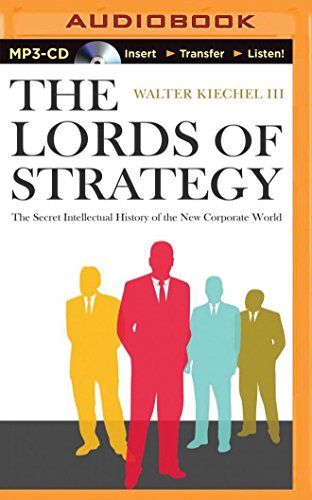
Lords of Strategy, The
Introduction: When Strategy Became Science
Introduction: When Strategy Became Science
Nova: Welcome to Strategy Unpacked. Today, we are diving into a book that reads like a corporate thriller, a history of how the modern C-suite learned to think: Walter Kiechel III’s "The Lords of Strategy."
Nova: : That title sounds intense, Nova. Usually, I think of strategy as something ancient, like Sun Tzu. What makes Kiechel’s version so secret and so modern?
Nova: That’s the hook! Kiechel argues that corporate strategy, as we know it—structured, analytical, data-driven—wasn't discovered; it was invented, largely between the 1960s and 1980s, by a handful of brilliant, often competing, thinkers. Before them, business planning was often just budgeting or wishful thinking. Kiechel calls it the 'secret intellectual history' because these foundational ideas, which now underpin every Fortune 500 company, were forged in the competitive fire of early consulting firms.
Nova: : So, this isn't just a history of consulting firms, but a history of how we learned to ask the right questions about business direction? That’s huge. If I’m a listener who thinks strategy is just about having a mission statement, why should I care about this book?
Nova: Because these ideas dictate where capital flows, where careers are made, and which companies survive. Kiechel shows us that the tools you use to decide whether to enter a new market or divest a division were literally invented by these 'Lords.' We’re talking about the birth of the analytical mindset that replaced gut feeling with frameworks. It’s the origin story of modern corporate power.
Nova: : I'm ready to meet these architects of modern business. Where does this saga begin?
Nova: It begins in the 1960s, a time when corporations were getting huge, complex, and frankly, a little lost. They needed a map. And that map was drawn by the first Lord we’ll discuss: Bruce Henderson of BCG.
Key Insight 1: Quantifying Experience
The First Lord: Bruce Henderson and the Experience Curve
Nova: Bruce Henderson, the founder of the Boston Consulting Group, or BCG, is often credited with kicking off the modern strategy revolution. His core insight was deceptively simple: cost declines predictably as cumulative production volume increases. He called this the Experience Curve.
Nova: : The Experience Curve. That sounds like a fancy way of saying 'practice makes perfect,' but for a whole company, right? How much did the cost actually drop?
Nova: Exactly! It’s not just practice; it’s a quantifiable law. Henderson found that for every doubling of cumulative output, costs—in real terms—would drop by a consistent percentage, often around 10 to 15 percent. Think about that: a predictable mathematical relationship between volume and efficiency. This was revolutionary because it turned cost reduction from a management goal into a predictive science.
Nova: : Wow. So, if a company knew its current cost structure and its potential market share, it could mathematically project its future cost advantage over competitors? That’s a massive competitive weapon.
Nova: It was the ultimate weapon! Henderson used this to argue that the company with the largest market share—the one that could learn the fastest by producing the most—would inevitably have the lowest cost structure and therefore the highest profitability. This directly fueled the concept of 'market share is destiny.'
Nova: : That sounds like it created a huge incentive for aggressive growth, maybe even at the expense of short-term profit, just to capture that learning advantage. Did this lead directly to the famous BCG Growth-Share Matrix?
Nova: It did! The Experience Curve provided the 'cost' side of the equation, and BCG combined it with the attractiveness of the market—the 'growth' side—to create the Matrix. Stars, Cash Cows, Question Marks, and Dogs. It was the first universally recognized visual tool for corporate portfolio management. Kiechel highlights how this simple four-box grid became the language of boardrooms globally.
Nova: : It’s incredible how one concept—the Experience Curve—spawned an entire management paradigm. But I imagine this focus on volume and market share created some enemies or at least some skeptics?
Nova: Absolutely. The book details how this approach was criticized for being too focused on volume over value, and for potentially leading to price wars that destroyed industry profitability. It was a powerful idea, but perhaps too blunt an instrument for every situation. It set the stage for the next Lord to offer a more nuanced view.
Key Insight 2: Diversifying the Strategic Toolkit
The Architects of Analysis: Bain, Gluck, and Porter
Nova: If Henderson was the revolutionary who brought math to strategy, the next wave focused on refining the application and broadening the scope. We move to Bill Bain, a BCG alumnus who founded Bain & Company. His focus was different: deep, actionable advice for the client.
Nova: : What was Bain’s main critique of BCG’s approach? Was it that the Experience Curve didn't apply everywhere?
Nova: Precisely. Bain saw that simply chasing market share wasn't enough. He focused on the concept of 'customer loyalty' and the idea that a small improvement in customer retention could have a massive impact on profitability—far more than just chasing volume. Kiechel notes that Bain & Company was built on the premise of delivering measurable, tangible results that stuck with the client long after the consultants left.
Nova: : That’s a fundamental shift from an abstract model like the Matrix to a direct client relationship focused on retention. Who was the third major player Kiechel profiles?
Nova: That would be Fred Gluck at McKinsey & Company. McKinsey, historically, was the established giant, focused on organizational structure and efficiency. Gluck pushed them to become the premier firm. While BCG was focused on cost and Bain on customer value, Gluck pushed McKinsey to adopt a more holistic, almost scientific, approach to defining the entire scope of the business.
Nova: : So, McKinsey became the master of process and structure applied to strategy. But the research also points to a fourth major influence, often linked back to BCG’s orbit, but distinct: Michael Porter.
Nova: Michael Porter is the intellectual heavyweight of this group. While Henderson gave us the 'where to play', Porter gave us the 'how to win' at the industry level. His Five Forces framework—Threat of New Entrants, Bargaining Power of Buyers and Suppliers, Threat of Substitutes, and Rivalry—became the de facto standard for industry analysis.
Nova: : The Five Forces. That’s probably the most taught concept in any introductory business course. It forces you to look outside your own company at the entire ecosystem. What was Porter’s big contribution that separated him from the others?
Nova: Porter’s genius, as Kiechel lays out, was moving strategy from the level—which is what the Matrix did—down to the level. He argued that competitive advantage comes from either being the low-cost producer or achieving differentiation, and you have to choose one path. He made strategy about positioning within a specific industry structure, not just about being the biggest player overall.
Nova: : So, we have Henderson saying 'Get big,' Bain saying 'Keep your customers happy,' Gluck saying 'Organize for success,' and Porter saying 'Understand the competitive anatomy of your industry.' That’s a powerful toolkit.
Nova: It is. And Kiechel shows us the friction between these approaches. For years, the consulting world was a battleground between the BCG approach, the McKinsey approach, and the emerging Bain approach, all fighting to define what 'strategy' truly meant.
Key Insight 3: From Concept to Corporate Mandate
The Tools That Changed Everything
Nova: Let's zoom in on one of the most enduring concepts that came out of this era, which Kiechel details extensively: the Experience Curve and its cousin, the Learning Curve. It’s easy to dismiss now, but in the 60s, it was a revelation.
Nova: : I remember hearing about the Learning Curve in manufacturing, but how did Henderson apply it to? It sounds like an operations concept.
Nova: That’s the brilliance. Henderson elevated it. He argued that the learning that drives cost reduction isn't just about the factory floor workers getting faster; it’s about the entire organization learning how to manage complexity, streamline distribution, and innovate processes as volume grows. It’s systemic learning.
Nova: : So, if Company A was producing 100,000 units and Company B was producing 50,000, Company A wasn't just cheaper per unit; they were fundamentally a organization because they had experienced twice the complexity. Is that right?
Nova: Exactly. And this directly informed the famous 'Cash Cow' in the Matrix. A product that was a 'Star'—high growth, high share—was expected to eventually mature into a 'Cash Cow,' generating massive free cash flow because its costs had been driven down by experience, allowing it to fund the next generation of 'Question Marks.'
Nova: : That’s a beautiful, self-sustaining narrative for a corporation. But what about the other side of the coin? Porter’s Five Forces—how did that change the day-to-day work of a CEO?
Nova: Porter forced CEOs to stop looking inward and start looking outward at the industry structure. Before Porter, a CEO might think, 'We need to cut R&D to save money.' After Porter, the question becomes, 'How powerful are our suppliers? If they raise prices by 20%, can we pass that cost on to our powerful buyers, or will our substitute products steal our customers?' It made strategy competitive, not just operational.
Nova: : It sounds like the consulting industry itself became a product of these ideas. Did the firms use their own frameworks to compete against each other?
Nova: They absolutely did. Kiechel shows that the firms were constantly trying to one-up each other. BCG had the Matrix, McKinsey had its rigorous analytical process, and Bain focused on proving ROI to the client. The competition wasn't just for clients; it was for intellectual dominance over the definition of strategy itself. It was a war fought with whiteboards and slide decks.
Nova: : It’s fascinating to think that the very existence of these firms—McKinsey, BCG, Bain—is a direct result of these four men successfully packaging abstract thought into sellable products. It’s strategy as a commodity.
Key Insight 4: Strategy in the Digital Age
The Enduring Legacy and Modern Relevance
Nova: We’ve covered the golden age of strategy invention, roughly 1960 to 1990. But the crucial question for today’s listener is: Do these 50-year-old frameworks still hold up in the age of AI, platform economies, and hyper-speed disruption?
Nova: : That’s what I was wondering. Does the Experience Curve still work when a software company can scale globally overnight with near-zero marginal cost? The rules of volume seem broken.
Nova: Kiechel addresses this by noting that the of the concept remains, even if the mechanics change. The Experience Curve has evolved into concepts like 'Network Effects' and 'Data Moats.' A modern platform company isn't learning how to make a widget cheaper; it's learning how to connect users more effectively, making its platform more valuable with every new user—a different kind of learning curve.
Nova: : So, the fundamental drive to achieve a structural advantage through accumulated experience—whether that experience is in manufacturing or in data processing—is still the core idea.
Nova: Precisely. And Porter’s Five Forces? They are more relevant than ever, but the 'Threat of Substitutes' is now instantaneous. A startup can create a substitute overnight using new technology. The analysis has to be faster, more dynamic, but the underlying logic of analyzing competitive forces remains the bedrock.
Nova: : What about the firms themselves? Are McKinsey, BCG, and Bain still fighting the same battles, or have they adapted?
Nova: They’ve adapted by absorbing new fields—digital transformation, sustainability, AI strategy. But Kiechel’s book serves as a reminder that their core value proposition—providing an external, objective, analytical lens—is what keeps them relevant. They are the institutional memory of strategic thinking. They are the ones who codified the rules, and now they are the ones paid to help companies rewrite them for the digital era.
Nova: : It sounds like the book is a necessary historical grounding. If you don't know how these concepts were born—the trade-offs and the arguments that went into them—you risk applying them blindly today.
Nova: That’s the ultimate takeaway. These weren't divine revelations; they were hypotheses tested in the real world, often with massive corporate stakes. Kiechel reveals the human drama, the egos, and the intellectual sparring that created the very DNA of modern corporate management. It’s a story of how ideas, packaged correctly, can reshape the world.
Conclusion: Mastering the Mindset
Conclusion: Mastering the Mindset
Nova: We’ve journeyed from the cost-cutting insights of Bruce Henderson at BCG to the structural analysis of Michael Porter, tracing the intellectual lineage of corporate strategy. What’s the single biggest lesson you’re taking away from the Lords of Strategy today?
Nova: : I think it’s the realization that strategy is a discipline, not a destination. It’s a set of tools that must be constantly re-evaluated. The Experience Curve was a powerful lens for the 70s, but today, we need to be asking: What is version of the Experience Curve? Is it data accumulation? Is it speed of iteration? The framework matters less than the rigor of the thinking behind it.
Nova: I agree completely. The key takeaway is that strategy is fundamentally about trade-offs and choices, codified by these pioneers. Whether you’re a CEO, a manager, or just an ambitious professional, understanding you use a certain framework—and what its inherent biases are—gives you a massive advantage over those who just follow the latest management fad.
Nova: : It forces us to be intellectually honest about our competitive position. We can’t just hope to be the biggest; we have to understand the mechanics of how size translates to advantage, or how positioning creates barriers to entry.
Nova: Absolutely. Kiechel’s book is a masterclass in intellectual history, showing us that the most powerful forces shaping our economy are often just well-articulated ideas. It’s a call to stop accepting strategy as a given and start treating it as the powerful, human-created discipline that it is.
Nova: : A fantastic deep dive into the foundations of modern business. I feel much better equipped to question the next strategy presentation I sit through.
Nova: That’s the goal. Thank you for unpacking the strategy revolution with me. This is Aibrary. Congratulations on your growth!