

** Mind Over Misery: Decoding the SEAL Mindset
Golden Hook & Introduction
SECTION
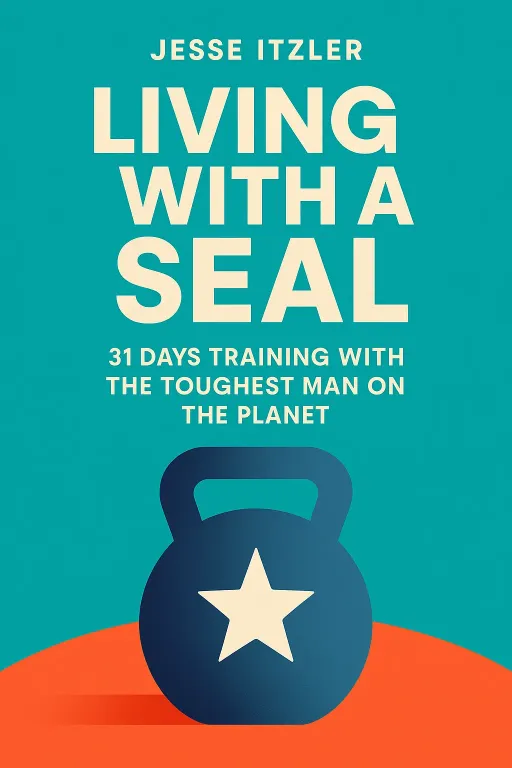
Socrates: How much of your life is lived on autopilot? You wake up, you work out, you go to work... it's a good life, a comfortable life. But what if that comfort is actually a cage? That's the question entrepreneur Jesse Itzler asked himself before he did something truly insane: he hired a Navy SEAL to live in his Manhattan apartment for 31 days with one rule: Jesse had to do everything he said. The result is a hilarious and brutal story, but we're here to look deeper. Today, we're going to tackle this book, 'Living with a SEAL,' from two different angles. First, we'll explore the '40% Rule' and the philosophy of using discomfort as a tool for growth. Then, we'll shift gears to analyze the 'SEAL Operating System'—the hyper-vigilant mindset that sees threats and targets everywhere.
Socrates: Chris, as someone who loves to deconstruct ideas, this book feels less like a memoir and more like a 31-day psychological experiment. What was your first impression of this premise?
Chris: My first thought was, it’s brilliant because it’s a forcing function. Most self-help is voluntary. You can read a book and decide not to do the hard thing. But by inviting this person into his home, Jesse Itzler created a system where he couldn't back out. He outsourced his willpower to someone who has an infinite supply of it. It's an extreme form of a commitment device.
Deep Dive into Core Topic 1: The '40% Rule' & Engineering Discomfort
SECTION
Socrates: Exactly. It's a system. And that system starts on Day 1. There's no handshake, no tour of the apartment. The man, who we'll just call SEAL, arrives at 7 a. m. without any luggage. He looks around Jesse's fancy Central Park West apartment and his first real question is, "You got a gym?" Within minutes, he has Jesse in the building's gym with a single, simple demand: "Give me a hundred pull-ups."
Chris: And Jesse isn't a pull-up guy. He's a marathon runner, but this is a different kind of strength.
Socrates: Not at all. He struggles to do eight. After a short rest, he can only do six more. He's gassed. He tells SEAL, "That's all I got." And SEAL just looks at him and says, "We're not leaving until you do one hundred." It takes Jesse ninety minutes. For the last thirty or so, he's doing them one… at… a… time. Just hanging there, getting one more. After, SEAL explains his philosophy, which he calls the '40% Rule.' He says, "When your mind is telling you you're done, you're really only at forty percent of what your body is capable of doing."
Chris: That's fascinating. So the exercise isn't really about the pull-ups, is it? It's about immediately shattering Jesse's mental 'governor.' The first thing SEAL does is prove to Jesse that his internal gauge for 'empty' is fundamentally wrong. He's establishing a new baseline for what 'done' means. He's teaching him that the feeling of 'I can't' is just a suggestion from his brain, not a physical fact.
Socrates: Right! And it's not a one-time lesson. He escalates it constantly. On Day 3, they get stuck overnight in Boston on a business trip. They have to run in the freezing cold, and Jesse, who didn't pack extra underwear, is chafing so badly he's literally bleeding. He's in agony. When they get back to New York that night, Jesse is exhausted and just wants to sleep. But SEAL looks at Jesse's comfortable bed and says, "You got to get out of your comfort zone, Jesse. Enough of this comfy shit." He makes him sleep in a hard, wooden chair with no armrests.
Chris: That's a classic pattern disruption. Our brains are wired for efficiency, which creates routines. We sleep in a bed, we eat at a table. But those routines can become ruts that limit our resilience. By forcing him to sleep in a chair, SEAL is attacking the most basic comfort routine we have. It’s a constant, low-level stressor designed to keep Jesse's mind and body off-balance and, therefore, more adaptable. He's not letting him settle.
Socrates: And the ultimate example of this comes on Day 25. Jesse's recovering from an injury, and SEAL suggests they treat it by jumping in a frozen lake. Not for any medical benefit, just for the challenge. They run down to the lake, SEAL breaks a hole in the ice with a giant rock, and jumps in. He yells at Jesse to follow. Jesse's wife, Sara, is watching from the house, horrified. She asks what the benefit is, and SEAL just yells back, "There is none, Sara! This is what your husband SIGNED UP FOR!"
Chris: And that's the key phrase. It's a voluntary hardship. He's choosing to enter a state of crisis in a controlled environment. Psychologically, this builds an incredible sense of agency and what's called 'stress inoculation.' If you can willingly walk into a frozen lake, the stress of a difficult business meeting or a bad sales quarter seems trivial in comparison. He's not just building muscle; he's recalibrating his entire internal scale of what constitutes a 'problem.'
Socrates: It's a mental workout disguised as a physical one.
Chris: Precisely. He's training his nervous system to handle extreme spikes of discomfort, which makes everyday stressors feel like nothing.
Deep Dive into Core Topic 2: The SEAL Operating System
SECTION
Socrates: And this idea of recalibrating your entire worldview brings us to the second, and maybe more unsettling, part of this: the SEAL's own mind. This isn't just a training philosophy he turns on and off; it's how he lives 24/7. It's a completely different operating system.
Chris: An OS programmed by a world with much higher stakes than most of us will ever face.
Socrates: Exactly. There's a story in the book where Jesse asks SEAL to drive them back from their lake house in Connecticut. Jesse is used to just driving, maybe listening to music. But when SEAL gets behind the wheel, he starts pointing at every single car that approaches them. An eighteen-wheeler, a minivan... it doesn't matter. He just mutters, "Target." Jesse asks him what he's doing, and SEAL explains, "That’s what they are to you. To me, they’re targets." He points to a mom with kids in a Honda and says, "You have no idea what the lady in that Honda can do. You’re too trusting."
Chris: That's a perfect illustration of a mind shaped by a specific, high-stakes environment. For most of us, other cars are just background noise, part of the landscape. For him, they are all potential variables in a threat matrix. It's an extreme version of situational awareness that's essential for survival in his world, but it must be absolutely exhausting to maintain in civilian life. His brain is constantly running threat-assessment algorithms.
Socrates: Exhausting is right. And it bleeds into everything. It even extends to home repair! A plumber comes to the house to give a quote on some tile work. SEAL thinks the price is too high and immediately concludes it's because the plumber Googled Jesse's fancy address and is trying to rip them off. So he confronts the guy. He's pounding his fist on the tile, yelling, "You Googled them! Well, Google me, motherfucker!" The plumber is, of course, terrified. He calls Jesse the next day, offering massive discounts, begging for mercy, saying he's contacted his lawyer.
Chris: It's a zero-tolerance policy for being perceived as a 'soft target.' In his world, any sign of weakness, naivety, or wealth that can be exploited, is a vulnerability that must be shut down immediately and forcefully. So his response, while wildly disproportionate for a plumbing quote, is perfectly logical within his own operating system. He's not negotiating a price; he's neutralizing a perceived threat to his perimeter.
Socrates: And that perimeter is always on his mind. Early on, he goes out and comes back with a huge camouflage backpack and four oars. He tells Jesse and his wife, "This is our escape vehicle." Inside is an inflatable raft. His plan is that if there's another 9/11-type event and the bridges and tunnels are closed, they can carry this raft to the Hudson River and paddle to New Jersey.
Chris: And again, it's about probability versus possibility. For most of us, the probability of that specific scenario is so low that we don't prepare for it. For him, if it's, it must be prepared for. It's a fundamentally different way of assessing risk, and it's what makes him who he is. It's not paranoia in the clinical sense; it's a highly trained, professional vigilance that doesn't have an off-switch.
Synthesis & Takeaways
SECTION
Socrates: So when you put it all together, we have these two powerful, intertwined ideas. First, that we can engineer our own growth by strategically embracing discomfort and breaking our routines.
Chris: And second, that extreme environments create these extreme mindsets. By analyzing them, we can understand the underlying principles of resilience and vigilance, even if we don't need to apply them to the same terrifying degree.
Socrates: I think that's the big takeaway. The book isn't an instruction manual to become a Navy SEAL. It's a mirror. It makes you ask: Where am I too comfortable? Where have I set my own limits far too low? It forces you to look at your own routines and question them.
Chris: Exactly. So the question for everyone listening isn't 'Should I jump in a frozen lake?' It's 'What is my version of the hard wooden chair?' What's one small, safe, but uncomfortable thing you can do this week to intentionally disrupt your routine and see what's on the other side?
Socrates: It could be taking a cold shower. It could be finally having that difficult conversation you've been avoiding. It could just be taking the stairs instead of the elevator.
Chris: Right. It's about building that 'discomfort muscle' in small ways, so that when a real challenge comes along, you're not starting from zero. You've already taught your brain that discomfort is survivable. That it's temporary. And that's a lesson worth more than a thousand pull-ups.









