

Unlocking Your Brain's Potential: How Neuroscience Boosts Learning and Performance
Golden Hook & Introduction
SECTION
Nova: What if I told you that the biggest lie you've ever been told about your brain isn't that you can't teach an old dog new tricks, but that you that old dog?
Atlas: Whoa, Nova, that's a bold claim. Are you saying my brain isn't already set in stone, especially after all these years of... well, using it? I imagine a lot of our listeners feel like their learning capacity has plateaued.
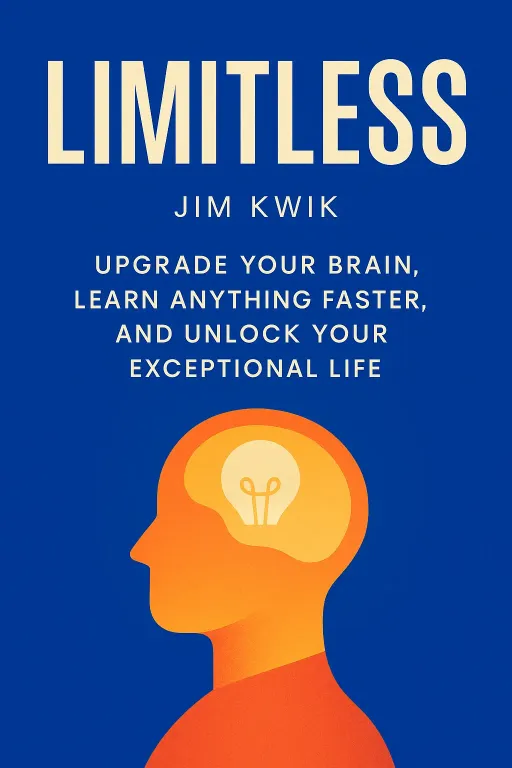
Nova: Absolutely. And that's exactly what we're dissecting today, starting with Jim Kwik's transformative work in his book, "Limitless." Kwik, who overcame significant learning disabilities after a childhood brain injury, became a global expert in brain performance. His entire life story is a living testament to neuroplasticity.
Atlas: That's incredible. So it's not just theory; it's born from personal triumph. That gives it such a powerful foundation. And we're also delving into John Medina's "Brain Rules," right? The scientific side from a developmental molecular biologist.
Nova: Precisely. Two powerful perspectives on brain optimization, perfectly complementing each other to show us how to truly unlock our mental agility.
Unlocking Your Inner 'Limitless' Learner
SECTION
Nova: Kwik's journey started from a place of profound struggle. As a child, a head injury left him with severe learning difficulties. He was told he'd never be able to read or function normally. But instead of accepting that verdict, he embarked on a relentless quest to understand his own brain. His breakthrough came when he realized that the problem wasn't his intelligence, but his.
Atlas: That's fascinating. I can definitely relate to feeling like my methods are holding me back sometimes, especially when tackling complex new fields like behavioral economics. So what did he discover about these "methods" that transformed his learning?
Nova: He identified three crucial M's: Mindset, Motivation, and Methods. Mindset is about unlearning those limiting beliefs we just touched on – the "I'm not smart enough" or "I have a bad memory" narratives that hold us back. He argues these aren't facts; they're habits of thought.
Atlas: Okay, but how do you actually "unlearn" something so ingrained? I imagine a lot of our listeners, especially those managing high-pressure situations or looking to lead in future-focused roles, might hear 'unlearn limiting beliefs' and think, 'Easier said than done.' We're not exactly sitting around with endless time for introspection.
Nova: That's where the 'Methods' come in. Kwik offers practical, actionable techniques. Take active recall, for instance. Instead of passively re-reading notes, you actively test yourself. After reading a paragraph, close the book and try to explain what you just read in your own words. Or spaced repetition: reviewing information at increasing intervals. These aren't just tricks; they're based on how our memory actually works.
Atlas: So basically, you're saying our brain is like a muscle, and these are targeted exercises? Like instead of just lifting weights randomly, you're doing specific movements that build strength more efficiently. Can you give an example of how something like active recall plays out in real life?
Nova: Think about trying to learn a new language. Most people just drill vocabulary lists. But with active recall, after learning five new words, you'd immediately try to recall them without looking. Then you'd try again a few minutes later, then an hour, then a day. It forces your brain to retrieve the information, which strengthens the neural pathways far more effectively than simply rereading. It's about making your brain for the answer.
Atlas: That makes sense. It's like the difference between just looking at a map versus actually navigating a new city yourself. The latter builds a much stronger mental model. So, Kwik is really about empowering us to take charge of our own cognitive processes, almost like upgrading our personal operating system.
Nova: Exactly! He emphasizes that memory, focus, and rapid learning aren't inherent talents; they're skills you can cultivate. And his personal story, going from 'the boy with the broken brain' to teaching CEOs and celebrities how to learn faster, powerfully illustrates that. It's about trusting your inner compass that growth is possible, no matter your starting point.
Brain-Friendly Learning: Applying Biological Rules to Life
SECTION
Nova: And that naturally leads us to the second key idea we need to talk about, which often acts as a biological underpinning to what Kwik teaches: John Medina’s "Brain Rules." Medina, as a developmental molecular biologist, approaches learning from a deeply scientific perspective, explaining how our brains are wired for survival and how we can leverage these innate rules.
Atlas: Oh, I love that. So if Kwik gives us the "how-to" for mental upgrades, Medina explains the "why" from a biological standpoint. What are some of these foundational "rules" he talks about?
Nova: One of the most striking rules is about movement. Our brains evolved to move. He points out that physical activity significantly boosts cognitive function, improves memory, and reduces stress. Think about our hunter-gatherer ancestors – they weren't sitting at desks for eight hours a day.
Atlas: That's actually really interesting. It makes me wonder about the implications for strategic planning meetings or intense learning sessions. So if our brains are wired for survival and movement, how does that translate to, say, a leader trying to absorb complex strategic planning documents, or someone trying to master behavioral economics? It feels like our modern learning environments are almost designed our brain's natural wiring.
Nova: They often are! Medina also highlights the "10-minute rule" for attention. Our brains aren't designed for sustained, uninterrupted focus for long periods. After about 10 minutes, attention drops significantly unless there's an emotional hook or a change in stimulus. This means those hour-long lectures or back-to-back meetings are often incredibly inefficient.
Atlas: Whoa, that's a tough pill to swallow for anyone in a corporate environment. So what's the practical implication? Are we supposed to do jumping jacks in the middle of a board meeting?
Nova: Not necessarily jumping jacks, but definitely incorporating breaks, changing the activity, or introducing novelty. For instance, in a long learning session, every 10-15 minutes, you could shift from listening to discussing, or from reading to writing. Make it interactive, make it emotionally engaging. Medina emphasizes that emotion is a powerful memory enhancer. If you want something to stick, attach an emotion to it.
Atlas: That's a great way to put it. Emotion as the superglue for memory. It also makes me think about the importance of sleep, which Medina heavily emphasizes, right? It's not just downtime; it's active brain work.
Nova: Absolutely. Sleep is when our brains consolidate memories, flush out toxins, and essentially "reboot." Chronic sleep deprivation is a cognitive disaster. Medina's work really underscores that ignoring these biological imperatives isn't just suboptimal; it's actively working against our own brain's design. It's about creating environments and habits that how our brains are wired, rather than fighting against them.
Synthesis & Takeaways
SECTION
Nova: So, what we're really seeing is that both Kwik and Medina are pointing to the same profound truth: your brain is a dynamic, evolving organ, not a static hard drive. The limits are often self-imposed beliefs or products of environments that ignore our biological design.
Atlas: That's actually really inspiring. It means we have far more agency over our intellectual growth than we often assume. No wonder these books are so highly acclaimed for empowering people. It's about moving from passive learning to active mastery, making our growth self-directed and consistent. But what's the one thing our listeners, those future-focused leaders and curious explorers, can do this week?
Nova: My challenge, directly from Kwik's approach, is to pick just one new learning technique – say, active recall or spaced repetition – and apply it to something you're currently trying to learn. Just for one week. See what happens when you actively engage your brain's incredible capacity. It's about dedicating specific time blocks for this learning, protecting that time.
Atlas: A tiny step with potentially limitless impact. I love that. It's about empowering that inner compass, right? Trusting your own unique journey and embracing the process of growth, not just the destination.
Nova: Exactly. It's about moving from passive consumption to active mastery. And understanding these brain rules and methods can make that journey not just effective, but genuinely exciting.
Atlas: Fantastic. That's a powerful call to action for anyone looking to boost their mental agility.
Nova: This is Aibrary. Congratulations on your growth!









