

The End of the 'A' Student
Introduction
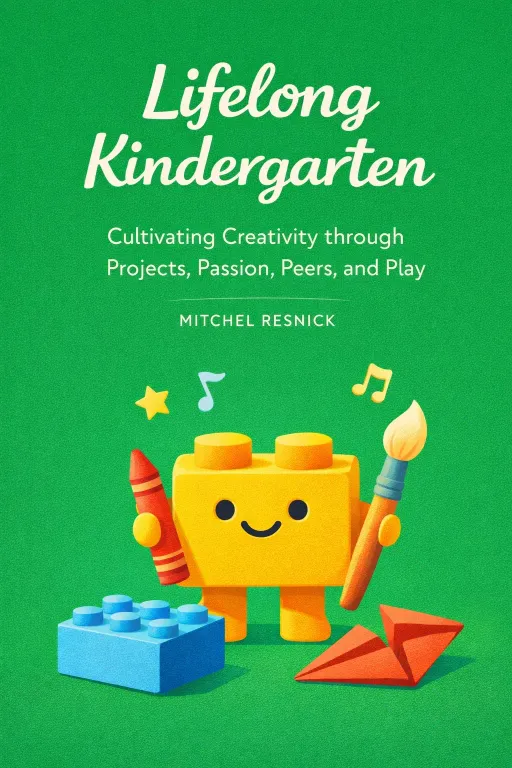
Narrator: Imagine the president of China's top engineering university, a place renowned for producing students with perfect grades, admitting a profound failure. In 2013, Chen Jining, then-president of Tsinghua University, confessed that his system was excellent at creating "A students"—those who master existing knowledge and follow instructions flawlessly. But society, he argued, no longer needed more A students. It needed "X students"—creative, innovative risk-takers who could define their own problems and invent new solutions. This startling admission from a leader at the pinnacle of traditional academic success highlights a global crisis in education: our schools are preparing students for a world that no longer exists. The search for a new model, one that cultivates this elusive "X-style thinking," is the central quest of Mitchel Resnick's book, Lifelong Kindergarten: Cultivating Creativity through Projects, Passion, Peers, and Play. Resnick, a professor at the MIT Media Lab, provides a compelling blueprint for how to nurture the creative spirit not just in children, but in learners of all ages.
The Crisis of the 'A Student' and the Need for the 'X Student'
Key Insight 1
Narrator: The modern world is defined by accelerating change, where, as one estimate suggests, two-thirds of today's grade-schoolers will work in jobs that haven't been invented yet. In this landscape, the ability to follow instructions and regurgitate known facts—the hallmark of the "A student"—is becoming obsolete. The most valuable skill is the ability to think and act creatively. This is the core problem identified by leaders like Tsinghua's Chen Jining. He saw that his graduates, despite their academic brilliance, were unprepared for a world that demands innovation.
Resnick argues that the solution is to foster "X students." These are not students who are merely better at taking tests, but individuals who are driven by curiosity, willing to experiment, and comfortable with ambiguity. They don't just solve problems; they find and frame them. The book makes a powerful case that our educational systems, with their intense focus on standardized testing and right answers, are actively stifling the development of these essential creative capacities. The pressure to perform is turning even kindergarten into what some call "literacy boot camps," stripping away the very elements of exploration and play that are most crucial for development.
The Four P's of Creative Learning
Key Insight 2
Narrator: To cultivate these "X students," Resnick proposes a framework built on what he calls the "Four P's of Creative Learning." These are the essential conditions for creativity to flourish. First is Projects. People learn best when they are actively working on meaningful projects, creating something they can share. Second is Passion. When people work on projects they genuinely care about, they work longer, harder, and are more willing to overcome obstacles. Third is Peers. Creativity is a social process. Learning and creating with others, whether through collaboration or sharing and building on each other's work, is fundamental. And fourth is Play. This isn't just about fun; it's about a playful, experimental mindset—the willingness to tinker, take risks, and try new things.
These four principles fuel what Resnick calls the "Creative Learning Spiral": a process where a person imagines an idea, creates a project based on it, plays with the creation, shares it with others, and then reflects on the experience and feedback, which in turn leads to new ideas to imagine. This iterative cycle is the engine of creative development.
Learning Through Making: The Power of Projects
Key Insight 3
Narrator: The book positions "learning through making" as the cornerstone of a creative education. This idea, rooted in the work of educational pioneer Seymour Papert and his theory of "constructionism," posits that people build knowledge most effectively when they are actively building things in the real world. As they construct a sandcastle, a robot, or a computer program, they are simultaneously constructing new ideas and understanding in their minds.
Resnick contrasts this with passive, consumption-based activities. He uses the example of the movie Toy Story to illustrate the point. Andy's room is filled with sophisticated toys that "think," limiting him to a consumer role. In contrast, his neighbor Sid, though portrayed as a villain, is a "maker of toys," taking them apart and creating new, unexpected things. Resnick argues that Sid, the tinkerer, is the one truly developing as a creative thinker. This is why project-based schools like Brightworks in San Francisco are so effective. When students build a theater stage or a covered wagon, they learn math, physics, and history not as abstract subjects, but in a rich, meaningful context that makes the knowledge stick.
Fueling the Fire: How Passion Drives 'Hard Fun'
Key Insight 4
Narrator: Passion is the fuel for the creative engine. The book tells the origin story of the Computer Clubhouse, a global network of after-school learning centers. The idea was sparked when a group of children became so engrossed in a temporary LEGO robotics exhibit at a museum that, after it was removed, they were found trying to sneak back in just to continue their projects. Their intense, intrinsic motivation demonstrated that when learning is connected to personal interests, it becomes irresistible.
This deep engagement leads to what Seymour Papert called "hard fun"—the satisfaction that comes from wrestling with a difficult challenge that you are passionate about. A 13-year-old named Leo, for instance, was desperate to add a scoring system to a game he was building in Scratch. The abstract concept of a "variable," which might be boring in a math class, became intensely exciting because it was the key to solving his problem. This contrasts sharply with "gamification," the use of points and badges to motivate learning. Resnick argues that such extrinsic rewards are like caffeine—they provide a short-term jolt but can ultimately undermine long-term, genuine interest.
From Solo Thinkers to Collaborative Creators: The Role of Peers
Key Insight 5
Narrator: Creativity is rarely a solo act. The book powerfully illustrates this by comparing two computer-access initiatives in Jordan. The government-run "Knowledge Stations," with computers in rigid rows facing a teacher, were consistently empty. In contrast, the Computer Clubhouse in Amman, with its clustered computers, wheeled chairs, and central collaboration table, was always bustling. The physical design either encouraged or inhibited peer learning.
This collaborative spirit is even more evident in the online Scratch community, where millions of young people share their projects. The platform is designed for "remixing"—allowing anyone to see the code behind a project and build upon it. A simple Tetris game, for example, was remixed over 700 times, with each new version adding features like scoreboards, new levels, and improved controls. This open, collaborative environment turns every project into a potential tutorial and every user into a potential teacher, creating a "samba school" for the digital age where everyone learns by participating.
Beyond Fun and Games: Play as a Mindset for Innovation
Key Insight 6
Narrator: The final "P" is Play, which Resnick defines not as a specific activity, but as a mindset of experimentation and risk-taking. He uses the metaphor of a "playpen" versus a "playground." A playpen is safe but restrictive, offering limited options, much like a paint-by-numbers kit. A playground, however, is an open environment that encourages exploration, imagination, and invention, like a box of LEGO bricks. Creative learning requires playground-style environments.
This playful mindset is best seen in the act of "tinkering." The book tells the story of Nicky, a fourth-grader building a LEGO car whose motor accidentally fell off. Instead of seeing it as a failure, Nicky became fascinated by the vibrating motor and began experimenting, eventually creating an innovative "vibrating walker." He embraced the unexpected. This willingness to be wrong, to debug, and to iterate is central to developing what psychologist Carol Dweck calls a "growth mindset"—the belief that abilities can be developed through dedication and hard work.
Building a Creative Society, One Playground at a Time
Key Insight 7
Narrator: The ultimate goal of Lifelong Kindergarten is to foster a "creative society." The book holds up the preschools of Reggio Emilia, Italy, as a living example. There, children are seen as competent citizens from birth, capable of exploring the world through their "hundred languages" of expression—drawing, sculpting, music, and more. They engage in long-term, collaborative projects that are deeply integrated into their community, such as designing new curtains for the city's opera house.
Achieving this vision on a broader scale requires a systemic shift. Resnick provides actionable tips for parents, teachers, and designers on how to create these fertile environments. For parents and teachers, it means asking authentic questions instead of testing for right answers and emphasizing the process over the final product. For designers, it means creating tools with "low floors" (easy to get started), "high ceilings" (room to grow), and "wide walls" (supporting many different types of projects). While the structural barriers in our current educational system are immense, Resnick remains optimistic that the accelerating need for creativity will eventually force this necessary transformation.
Conclusion
Narrator: The single most important takeaway from Lifelong Kindergarten is a radical inversion of our current educational trajectory. For decades, the trend has been to make kindergarten more like the rest of school—more structured, more academic, more focused on assessment. Mitchel Resnick argues that we must do the exact opposite: the rest of school, and indeed the rest of life, must become more like kindergarten. The principles of creative exploration, joyful discovery, and social collaboration that define the best kindergarten experiences are the very skills needed to thrive in the 21st century.
The book's ultimate challenge is not just to reform schools, but to change our own mindsets. It asks us to look at our workplaces, our communities, and our own learning habits and question: are we creating playpens or playgrounds? By embracing the spirit of lifelong kindergarten, we can begin to cultivate the creativity, resilience, and collaborative spirit needed to build a more innovative and equitable future for everyone.