

The Lifelong Playground: Fostering Human Creativity in the Age of AI
Golden Hook & Introduction
SECTION
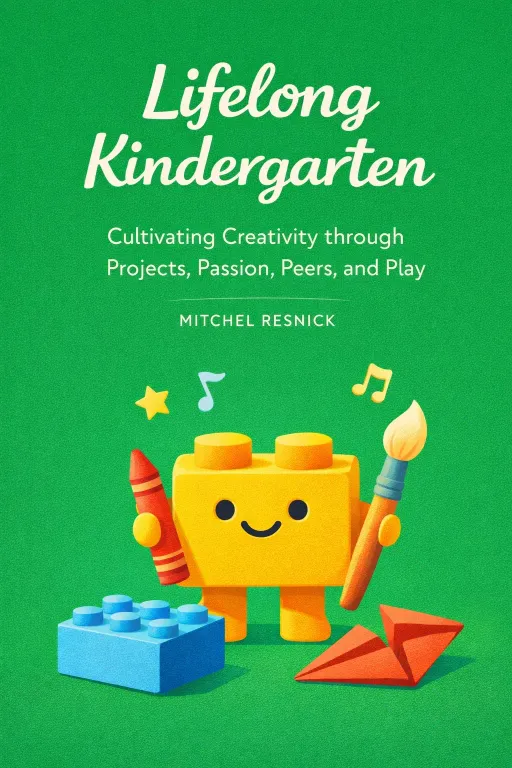
Nova: What if the most successful students in our schools are actually the least prepared for the future? Back in 2013, the president of Tsinghua University, China's top engineering school, met with Mitchel Resnick at the LEGO headquarters in Denmark. He made a shocking admission. He said his university was packed with "A students" who excelled at exams but lacked the creative, innovative spirit needed to succeed in today's rapidly changing society. What the world actually needs, he argued, are "X students"—risk-takers who are willing to define their own problems and try new things. Today, we are going to tackle Mitchel Resnick's incredible book,, from three different angles. First, we'll look at the Creative Learning Spiral and why we need to treat all of life like kindergarten. Second, we'll break down the "Four Ps"—Projects, Passion, Peers, and Play—and why gamification might actually be killing our creative drive. And finally, we'll explore how we can design AI to be a playground for human growth, not just a high-tech playpen. I'm Nova, and joining me today is Frank Wu, co-founder of Aibrary, a Harvard Master in Public Policy graduate, and a dad to a wonderful three-year-old girl. Frank, welcome!
Frank Wu: Thanks, Nova! It is so great to be here. You know, that Tsinghua story really hits home for me, both as an education entrepreneur and as a dad. We live in a world where Cathy Davidson estimates that roughly two-thirds of today's grade-school students will end up doing work that hasn't even been invented yet. If we are just training kids—or ourselves—to get "A's" by following instructions, we are preparing them for a world that no longer exists. We need to cultivate that "X" factor, that raw, adaptive creativity. And honestly, the best model we have for that isn't a high-tech university lecture hall. It's a kindergarten classroom.
Nova: It's so true! Resnick argues that the rest of school, and really the rest of life, should be more like kindergarten. But before we dive into how we do that, let's talk about what kindergarten actually. Or at least, what it was meant to be.
Deep Dive into Core Topic 1
SECTION
Nova: Resnick takes us back to 1837, when Friedrich Froebel opened the world's very first kindergarten in Germany. Before Froebel, school was basically a "broadcast" system. The teacher stood at the front and poured information into the children like water into a vase. But Froebel had this radical idea: children learn best by interacting with their environment. So, he designed these physical toys called "Froebel's Gifts"—things like geometric wooden blocks, colored papers, and sticks and peas. The kids weren't just playing; they were "re-creating" the world. They were mixing art, design, science, and engineering without even realizing it.
Frank Wu: Yes! And what's fascinating is how those simple physical gifts influenced some of the greatest minds of the twentieth century. Frank Lloyd Wright, the legendary architect, actually credited his childhood play with Froebel's blocks as the foundation for his architectural style. Buckminster Fuller did the same with the sticks and peas, which helped him conceptualize the geodesic dome. Froebel understood that "recreation" and "re-creation" are deeply connected. But here's the tragedy, Nova. Today, we are seeing the exact opposite happen. Kindergarten is becoming like the rest of school.
Nova: Oh, absolutely. People are calling them "literacy boot camps."
Frank Wu: Exactly! We're seeing sand tables and block areas being replaced by phonics flashcards and math worksheets. There was a veteran kindergarten teacher, Susan Sluyter, who resigned in 2014 because she couldn't bear to watch the shift from "hands-on exploration, investigation, and joy" to "testing, data collection, and competition." We are taking the one part of the education system that actually worked for creativity and turning it into a factory assembly line. And as a dad of a three-year-old, I see this daily. When my daughter plays with her blocks, she isn't following a manual. She's imagining a castle, building it, watching it fall, laughing, and then rebuilding it differently. That is the "Creative Learning Spiral" in action.
Nova: Let's break down that spiral, because Resnick says it's the engine of creative thinking. It goes: Imagine, Create, Play, Share, Reflect, and then back to Imagine.
Frank Wu: Right. Think about how a child plays with blocks. First, they a tower. Then they it by stacking the blocks. They with it, maybe testing how high it can go. They it with a friend or a parent, saying, "Look what I made!" They on why it fell over when they added that last block. And that reflection sparks a new idea, so they a new design and start the spiral all over again.
Nova: It sounds so simple, but it's incredibly profound. And Resnick's research group at the MIT Media Lab—which is literally called the "Lifelong Kindergarten" group—uses this exact same spiral for their graduate students and the technologies they build, like Scratch.
Frank Wu: And that's the key. The spiral isn't just for five-year-olds. It's for fifty-year-olds, too. Whether you are a software engineer debugging code, a marketer designing a campaign, or an entrepreneur building a startup, you are constantly cycling through this spiral. But to make this spiral spin, you need the right environment. And that brings us to Resnick's "Four Ps" of creative learning: Projects, Passion, Peers, and Play.
Deep Dive into Core Topic 2
SECTION
Nova: Let's start with the first two Ps: Projects and Passion. Resnick argues that we don't learn creative thinking by learning isolated skills. We learn it by working on that we have a deep for. He contrasts this with the way coding is often taught today. A lot of schools use coding "puzzles" where kids program a virtual character to navigate a maze. Resnick says that's like teaching writing by only doing grammar drills. Sure, you learn the syntax, but you don't learn how to express yourself.
Frank Wu: Oh, I love that analogy. Coding, like writing, is a medium for expression. When you write, you don't just write sentences; you write stories, poems, or essays that mean something to you. It should be the same with technology. Take the story of MahoAshley, an eleven-year-old girl who was one of the early users of Scratch. She was obsessed with Japanese anime. She didn't care about "computer science" in the abstract. But she wanted to make her anime characters move, dance, and talk. So, she started creating animated stories. She ended up making over two hundred projects! She learned complex programming concepts like variables and conditionals, not because they were on a test, but because she needed them to bring her passion to life.
Nova: And she didn't do it alone, which brings us to the third P: Peers. MahoAshley shared her projects on the Scratch online community. She got feedback, she ran character design contests, and she even created tutorials to teach others how to draw anime.
Frank Wu: That peer aspect is so critical. We often have this "Rodin's Thinker" image of creativity—the solitary genius sitting alone in a room, waiting for an "Aha!" moment. But Resnick says creativity is highly collaborative. It's about "make-it-together" rather than "think-it-yourself." He compares the Scratch community to a "samba school" in Brazil, where people of all ages and skill levels come together to create a carnival parade. The beginners learn from the experts, the experts get inspired by the beginners, and everyone is learning in a social, supportive environment.
Nova: Yes! And to make that social environment work, you need a "culture of caring." I was so moved by the story of Sam, a nine-year-old Scratcher. When researchers asked him what it meant to be a "good Scratcher," he didn't talk about coding skills. He said the most important thing is "to not be mean" in the comments and to "comment on something good when you came across it."
Frank Wu: That is beautiful. And it's not accidental. The Scratch team actively moderates the site and models that behavior because they know that without emotional safety, people won't take creative risks. If you're afraid of being mocked, you'll stay in your comfort zone. You'll build a "playpen" instead of a "playground."
Nova: Ah, the "playpen vs. playground" metaphor! That's from Marina Bers, right? Can you explain that?
Frank Wu: Yes, it's a brilliant distinction. A playpen is a restrictive environment. It keeps the child safe, but it limits their exploration. They can only interact with the few toys you put inside. A playground, on the other hand, is open-ended. It encourages kids to run, climb, collaborate, and invent their own games. A lot of educational technology today is designed like a playpen. Think of those adaptive learning apps that guide a child through a linear sequence of math problems, giving them points and badges for correct answers. It's highly structured, but it doesn't give the child any agency. They are just consuming. We need to design "playgrounds"—tools like Scratch or LEGO Mindstorms—where kids can build, tinker, and express their own ideas.
Nova: And that brings us to the fourth P: Play. But not just play as "having fun." Resnick defines playfulness as an of mind—a willingness to experiment, take risks, and test boundaries. He shares the story of Nicky, a fourth-grader who was trying to build a LEGO car. During the process, the motor fell off and started vibrating across the table. Now, in a traditional classroom, that might be seen as a "failure" or a mistake. But Nicky was tinkering. He got intrigued by the vibration. He decided to pivot. He mounted the motor on "legs" and added a hinged arm, using his skateboarding experience to figure out how to steer it. He ended up creating a "vibrating walker."
Frank Wu: That is the essence of tinkering! It's a bottom-up, iterative process. You start with a vague idea, you mess around with materials, you take advantage of unexpected occurrences, and you continuously revise your plans. It's the opposite of the traditional "top-down" planning we are taught in school, where you have to have a perfect blueprint before you start. In the real world, the most innovative designs come from tinkering. Joi Ito, the former director of the MIT Media Lab, has this great quote: "You don't get lucky if you plan everything."
Nova: I love that! But Frank, how do we foster this tinkering mindset when our entire education system is obsessed with standardized testing? Resnick points out the irony of Singapore. Their students consistently rank at the very top of international exams like PISA. But Singaporean business leaders complained that graduates lacked adaptability and creativity when faced with unexpected real-world challenges. They were great at solving well-defined problems, but helpless when the problems were messy and undefined.
Frank Wu: It's a classic policy failure. We measure what is easy to count, not what actually counts. Standardized tests measure rote memorization and instruction-following. They don't measure creative thinking, persistence, or collaboration. As the sociologist William Bruce Cameron said, "Not everything that can be counted counts, and not everything that counts can be counted." If we want to cultivate creative thinkers, we have to change how we assess learning. We need to move toward qualitative assessments, like portfolios, where students document their creative process, their reflections, and their iterations over time.
Deep Dive into Core Topic 3
SECTION
Nova: This is where your work at Aibrary becomes so relevant, Frank. You are building Agentic AI for Personal Growth. When most people think of AI in education, they think of "personalized learning" in the playpen sense—an AI tutor that delivers customized lectures and quizzes to help you memorize facts faster. But how do we apply the "Four Ps" and the "Lifelong Kindergarten" philosophy to AI design? How do we build an AI "playground"?
Frank Wu: That is the million-dollar question, Nova. And it goes back to Seymour Papert, who was Mitchel Resnick's mentor and the "patron saint" of the maker movement. In his 1980 book, Papert wrote about the difference between "the computer being used to program the child" and "the child programming the computer." In the first scenario, the computer is in control; it's just a high-tech teaching machine. In the second scenario, the child is in control; the computer is a tool for creation and expression.
Nova: Hmm. So how does that apply to AI?
Frank Wu: Well, right now, a lot of generative AI is being used in a "playpen" way. You type a prompt, and the AI instantly gives you a finished product—a written essay, a piece of art, or a coded program. The user is just a passive consumer of the AI's output. The "perspiration" and the "iteration" are gone. But as Thomas Edison said, "Creativity is one percent inspiration and ninety-nine percent perspiration." If the AI does all the perspiration, we lose the learning. At Aibrary, we are trying to design AI as a in the Creative Learning Spiral. We want the AI to act as a "catalyst" and a "connector," not just an answer-machine.
Nova: Oh, tell me more about that. How does an AI act as a catalyst or a connector?
Frank Wu: Think about the four roles of good teaching that Resnick outlines: Catalyst, Consultant, Connector, and Collaborator. An AI shouldn't just give you the answer. It should act as a by asking open-ended, authentic questions to spark your imagination. It should act as a by offering subtle design tips or debugging advice when you get stuck, rather than doing the work for you. It should act as a, linking you to other human peers who share your passions, so you can collaborate. And it should act as a, working alongside you on projects, allowing you to tinker and iterate. We want to use AI to expand the "walls" of learning. Resnick talks about "low floors" and "high ceilings", but also "wide walls"—supporting many different pathways and styles of learning. AI has the potential to create incredibly wide walls, helping every individual find a unique, passion-driven path to personal growth.
Nova: That is a beautiful vision. It reminds me of Jaleesa's story in the book. She started at the Tacoma Computer Clubhouse with no interest in technology; she just wanted to "do hair." But her coordinator, Ms. Luversa, didn't force her into a rigid coding curriculum. She supported Jaleesa's interests, gently pushing her to explore. Jaleesa ended up creating interactive CD-ROMs for Black History Month and. She went on to major in Human-Centered Design and Engineering, interned at Microsoft, and eventually returned to run that very same Clubhouse! She waited for the youth to see a reason to learn, rather than forcing it.
Frank Wu: Exactly! Ms. Luversa was a master of balancing freedom and structure. She didn't just leave Jaleesa alone, but she didn't dictate her path either. She "employed structure in a way that amplified learner agency." That is what we need to build into our technology and our parenting.
Synthesis & Takeaways
SECTION
Nova: We've covered so much ground today, Frank. We talked about the shift from "A students" to "X students," the power of the Creative Learning Spiral, the "Four Ps"—Projects, Passion, Peers, and Play—and how we can design AI to be a playground for lifelong learning. If you had to leave our listeners with one actionable piece of advice, what would it be?
Frank Wu: I would say, whether you are a parent, an educator, or a lifelong learner yourself, try to shift your relationship with technology from consumption to creation. Next time you or your child are using a digital tool, ask yourself: "Is this a playpen or a playground? Am I just consuming someone else's story, or am I building my own?" Let's embrace the messiness of tinkering. Let's not be afraid to make mistakes, because as that teenage Scratcher said, "Getting something wrong is the best thing you can do, because it leads to solving the challenge, or the computer does something weird you didn't expect, and now you're pursuing a new path." Let's keep our inner kindergartener alive.
Nova: What a perfect note to end on. Frank, thank you so much for sharing your insights and your passion with us today.
Frank Wu: Thank you, Nova. This was a blast!
Nova: And to our listeners, thank you for joining us on this journey through. Go out there, find a project you love, tinker with it, share it with a friend, and never stop playing. Until next time!