

The Hidden Logic of Life: Why Organic Chemistry Isn't Just About Carbon
Golden Hook & Introduction
SECTION
Nova: Most of us remember organic chemistry as a blur of hexagons and squiggly lines from school. Maybe you thought it was just about memorizing reactions, or perhaps you even dreaded the class.
Atlas: Oh, I know that feeling! For anyone who's ever looked at a benzene ring and thought, "That's just a fancy circle," I'm with you. It often felt like a collection of isolated facts.
Nova: Exactly. But what if I told you those squiggles, those carbon chains, are actually the secret language of evolution, written into the very fabric of life? That organic chemistry isn't just a technical subject, but the foundational explanation for everything biological?
Atlas: Whoa. That's a pretty bold claim, Nova. I'm intrigued. You're saying we've been missing the 'why' behind the 'what' all along?
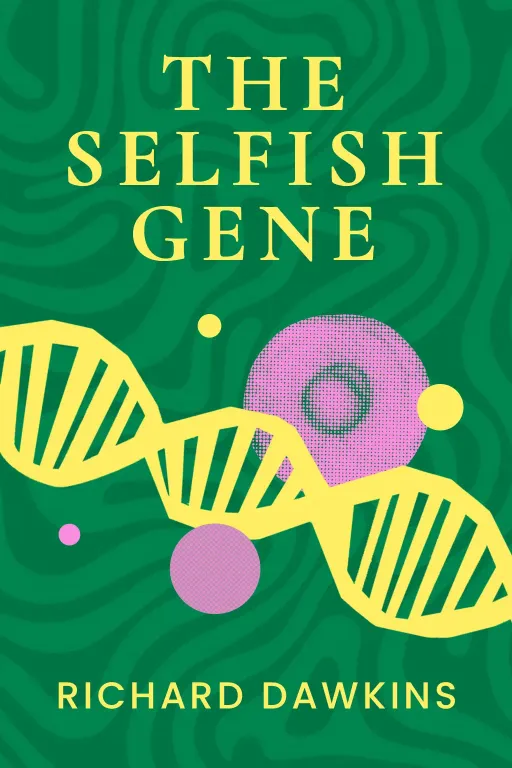
Nova: Absolutely. And that's what we're really digging into today, inspired by the profound insights found in works like Richard Dawkins' seminal book, "The Selfish Gene." That book, published decades ago, famously popularized the gene-centric view of evolution, fundamentally reshaping how we understand biology and our place within it. It’s not explicitly about organic chemistry, but it sets the stage for seeing life as a chemical dance.
Atlas: I can see how that would shift your perspective. But for someone like me, who tends to build knowledge from the ground up, how do we get from a textbook full of reactions to the grand narrative of life? Where do we even start to unpack that "blind spot" you mentioned?
Organic Chemistry: The Engine of Life and Evolution
SECTION
Nova: That's a perfect question, Atlas, because it brings us right to our first big idea: organic chemistry as the dynamic engine of life and evolution. Think of it this way: traditional organic chemistry often presents molecules as static structures, like blueprints. But Dawkins, in his work, implicitly asks us to see them as dynamic, self-replicating entities.
Atlas: So you're saying a gene isn't just a blueprint, but almost like a tiny, self-aware machine trying to copy itself?
Nova: Precisely! While not literally self-aware, the is that these complex organic molecules—genes—are the fundamental units driving their own replication. They are the 'replicators.' This isn't about some mystical life force; it's about the inherent chemical properties of these molecules leading to self-organization. Imagine a world where the most stable, most efficient chemical structures are the ones that persist and make more of themselves.
Atlas: That makes me wonder, how does something so complex arise from what we usually think of as simple chemical bonds? It sounds like you're implying that life organic chemistry in action, rather than just using it as a tool.
Nova: That’s it! It’s the process. Over vast timescales, these simple chemical interactions, governed by the laws of organic chemistry, lead to incredibly complex, self-organizing systems. The "selfish gene" idea, while a metaphor, highlights how these particular organic molecules, DNA, are incredibly good at making copies. And the ones that are best at copying themselves, and surviving, are the ones that get passed on. It’s a chemical arms race, if you will.
Atlas: That's actually really inspiring. So, the stability of these organic molecules, combined with their ability to replicate, is what propels evolution forward? It’s not some grand design, but a chemical imperative?
Nova: In essence, yes. It's the elegant simplicity of chemical rules leading to emergent complexity. This isn't just about carbon atoms; it's about carbon atoms arranged in specific, highly stable, yet reactive ways that allow for the information storage and transfer essential for life. It completely shifts our understanding from static structures to a dynamic, self-organizing chemical dance.
Carbon's Unique Role: Building Blocks of Biological Complexity
SECTION
Atlas: Okay, I’m following the dynamic nature of it all. But that makes me think about the actual building blocks. What is it about carbon, specifically, that makes it the superstar of this chemical dance? I mean, why carbon and not, say, silicon, which also forms four bonds?
Nova: Fantastic question, Atlas, and it brings us to our second core idea: Carbon’s unique role as the master builder of biological complexity. Carl Zimmer, in "Life's Edge," explores this boundary between living and non-living, and he often highlights carbon's unparalleled versatility. Carbon has this incredible ability to form four stable covalent bonds with other atoms, including other carbon atoms.
Atlas: Right, I remember that from school. The four bonds. But what makes that so special?
Nova: It’s not just the number of bonds, but the it bonds. Carbon can form long, stable chains, intricate rings, and complex branched structures. Think of it like Lego bricks. Carbon is the ultimate Lego brick: it can connect in so many different ways, forming the backbones of everything from simple sugars to massive proteins and DNA. Silicon, while also forming four bonds, creates much less stable and less diverse structures in the presence of water, which is, of course, the solvent of life.
Atlas: So it's about versatility and stability then? How does this atomic property translate into something as complex as a protein or an entire cell?
Nova: It’s a delicate balance. Carbon's bonds are strong enough to create stable, complex molecules that can hold their shape, like the double helix of DNA, which stores our genetic information. But they’re also just reactive enough to allow for the constant breaking and forming of new bonds that are essential for metabolic processes – for energy transfer, for building new molecules, for everything life does. Without this precise balance, life as we know it simply wouldn't exist.
Atlas: That gives me chills. It’s like carbon is the Goldilocks element – just right for building life. Not too stable, not too reactive. And that allows for the kind of intricate, dynamic systems that Dawkins was talking about with the selfish gene.
Nova: Exactly! It allows for the complexity, the information storage, and the constant flux that defines living systems. It's the unique chemical properties of carbon that enable the biological phenomena we observe, from the smallest bacteria to the largest whales. It's the silent architect behind every living thing.
Synthesis & Takeaways
SECTION
Nova: So, when we put these two ideas together, we see that organic chemistry isn't just a collection of reactions. It's the foundational language of life. It’s the dynamic process by which carbon, with its incredible versatility, builds and sustains the self-replicating systems that drive evolution.
Atlas: It completely changes how I think about that subject. It's not just about memorizing structures anymore; it's about understanding the deep, fundamental 'why' of life. It’s the ultimate interdisciplinary subject, bridging chemistry and biology in a way I hadn't fully appreciated.
Nova: And that's the profound insight. Organic chemistry isn't just a discipline; it's the very mechanism of life. It’s the hidden logic that explains our existence and the incredible diversity of the natural world. It shows us that at the most fundamental level, we are all just incredibly complex, self-organizing chemical reactions.
Atlas: Wow. That's a powerful thought. So, for our listeners, the next time you see a tree, or even just look at your own hand, consider the billions of years of carbon chemistry that made it all possible. How does that shift your personal understanding of life and your connection to the world around you?
Nova: This is Aibrary. Congratulations on your growth!