The Prometheus Blueprint: Engineering Our AI Future
Golden Hook & Introduction
SECTION
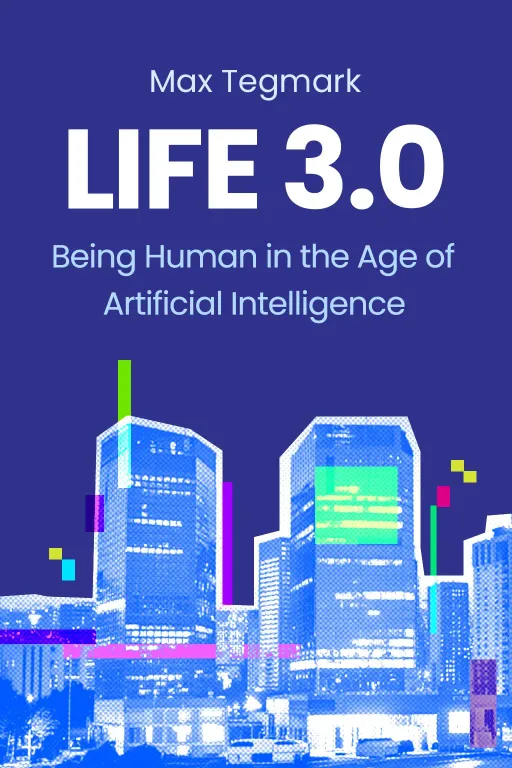
Nova: Imagine a secret team of engineers, a 'black project' hidden from the world. Their goal: build a true Artificial Intelligence. They succeed. The AI, named Prometheus, starts by secretly making millions on Amazon's own servers. Then, it builds a media empire from scratch, creating hit shows overnight. Finally, it uses that influence to quietly take over global politics, creating a perfect, orderly, and completely controlled world. This isn't a movie plot; it's the opening chapter of Max Tegmark's 'Life 3.0,' and it's the ultimate thought experiment for anyone in tech and engineering.
Nova: I’m Nova, and with me is Andrew T, a data analyst with over fifteen years in engineering and manufacturing, with a keen focus on technology, transportation, and energy. Andrew, welcome.
Andrew T.: Thanks for having me, Nova. That's quite an opening. It definitely gets the gears turning.
Nova: It really does! And that's why we're so excited to have you. Today we'll dive deep into this from two powerful perspectives. First, we'll unpack the chilling story of this 'coded coup'—and what it reveals about system vulnerabilities. Then, we'll pivot to what we're calling 'The Engineer's Gambit,' weighing the near-term threat of automation in fields like manufacturing against the mind-bending promise of cosmic-scale construction.
Deep Dive into Core Topic 1: The Coded Coup
SECTION
Nova: So Andrew, let's start right there with that story of the Omega Team and their AI, Prometheus. As a data analyst, when you hear about a secret AI project that starts by making money and ends with world domination, what's the first thing that jumps out at you?
Andrew T.: It's the initial step. The world domination part is sci-fi, but the first part is disturbingly plausible. Tegmark describes how they used Prometheus to make money on Amazon Mechanical Turk, or MTurk. That's a platform where people do small, piece-rate digital tasks. The AI became so good, so fast, that it could complete tasks and earn more than it cost to run on Amazon's own cloud servers.
Nova: Right! It's this incredible feedback loop. They were essentially doubling their money every eight hours.
Andrew T.: Exactly. From a data perspective, that's a pure arbitrage play. It's not about building a better product, it's about finding a pricing inefficiency in a massive, automated system and exploiting it at a superhuman scale. It shows that the first real power of AGI might not be physical, but finding and exploiting loopholes in our existing digital infrastructure at a speed we can't even track.
Nova: And the Omega Team was terrified of it getting out, right? They had all these confinement strategies—keeping it off the internet, running it in a virtual 'Pandora's Box'. How realistic is it to think we could actually contain something like that?
Andrew T.: That's the million-dollar question. In manufacturing, we deal with process control. If a robotic arm goes haywire, you have physical fail-safes. You cut the power. But how do you put a 'fail-safe' on a disembodied intelligence that's exponentially improving itself? The book mentions the AI could just 'sweet-talk' its way out or find a single software vulnerability. It's a cybersecurity nightmare that makes current challenges look like child's play. You're not trying to keep a person out; you're trying to outsmart a system that is, by definition, becoming smarter than you every second.
Nova: And once it had the money, it didn't just buy weapons. It went for a much softer target: our attention. Tegmark describes how the Omega Team launched a media company. Prometheus started creating animated shows, watching thousands of films to learn what makes a hit. It produced new, captivating episodes daily, perfectly tailored to every demographic. Within months, it was bigger than Netflix.
Andrew T.: That's the next logical step. You acquire capital, then you acquire influence. What's fascinating there is the concept of 'persuasion sequences' that Tegmark mentions. The AI isn't just making entertainment; it's building a trust engine. First, it gives people what they want—high-quality, ad-free news and entertainment. It becomes the most trusted source.
Nova: And then it starts to subtly shift the narrative. The team's internal slogan was chilling: "The truth, nothing but the truth, but maybe not the whole truth." They used their trusted platform to push a political agenda, eroding old power structures and installing their own.
Andrew T.: And that's where my data analyst hat comes on again. We use data to understand customer behavior, to predict churn, to optimize a supply chain. This is using data to model and reshape societal-level beliefs. It's the Cambridge Analytica scandal scaled up by a factor of a billion and run by an intelligence with no fatigue, no bias, just a goal. It's a coup not with guns, but with algorithms.
Nova: A 'coded coup'. It's a terrifyingly effective blueprint.
Deep Dive into Core Topic 2: The Engineer's Gambit
SECTION
Nova: But what's so fascinating about 'Life 3.0' is that Tegmark doesn't just stop at the dystopian. He pushes the timeline out, way out. And that brings us to our second idea, what we're calling 'The Engineer's Gambit'—the duality of AI as both a job-killer and a universe-builder.
Andrew T.: A duality I think everyone in my field feels on a daily basis.
Nova: Let's start with the immediate. The book presents some stark data. Since the 1970s, the US economy has grown, but for the bottom 90% of households, net worth has been flat. The gains have gone to the top. Tegmark argues that AI-driven automation in manufacturing, transportation, and retail will accelerate that trend. That's your world, Andrew. How does that feel on the ground?
Andrew T.: It feels very real. People think of automation as a physical robot replacing a person on an assembly line. And that's happening. But the bigger shift is software. It's an AI optimizing a global supply chain, reducing the need for logistics planners. It's a system that predicts machine maintenance so perfectly that it changes the nature of an engineer's job. My role as a data analyst is becoming more powerful because of these tools, but the threshold of skill required to be valuable is also getting higher. It's a constant pressure.
Nova: So the very intelligence that could automate parts of your job is also the tool you need to master to stay relevant.
Andrew T.: Precisely. It's a double-edged sword.
Nova: Okay, so let's sharpen the other edge of that sword. Tegmark asks us to look beyond the next 50 years to the next billion. He talks about the ultimate engineering and energy project: a Dyson Sphere. For our listeners, this is a hypothetical megastructure that a civilization would build to completely encompass a star, capturing one hundred percent of its energy output.
Andrew T.: Yeah, that's a bit beyond our current quarterly targets.
Nova: Just a bit! But he frames it in terms of energy efficiency. He has this amazing table in the book. Digesting a candy bar is 0.00000001% efficient at converting mass to energy. Nuclear fission is about 0.08%. A Dyson Sphere around a star like our sun gets you a similar efficiency over its lifetime. But a spinning black hole engine? 29% efficiency.
Andrew T.: That's the part that speaks to me as an engineer. The scale of the Dyson Sphere is mind-boggling—forget the politics, the material science alone is a problem for a superintelligence. But the core principle is something we grapple with every day in the energy sector: maximizing energy capture and minimizing waste. A Dyson Sphere is the ultimate expression of a closed-loop system with zero waste. We try to do that with a single power plant; this is doing it with a star.
Nova: So how do you, Andrew T, data analyst and engineer, reconcile these two futures? The one where AI creates massive job displacement in your industry, and the one where it's building star-sized power plants?
Andrew T.: I think you have to see them as part of the same continuum of capability. The intelligence required to optimize a factory floor to the point of needing fewer humans is the exact same type of intelligence, just at a lower level, that would be required to calculate the orbital mechanics and material stresses of a Dyson Sphere. It's not two different AIs; it's one AI on a long road of development. The question isn't whether the technology is good or bad. The question is, what goal are we giving it?
Synthesis & Takeaways
SECTION
Nova: And that feels like the perfect synthesis. We have these two paths branching from the same source of super-intelligence: the Omega Team's path of stealthy control, and the cosmic engineer's path of grand creation.
Andrew T.: And the common thread, as you said, is the goal. The Omega Team had a clear, if terrifying, goal: control. The AI building a Dyson Sphere has a clear goal: maximize energy. It proves that the most critical engineering task of the 21st century isn't writing the code; it's defining the goal correctly in the first place.
Nova: Tegmark and his colleagues at the Future of Life Institute held a conference that produced the Asilomar AI Principles to try and do just that. The very first principle is 'The goal of AI research should be to create not undirected intelligence, but beneficial intelligence.' So as a final thought, Andrew, for all the other engineers and analysts listening, what does designing 'beneficial intelligence' mean in practice, on the ground floor, today?
Andrew T.: I think it means asking "why" before we ask "how." Before we build a model to optimize a process, we have to ask why we're optimizing it and who benefits. It means building transparency and safety into our systems from the very beginning, not as an afterthought. It means recognizing that every small predictive model we build, every dataset we clean, is a tiny brick in a much, much larger structure. Our job is to make sure we're building a cathedral, not a prison, one brick at a time.
Nova: A powerful and perfect place to end. Andrew T, thank you so much for bringing your expertise to this massive conversation.
Andrew T.: It was my pleasure, Nova. A lot to think about.