** The Architect's Mindset: What Thomas Hobbes Can Teach Tech Leaders About Building from Chaos
Golden Hook & Introduction
SECTION
Socrates: Imagine you're tasked with building something revolutionary. But your team is in chaos. Engineering wants one thing, design another, and marketing is on a different planet. Everyone is brilliant, everyone is passionate, but they're all pulling in different directions. It feels like a war of all against all. Now, what if I told you the blueprint for solving this chaos wasn't in a modern business book, but in a 370-year-old masterpiece of political philosophy written during a bloody civil war?
Socrates: Today, we're exploring the surprising lessons for modern tech leaders hidden in the creation of Thomas Hobbes's. And with me is Kareem, a product manager who lives in this world of structured chaos every day. Welcome, Kareem.
Kareem: Thanks for having me, Socrates. And I have to say, that 'war of all against all' sounds a lot like my Monday morning stand-up meeting. I'm intrigued to see how a philosopher from the 1600s has any advice for building software in the 21st century.
Socrates: That's the beauty of it. We're not just looking at Hobbes's ideas, but he created them. The context is everything. Today we'll dive deep into this from two perspectives. First, we'll explore how a 17th-century solution to civil war can help you manage a chaotic project team. Then, we'll uncover how intellectual conflict and intense focus, key to Leviathan's creation, are the secret ingredients to true innovation.
Kareem: Sounds like a plan. Let's get into it.
Deep Dive into Core Topic 1: The 'Social Contract' of Product Management
SECTION
Socrates: Alright, let's start with that chaos. When Thomas Hobbes was writing in Paris around 1650, he wasn't in some peaceful, academic bubble. He had fled his home country of England, which was tearing itself apart in a brutal civil war. There was no single, accepted authority. It was a time of profound uncertainty and violence. He called this condition the 'state of nature,' a situation where life is, in his famous words, "solitary, poor, nasty, brutish, and short."
Kareem: Okay, maybe not quite that bad in the office, but the core feeling of uncertainty and competing interests is very familiar. When a new project kicks off without a clear leader or a clear goal, it feels a lot like that. Everyone has their own idea of what's important.
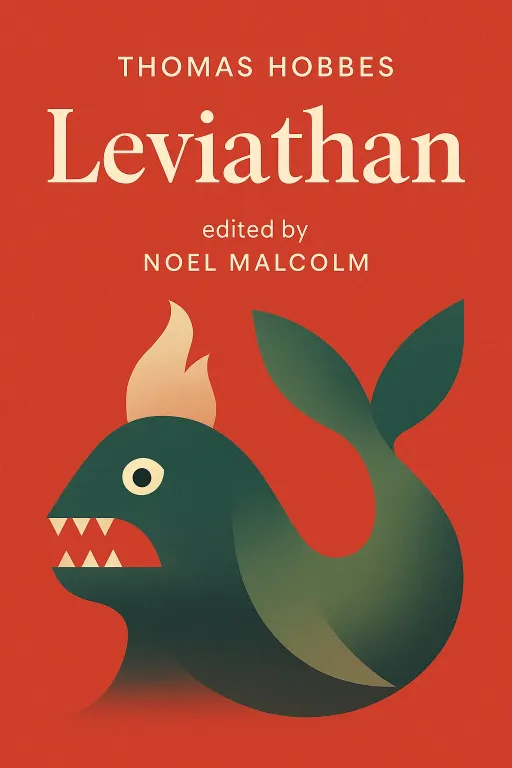
Socrates: Exactly. And Hobbes's solution to escape this state of nature was the 'Leviathan.' Now, most people think of this as a terrifying sea monster, or an all-powerful king. But the core idea is more subtle. It's a social contract. It's the moment when a group of free, self-interested individuals collectively agree to give up some of their freedom to a central, sovereign authority in exchange for security, peace, and the ability to build a functioning society. Does that concept of a central authority resonate at all?
Kareem: It does, but with a critical twist for the modern workplace, especially in tech. We don't have a king. A product manager, especially a more junior one like me, has influence but no real authority. I can't a senior engineer to code something or a lead designer to change their mockups. If I tried to act like an absolute monarch, I'd be laughed out of the room.
Socrates: That's a fantastic point. So if the sovereign isn't a person, what is it? What is the 'Leviathan' on a product team?
Kareem: It has to be an. Or more specifically, a document that represents a shared idea. It's the product vision. It's the roadmap. It's the PRD, the Product Requirements Document, that we all agree is the single source of truth. That document is our social contract.
Socrates: So you're saying the team collectively agrees to grant authority to the plan itself?
Kareem: Precisely. We all give up a little bit of our individual 'freedom'—the designer's pet feature that doesn't align with the core goal, the engineer's desire to use a cool new technology that adds risk, my own bias for a certain solution. We sacrifice those individual impulses in exchange for the security of knowing we are all building the same thing, together, and moving in the same direction. Without that shared agreement, that 'contract,' you just have a bunch of smart people wasting time and energy. It's chaos.
Socrates: That's a brilliant connection. So the Product Manager isn't the sovereign, but perhaps the of the social contract. You're the one who has to facilitate the debate, write the document, and get everyone to, in effect, sign on.
Kareem: Exactly. And it's a living document. It's a constant negotiation. We review it, we update it. It’s not a one-time thing you set in stone. Which, I imagine, was a weakness in Hobbes's original model. A society needs to adapt, and so does a product roadmap.
Socrates: An excellent critique. Hobbes was focused on stability above all else, perhaps at the expense of adaptability. But your point about negotiation, about the push and pull of creating that contract, is the perfect bridge to our second idea.
Deep Dive into Core Topic 2: Forging Genius: Innovation Through Conflict and Focus
SECTION
Socrates: You see, wasn't born in a quiet library from a single flash of insight. It was forged in the fire of intellectual debate. The book we're looking at today highlights this beautifully. In 1645, about five years before was published, Hobbes got into a fierce written dispute with a prominent bishop named John Bramhall.
Kareem: A dispute about what?
Socrates: About free will. It started innocently enough. A nobleman, the Marquess of Newcastle, asked Hobbes to write down his thoughts on liberty and necessity. Hobbes argued, essentially, that our actions are all caused by prior events, and that true 'liberty' is just the freedom to act without external impediment. Bishop Bramhall got ahold of this text and was horrified. He saw it as a denial of free will, morality, and God's justice. So he wrote a scathing, detailed critique, attacking Hobbes's logic from every angle.
Kareem: And what did Hobbes do?
Socrates: He didn't ignore it. He didn't get defensive and shut down. He dove right in. He wrote a meticulous, point-by-point response to Bramhall's attacks. In doing so, he was forced to defend, clarify, and sharpen every single one of his arguments. He had to make his logic ironclad. That intellectual battle was like a stress test for his philosophy.
Kareem: That sounds incredibly stressful. But also... incredibly productive. In the tech world, we try to create this environment intentionally. We call it 'radical candor' or the principle of 'strong opinions, weakly held.' The absolute worst thing for a product is for an engineer or a designer to disagree with the plan but stay silent to avoid conflict. That's how you ship bad products with critical flaws that a simple, honest debate could have fixed.
Socrates: So the conflict is a feature, not a bug?
Kareem: It's the most important feature of the innovation process! The best features I've ever worked on came from a tough, respectful debate where a designer challenged my user flow, or an engineer pointed out a technical constraint I hadn't considered. It forces you to defend your 'why.' If you can't, the idea wasn't strong enough to begin with. That 'dispute' with Bramhall wasn't a distraction for Hobbes; it was a crucial part of his writing process. It made the final product,, stronger.
Socrates: Precisely. He used Bramhall's attack as a whetstone to sharpen his own philosophy. And those refined, battle-tested ideas about human will and motivation went directly into the core of. But there's another piece to this. The book mentions a letter from a friend of Hobbes, Robert Payne, written in May 1650. Payne writes that Hobbes has already finished 37 chapters of his book on 'Politiques,' and was aiming for about 50 in total.
Kareem: Wow, so he was writing at an incredible speed.
Socrates: A furious pace. And this was supposedly a 'diversion' for him! His main intellectual passions in Paris were optics, physics, and mathematics. He was even tutoring the future King Charles II in math. But once he committed to this project, he entered a state of incredible focus. The conflict and debate had clarified his thinking, and now he was in a state of pure, obsessive execution.
Kareem: That's the other side of the coin. That is the perfect product development cycle. First, you have the chaotic debate, the divergence of ideas, the 'dispute' phase where you pressure-test everything. But you can't stay there forever. At some point, you have to commit. You have to converge and build. In my world, we call that the 'sprint.' It's the period of heads-down, focused execution to bring the vision to life. It's a rhythm: diverge and debate, then converge and build. It sounds like Hobbes was a natural-born product manager.
Synthesis & Takeaways
SECTION
Socrates: I think you're right. So when we step back and look at the of this monumental book, we see two powerful principles that apply to anyone trying to create something new. First, in any chaotic system, the leader's primary job is to be the architect of a 'social contract'—a unifying vision that brings order and shared purpose.
Kareem: And for a product manager, that vision is your Leviathan. It's the source of truth that aligns the team. And second, you can't fear conflict. You have to welcome healthy, rigorous debate as the process that refines your ideas from good to great. But then, you must follow it with periods of intense, dedicated focus to actually execute and build.
Socrates: Beautifully put. So for everyone listening, especially those in leadership roles like Kareem, here's the question to take with you from our discussion today: What is the 'Leviathan' for your team? Is it a person, or is it a powerful, shared idea that everyone has agreed to serve?
Kareem: And to add to that: are you creating a space for the healthy 'disputes' that make that idea stronger? The big takeaway for me is that my job isn't to have all the answers. My job is to build the system—the contract and the culture of debate—where the best answers can emerge and then be built. That's a much more powerful, and frankly, more realistic way to think about leadership.
Socrates: The leader as architect, not as king. A lesson as relevant today as it was in 1651. Kareem, thank you for bringing such a sharp, modern lens to this classic text.
Kareem: This was fascinating, Socrates. Thank you.