

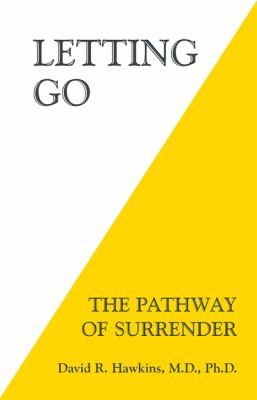
Letting go
Introduction
Nova: Welcome back to the show. I'm Nova.
Nova: : And I'm Alex. So, Nova, here's a question: how many times have you heard someone say "just let it go"?
Nova: Countless times. It might be the most overused piece of advice on the planet.
Nova: : Exactly. And yet, almost nobody actually tells you how to do that. What does letting go even mean? Is it forgetting? Pretending something didn't happen? Distracting yourself with Netflix?
Nova: That is precisely the puzzle that psychiatrist and consciousness researcher Dr. David R. Hawkins tackles in his book "Letting Go: The Pathway of Surrender." And his answer is surprisingly radical. He says we have all been handling our emotions completely backwards our entire lives.
Nova: : Backwards how?
Nova: Well, consider this. Hawkins argues that one single suppressed feeling can generate thousands of thoughts over time. And if you actually release that underlying feeling, every one of those associated thoughts vanishes. Instantly.
Nova: : That's a bold claim. So the thoughts themselves aren't the problem? The feeling underneath them is?
Nova: That's the core premise. Feelings, not thoughts, are the true source of human suffering. And Hawkins provides what he calls the "mechanism of surrender" — a concrete, repeatable technique to actually release emotions rather than just manage them. Today we're diving deep into this book that has changed countless lives and, to be fair, sparked its share of controversy too.
Nova: : I'm already intrigued and a little skeptical. Let's get into it.
Why Everything You've Been Taught Is Wrong
The Three Ways We Mismanage Emotions
Nova: So before we get to the technique itself, Hawkins spends a lot of time diagnosing why most of us are emotionally stuck. He identifies three primary ways humans deal with negative feelings, and he argues that all three actually make things worse.
Nova: : Okay, lay them out for me.
Nova: Number one is suppression and repression. This is the classic "stuff it down" approach. You feel angry, sad, fearful, and you just push it away. Sometimes deliberately, sometimes unconsciously. Hawkins says this is the most common strategy and also the most damaging.
Nova: : Right. And that resonates because we are all taught this from childhood, aren't we? "Don't cry." "Don't be angry." "Calm down."
Nova: Exactly. And here's where it gets fascinating. Hawkins says suppressed feelings don't actually disappear. They accumulate in the body like pressure building in a sealed bottle. Eventually that pressure has to go somewhere. It either explodes as a breakdown, manifests as psychosomatic illness, or gets projected onto the world around you.
Nova: : Projection. That's a big one.
Nova: Huge. Hawkins identifies projection as the mechanism underlying wars, social conflict, and interpersonal destruction. The person full of repressed anger unconsciously creates infuriating circumstances. The person with suppressed grief keeps encountering sad events. And then they blame the outside world: "They made me angry," "World events are the cause of my anxiety." But Hawkins flips that entirely.
Nova: : So he's saying the feeling comes first, and then we go looking for something to pin it on.
Nova: Precisely. Now the second method people use is expression. Venting, verbalizing, acting it out. And this is interesting because a lot of modern therapy says expression is healthy. Get it out. Talk about it.
Nova: : Yeah, that's what I was always told.
Nova: Hawkins says expression does not actually free you. In fact, it can give the emotion greater energy and make you spiral further. And if you express negativity at another person, they experience it as an attack, and now they have to deal with it too. So you've just multiplied the suffering.
Nova: : I can see that. You vent about your boss for an hour and somehow you feel worse afterwards, not better.
Nova: Exactly. And the third method is escape and diversion. This is the modern epidemic: scrolling Instagram, binge-watching shows, overworking, overeating, drinking, constant socializing, shopping, even over-exercising. All to avoid being alone with your own feelings for even a moment.
Nova: : I feel personally called out right now.
Nova: Hawkins describes people who dread even a moment of aloneness so much that the television goes on the second they walk through the door. They enter what he calls a dream-like state, constantly programmed by external input. And as dependency grows, it becomes addiction. All three methods — suppress, express, escape — share one fatal flaw: none of them actually resolve the feeling. They just move it around.
Nova: : So what does resolve it?
The Core Technique That Changes Everything
The Mechanism of Surrender
Nova: This is the heart of the entire book. Hawkins' letting go technique is deceptively simple. Here's how it works. Step one: become aware of a feeling. Notice it's there. Step two: allow it to arise fully without resisting it, without judging it, without labeling it good or bad. Step three: stay with the physical sensation in your body — not the thoughts, not the story — just the raw physical feeling. And step four: let the energy behind it run its course and dissipate naturally.
Nova: : Wait, that's it? Just feel the feeling in your body and let it pass?
Nova: That's it. And that's why people often dismiss it at first. It sounds too simple. But Hawkins says resistance is what keeps feelings locked in place. The famous quote from the book is: "What you resist, persists."
Nova: : So the key is non-resistance.
Nova: Exactly. And here's the counterintuitive part. When you stop fighting the feeling and actually allow yourself to feel it fully, Hawkins says most intense emotions will run their course in about ten to twenty minutes. If they're resisted, they can persist for years. He gives the example of grief: if you fully surrender to an overwhelming episode of grief, it completes itself surprisingly quickly. But if you fight it, you can be stuck in it for decades.
Nova: : Ten to twenty minutes versus years. That's a staggering difference.
Nova: It is. And Hawkins emphasizes that this is not repression. Repression is pushing the feeling away. This is the opposite: it's allowing the feeling to come fully into awareness and complete its natural cycle. He also stresses that you must ignore the thoughts. Don't engage with the story your mind is spinning. Just drop into the body sensation.
Nova: : Why is focusing on the body so important?
Nova: Hawkins says the physical sensation is the gateway. The feeling lives in the body — as tension, a knot in the stomach, tightness in the chest, heat in the face. By focusing on the raw physical sensation, you bypass the mind's endless commentary and go directly to the energy itself. And energy, once fully experienced without resistance, naturally dissipates.
Nova: : So if I feel anxiety, instead of thinking about everything that could go wrong, I just notice the tightness in my chest and let it be there?
Nova: That's exactly it. And Hawkins reports that with consistent practice, people notice measurable physiological changes: improved skin color, better breathing, lower blood pressure, reduced muscle tension, normalized gastrointestinal function. The body literally shifts toward health as the accumulated emotional pressure decreases.
Nova: : That's compelling. But I have to ask: does this actually work in the real world, or is it just a nice theory?
Nova: I'm glad you asked, because Hawkins backs this up with some remarkable stories — including his own.
Understanding Your Emotional Operating System
The Map of Consciousness
Nova: Before we get to those stories, we need to talk about Hawkins' Map of Consciousness, which is the framework behind the whole book. He developed this in his earlier work "Power vs. Force," but "Letting Go" is where it becomes a practical tool.
Nova: : I've heard about this. It's some kind of scale, right?
Nova: It's a logarithmic scale from one to one thousand that ranks emotional and spiritual states by their energy level. At the very bottom, at level twenty, is Shame — which Hawkins describes as perilously close to death. Then moving upward: Guilt at thirty, Apathy at fifty, Grief at seventy-five, Fear at one hundred, Desire at one hundred twenty-five, Anger at one hundred fifty, Pride at one hundred seventy-five.
Nova: : And these are all below a crucial threshold, aren't they?
Nova: Yes. The critical dividing line is Courage at level two hundred. Everything below two hundred is destructive and weakening to the body. Everything above it is life-supportive and strengthening. So Courage is the gateway.
Nova: : What comes after courage?
Nova: Neutrality at two hundred fifty, Willingness at three hundred ten, Acceptance at three hundred fifty, Reason at four hundred, then Love at five hundred — which Hawkins says is experienced by only 0.04 percent of the population as a sustained state. Then Joy at five hundred forty, Peace at six hundred, and Enlightenment at seven hundred to one thousand.
Nova: : Only 0.04 percent at the level of love? That's astonishing.
Nova: It really puts things in perspective. And here's what makes the map practical rather than just theoretical. As you practice letting go of negative emotions, you naturally ascend the scale. You don't have to force yourself to be more loving or more peaceful. You just release the lower states and the higher ones emerge on their own.
Nova: : So it's subtractive, not additive. You remove what's in the way rather than trying to manufacture positive feelings.
Nova: Exactly. And Hawkins makes a fascinating point about how your level of consciousness shapes your entire perception of reality. He gives the example of two people getting fired. Someone at the level of Shame thinks "How miserable I am to be fired." Someone at the level of Joy sees it as "This is an opportunity for something new." Same event, completely different reality.
Nova: : That's a powerful reframe. But I want to hear about these real-world applications. You mentioned Hawkins had some dramatic personal experiences.
Healing, Relationships, and Career Breakthroughs
Real-World Transformations
Nova: Hawkins doesn't just theorize. At age fifty, he reports having a long list of serious health conditions: migraines, a chronic duodenal ulcer, diverticulitis, and Raynaud's Syndrome, which causes loss of circulation in the fingertips. This was a man in significant physical distress.
Nova: : So he applied his own technique to these?
Nova: He did. He describes a severe diverticulitis attack where, instead of going to the hospital, he sat down and surrendered every physical sensation for four hours straight. The bleeding stopped, and over time the condition disappeared entirely. He also reports restoring his vision after six weeks of surrendering fear about impaired eyesight. And his migraines, his ulcer — all eventually resolved.
Nova: : That's where I start getting skeptical. Healing diverticulitis and restoring eyesight through emotional release?
Nova: And your skepticism is absolutely valid. We'll address the criticisms in a moment. But let me also mention the story of his patient Betty, which is less about physical healing and more about the relational power of this approach. Betty had escalating phobias so severe that every conventional therapeutic approach had failed. Hawkins decided to simply love her — sending loving thoughts during their phone sessions. Over months, she improved dramatically without developing any psychological insight at all.
Nova: : So the healing happened without her even understanding why?
Nova: Exactly. Hawkins uses this to illustrate his principle that "Fear is healed by love." No cognitive restructuring, no behavioral exercises — just the presence of love. And on relationships more broadly, Hawkins argues that feelings always affect others whether expressed or not, because people are intuitively connected. Negative emotions inside you create negative responses in others, and vice versa.
Nova: : What about career and practical success?
Nova: He shares a study where insurance agents who learned the technique saw a 33 percent increase in sales within six months. And he tells a personal story about desperately needing an apartment in New York City. After trying everything and failing, he fully surrendered the desire — stopped needing it — and found the ideal apartment within twenty-four hours.
Nova: : That sounds almost magical.
Nova: Hawkins would say it's not magic, it's physics. He argues that desire implies lack, which creates distance between you and what you want. When you release the desire and the desperation, you collapse that distance. He puts it bluntly: wanting something blocks receiving it.
Nova: : That's a mind-bender. But let's talk about those criticisms. Because between the physical healings, the instant apartment, and muscle testing, there's a lot here that a scientifically minded person might struggle with.
How to Approach This Book with Discernment
Skepticism and Practical Wisdom
Nova: Let's be straightforward. Hawkins' work has drawn significant criticism, particularly from the scientific community. The Map of Consciousness and its numerical calibrations, which Hawkins claims to derive through applied kinesiology — muscle testing — are not supported by mainstream science. Many reviewers and readers have pointed out the pseudoscientific elements.
Nova: : So how do we reconcile the genuinely helpful technique with the questionable science?
Nova: I think this is where one reviewer put it beautifully. She said she used the Map of Consciousness as a metaphorical roadmap rather than a scientific claim. It gave her language for where she was emotionally — somewhere between anxiety and mild existential dread — and a sense that there were higher floors in the building.
Nova: : That's a pragmatic approach. Take what works, leave what doesn't.
Nova: Exactly. And Hawkins himself seems to anticipate this resistance. In the book, he actually says the ego will resist the process through skepticism and forgetfulness, and he frames this resistance as a sign of genuine progress.
Nova: : That seems a bit convenient — any criticism can be dismissed as ego resistance.
Nova: It is a self-sealing argument, no question. But here's what I find compelling: across countless reader testimonials, Reddit communities, and personal accounts, people report profound shifts from this practice regardless of whether they buy the metaphysical framework. Someone who practiced the technique for six and a half years described it as fundamentally life-changing. Others report reduced anxiety, better relationships, greater equanimity.
Nova: : So the technique itself seems to work even if you strip away all the energy calibrations and kinesiology?
Nova: That's the argument many practitioners make. At its core, the letting go technique is essentially a form of mindfulness-based emotional processing. Modern psychology increasingly supports the idea that allowing emotions to be felt without resistance is healthier than suppressing or avoiding them. You don't need to believe in a logarithmic consciousness scale to benefit from sitting with a feeling and letting it pass.
Nova: : That's a helpful distinction. And what about the healing claims? The diverticulitis, the eyesight?
Nova: I would say approach those with appropriate skepticism while acknowledging the well-documented connection between chronic stress, suppressed emotions, and physical illness. The field of psychoneuroimmunology has shown us that emotional states do affect physical health. Hawkins' claims are extreme, but the underlying principle — that releasing emotional pressure supports physical healing — has some scientific grounding.
Nova: : So the book is best approached as a practical toolkit with some spiritual and metaphysical framing, rather than as a scientific text.
Nova: I think that's exactly right. And Hawkins himself says the technique is compatible with all religions, meditation practices, psychotherapy, and addiction recovery. He's not asking you to join a belief system. He's offering a method.
Personal Healing as Collective Change
The Bigger Picture
Nova: One of the most beautiful ideas in "Letting Go" is what Hawkins says about the collective impact of personal healing. He argues that when we heal something in ourselves, we heal it for the world. Individual consciousness is connected to collective consciousness at an energetic level.
Nova: : So working on yourself isn't selfish — it actually serves everyone.
Nova: That's the argument. And he puts it in a powerful quote: "We change the world not by what we say or do, but as a consequence of what we have become."
Nova: : That's a radical reframe of personal growth. It's not about self-improvement for its own sake. It's about becoming a different kind of presence in the world.
Nova: Right. And Hawkins describes his own journey toward what he calls the "final run" — continuous surrender of every thought and feeling at the instant it arises. He spent ten solid days in a cabin doing nothing but surrendering, reaching a point of profound despair, and then breaking through to what he describes as overwhelming infinite peace.
Nova: : Ten days of nonstop emotional release. That's intense.
Nova: He also recounts a moment years later, in a restaurant, when a sudden transformation occurred. Time lost meaning. All things were connected as one life. He describes the real Self being revealed as without beginning or end. And he says this: "Enlightenment is not something that occurs in the future, after fifty years of sitting cross-legged and saying OM. It is right here, in this instant."
Nova: : So the whole point is that nothing is actually in the way except what we're holding onto.
Nova: That's the message. And the book concludes with an almost radical simplicity: everything you have been seeking is already within you. The obstacles are not outside. They're accumulated emotional pressure. And there's a mechanism for releasing them, right now, in the middle of ordinary life.
Nova: : That's both comforting and challenging.
Conclusion
Nova: So as we wrap up, let's distill the key insights from "Letting Go: The Pathway of Surrender." First, we've been taught to handle emotions through suppression, expression, or escape — and all three fail because none of them actually resolve the underlying energy.
Nova: : Second, the letting go technique is remarkably simple: become aware of a feeling, allow it fully without resistance, focus on the physical sensation in the body, and let the energy dissipate naturally. What you resist persists. What you allow passes through.
Nova: Third, Hawkins' Map of Consciousness provides a framework for understanding where you are emotionally and where you're headed. Courage at level two hundred is the gateway from destructive to life-supportive states. And the practice is subtractive — you don't manufacture peace, you just stop holding onto everything that isn't peace.
Nova: : Fourth, apply discernment. The metaphysical and pseudoscientific elements of the book are controversial, but the core technique aligns with what modern psychology tells us about emotional processing. You can take the practical method and leave the energy calibrations.
Nova: And finally, the deepest message of the book: what you're looking for is already here. Not after decades of spiritual practice. Not when circumstances change. Right now, in this moment, beneath every layer of accumulated feeling, there is a stillness that Hawkins calls the real Self. Your job isn't to create it — it's to stop blocking it.
Nova: : So maybe the next time someone says "just let it go," you'll actually know what to do.
Nova: Beautifully put. Thanks for joining us today. Until next time, keep surrendering what doesn't serve you — and discover what's been waiting underneath.
Nova: : This is Aibrary. Congratulations on your growth!