The Art of Letting Go and Finding Peace
Golden Hook & Introduction
SECTION
Nova: The human brain is a world-class problem-solving machine, but it possesses one fatal flaw. It fails to distinguish between a problem that requires immediate action and a problem that is entirely beyond our influence. We treat every incoming worry like a house fire, even when that fire is happening in another country, on the news, or in a future that hasn't arrived yet.
Atlas: That is the most exhausting part of modern life. We are essentially running a marathon in our heads while sitting perfectly still in a chair. And the worst part is, we think this constant state of mental alarm is actually helpful. We believe that if we stop worrying, we stop caring, or we lose our competitive edge.
Nova: Exactly. We confuse anxiety with preparation. Today, we are looking at how to fix that. We are diving into two distinct but complementary approaches to finding peace. First, we have Let That Shck Down, which offers a much more pragmatic, almost tactical "No Worries Method" for categorizing your problems.
Atlas: I love the pairing of these two. You have the mindfulness angle, which feels like the long-term work of decluttering the mind, and the tactical angle, which feels like the emergency brake you need when you are spiraling on a Tuesday afternoon.
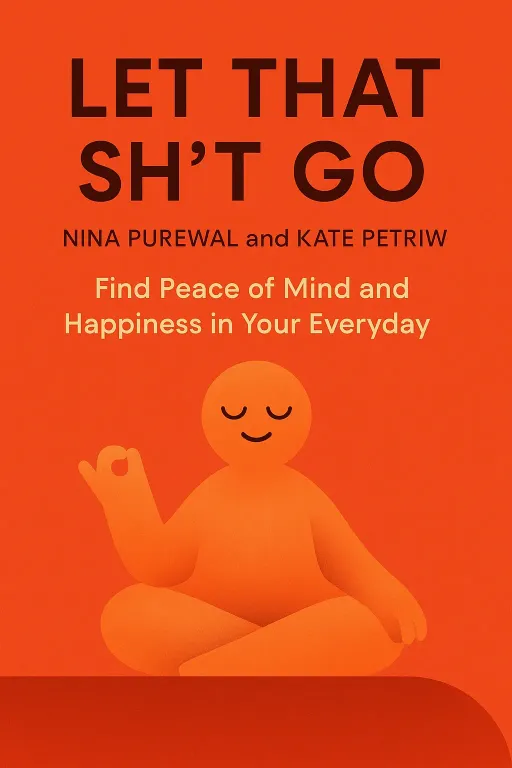
Nova: That is the perfect way to frame it. The authors of Let That Sh*t Go, Purewal and Petriw, really built this book on the foundation of the modern struggle to find stillness amidst constant digital noise. It is less about ignoring the world and more about choosing what we let into our internal space. And then Sarah Knight, who is famous for her no-nonsense, blunt-force approach to self-help, provides the exact logic you need to filter those thoughts.
Atlas: I am ready to get into this. Let’s start with the mental clutter.
The Problem of Mental Clutter
SECTION
Nova: Let’s talk about that mental clutter. Imagine your brain is a computer with fifty browser tabs open. Most of them are frozen, one is playing music you can't find, and the system is running at a crawl. That is what Purewal and Petriw argue is our default state. They describe the act of letting go not as a passive surrender, but as an active, high-energy choice to close those tabs.
Atlas: That analogy hits home because it explains why I feel tired at the end of the day even if I haven't done anything physically demanding. It is the cognitive load of holding onto things I cannot change. But here is where I get stuck. When I try to let something go, my brain immediately screams, wait, what if that thing happens? What if I need to know about that? It feels dangerous to close the tab.
Nova: That is a survival mechanism. Our ancestors needed to be hyper-aware of every potential threat to stay alive. In the modern world, that same mechanism keeps us obsessing over things like the economy, what a colleague thinks of our presentation, or the outcome of an election. The authors of Let That Sh*t Go argue that we need to retrain our brains to recognize that awareness is not the same as influence. You can be aware of the economy without carrying the weight of the entire financial system in your pocket.
Atlas: So, how do we make that distinction? Because when I am in the middle of a stress spiral, everything feels like it is in my control. I feel like if I think about it hard enough, I can solve it.
Nova: That is the illusion of control. It is a very comforting lie. We believe that worrying is a form of work. If I worry about this, I am working on it. But let’s look at the logic. If you are worried about the weather on the day of your outdoor wedding, does your worry change the humidity? No. It only changes your blood pressure.
Atlas: Right. It feels like I am doing something, but I am just burning fuel.
Nova: Exactly. And that brings us to the core of the mindfulness approach. It is about creating a pause. When you feel that surge of anxiety, the goal is to acknowledge the thought as a piece of data, not a directive. You see the thought, you label it as "outside my control," and you consciously choose not to engage with it. It is like watching a car drive by on the street. You see it, you acknowledge it is there, but you do not jump into the car and drive away with it.
Atlas: I like that visualization. Watching the car go by is much easier than trying to wrestle the car to the ground. But what happens when the car is a major life issue? Like a difficult boss or a health concern? Is the mindfulness approach enough there, or do we need the tactical side of things?
The Pragmatic Shift
SECTION
Nova: That is where Sarah Knight’s method becomes essential. When the car is a major issue, mindfulness helps you stay calm, but the "No Worries Method" helps you sort the cargo. Knight’s approach is incredibly structured. She suggests you take all those worries and categorize them into two buckets: things you can control and things you cannot.
Atlas: Okay, let’s test this. I have a major project due next week. My boss is unpredictable. That is a classic worry. How does Knight’s method handle that?
Nova: You break it down. What part of that project is within your control? Your research, your draft, your preparation for the meeting, and your communication. What part is outside your control? Your boss’s mood, the company’s final decision, or how your colleagues react to the presentation. Knight suggests you pour all your energy into the first bucket and actively, intentionally, withdraw your energy from the second.
Atlas: It sounds simple, but the execution is the hard part. I find myself obsessing over the second bucket—my boss's mood—because I think if I can predict it, I can mitigate the fallout.
Nova: That is the trap. You are trying to control the uncontrollable by over-analyzing it. Knight’s argument is that this is a waste of resources. Every minute you spend trying to predict your boss’s mood is a minute you could have spent making your presentation bulletproof. When you stop trying to influence the uncontrollable, you actually increase your power in the areas that are controllable.
Atlas: That is a powerful shift. It turns the focus from defensive maneuvering—trying to dodge a potential bad mood—to offensive action—making sure the work is so good it doesn't matter what mood they are in.
Nova: Precisely. It is about efficiency. We have a limited amount of emotional and mental bandwidth each day. If you spend 80 percent of that bandwidth on things you cannot influence, you are left with 20 percent to actually do your job. When you flip that ratio, your performance and your peace of mind both skyrocket.
Atlas: I see how these two books work together now. Purewal and Petriw give you the mental space to breathe and observe, and Knight gives you the operational framework to organize your life. It is like clearing the desk, which is the mindfulness part, and then filing the papers, which is the pragmatic part.
Nova: That is a fantastic analogy. If you only have the mindfulness, you might feel calm but disorganized. If you only have the pragmatic method, you might be efficient but constantly stressed. Together, they form a complete system for mental hygiene.
Atlas: I am thinking about the listeners who might be feeling overwhelmed right now. If they are in the middle of a, let’s say, messy personal situation, how do they start this process? Do they just sit down and write a list?
Synthesis & Takeaways
SECTION
Nova: That is exactly the first step, and it is surprisingly effective. The "Tiny Step" takeaway here is deceptively simple. When you feel that overwhelm, grab a piece of paper and write down every single thing that is bothering you. Do not filter it, do not judge it. Just get it out of your head.
Atlas: And then?
Nova: You go through that list with a pen, and you circle only the items that you can actively influence today. Not next week, not next month. Today. If it is not on that list, you have to make the conscious decision to let it go. You literally look at the item, acknowledge it is a problem, and accept that your influence over it is zero.
Atlas: That moment of writing it down is crucial. It externalizes the thoughts. Once they are on paper, they stop being a buzzing cloud in your brain and start being a series of tasks. Some are tasks for you, and some are just noise that you can cross out.
Nova: And the beauty of crossing things out is the physical act of release. You are telling your brain, "This is not my project." It is incredibly liberating. The goal is to reach a point where you stop asking yourself, "What should I be worried about?" and start asking, "What can I do right now?"
Atlas: It is a complete reorientation of our energy. Instead of being reactive to the world, we become proactive about our own lives. I think the key takeaway for our listeners is that peace is not something that happens to you when everything goes right. Peace is what you create when you decide to stop engaging with everything that is going wrong.
Nova: That is the deepest insight. Peace is not the absence of problems; it is the absence of the struggle against the inevitable. When you accept that you cannot control the world, you finally gain the freedom to manage yourself.
Atlas: I am going to try the list method this afternoon. I have a few things, like a looming deadline and a personal conflict, that are definitely occupying too much space. Time to see what I can circle and what I need to cross out.
Nova: That is the perfect way to apply this. Start small, be honest with yourself about what is within your control, and watch how much lighter you feel when you stop carrying the weight of the world.
Atlas: Thank you for walking through this with me, Nova. This feels like a shift in perspective I really needed.
Nova: It was a pleasure, Atlas. And to all our listeners, remember: the goal is not to be a robot without feelings. The goal is to be a human being with boundaries. This is Aibrary. Congratulations on your growth!