

Reclaiming Mental Space in the Digital Noise
Golden Hook & Introduction
SECTION
Nova: Three hours. That is the amount of time the average person spends staring at their palm every single day. That is nearly an entire part-time job, except the salary is anxiety and the promotion is just more notifications.
Atlas: That hits hard. Especially when you realize that most of those hours aren't spent creating anything or learning anything. They are spent in a loop of scrolling, tapping, and refreshing. It is effectively a tax on our cognitive bandwidth.
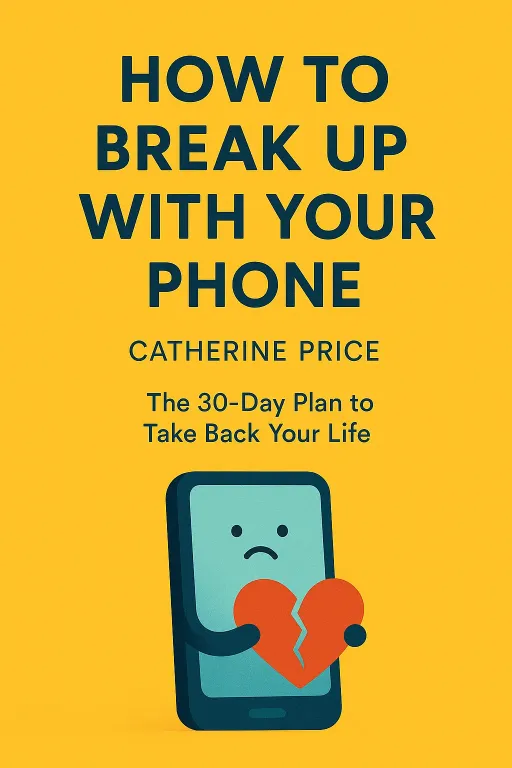
Nova: Exactly. And the tax is getting higher. Today, we are looking at two essential manuals for reclaiming your sovereignty. First, we have How to Break Up with Your Phone by Catherine Price. Catherine is a science journalist who, after realizing she was ignoring her child to check her email, decided to treat her relationship with technology as a serious, evidence-based behavioral intervention.
Atlas: I love that approach. Treating it like an intervention instead of a vague New Year's resolution.
Nova: It is deeply practical. And to pair with that, we are diving into LET THAT SH*T GO by Nina Purewal and Kate Petriw. These two offer a grounded, no-nonsense guide to mindfulness. They cut through the spiritual jargon and focus on the mechanics of overthinking, which, frankly, is the primary symptom of our digital addiction.
Atlas: It feels like these two books are the pincer movement we need. One handles the external environment—the phone—and the other handles the internal environment—the noise in our heads. Let’s start with the external. Because, truthfully, people feel like they cannot live without these devices.
The Architecture of Distraction
SECTION
Nova: That is the core myth. We act as if the phone is a utility, like electricity, when in reality, it is a slot machine. Catherine Price highlights that the apps we use are engineered to exploit the exact same neurological pathways as gambling. It is not an accident that you feel a compulsive need to pull-to-refresh your feed.
Atlas: Wait, let’s be precise here. Are you suggesting that the engineering is actually designed to keep us in a state of agitation?
Nova: Precisely. The design principle is intermittent variable reward. You do not know what you will get when you unlock your screen. It could be a boring email, or it could be a dopamine-hitting notification from a friend. That unpredictability is the hook. It is the same psychology used in Las Vegas to keep people at the machines.
Atlas: That makes sense. I have noticed that when I am bored for even a millisecond, my thumb moves toward the screen before my brain even registers the impulse. It is muscle memory.
Nova: It is worse than muscle memory. It is a hijacked reflex. Price argues that we are outsourcing our attention to companies whose business model relies on stealing it. When you are an architect or a strategist, your most valuable asset is your deep work. If you are constantly fracturing your attention into five-minute segments, you are effectively dismantling your own ability to think deeply.
Atlas: I can see how that would be catastrophic for anyone trying to build a career or a life of substance. But here is the pushback I hear from almost everyone: I need my phone for work. I need to be responsive. How do you balance the need for professional availability with the need to not be a digital addict?
Nova: The key is distinguishing between a tool and a toy. A tool serves a specific purpose and then gets put away. A toy is designed to be played with indefinitely. Price suggests a thirty-day plan to change this relationship, but the foundational step is simply creating friction.
Atlas: Friction. I like that. We spend so much time designing for seamlessness, but sometimes, seamlessness is the enemy.
Nova: Exactly. If it is too easy to use, you will use it unconsciously. Put the phone in a different room while you work. Turn off all non-human notifications. If a notification does not come from a person you actually know, it does not deserve to interrupt your neural processing.
Atlas: That sounds manageable, but I wonder about the social pressure. If I don't reply in ten minutes, people think I am ignoring them.
Nova: That is a social construct we have built, and it is one we can dismantle. The people who matter will respect your boundaries. The ones who do not are the ones training you to be constantly available. It is about reclaiming your time as a limited, non-renewable resource.
The Internal Noise
SECTION
Atlas: Okay, so let’s assume I manage to put the phone down. I have created this environment of friction, and I am not checking the screen every three minutes. But then, the silence happens. And suddenly, my brain starts racing. I am worrying about a project, replaying a conversation, or stressing about the future. This is where that second book comes in, right?
Nova: You have hit on the perfect transition. Nina Purewal and Kate Petriw argue that the phone is often just a distraction from our own internal chatter. We use the device to numb the discomfort of being alone with our thoughts. When you remove the external noise, the internal noise becomes deafening.
Atlas: That is a profound realization. It is not just that we are addicted to the phone; it is that we are afraid of the quiet.
Nova: Exactly. In LET THAT SH*T GO, the authors explain that overthinking is a habit, just like nail-biting or scrolling. It is a repetitive neural pathway. You are practicing being anxious. You are training your brain to scan for threats and problems even when there are none.
Atlas: What is the mechanism for stopping that? Because telling someone to just stop overthinking is like telling someone to just stop breathing. It is involuntary.
Nova: The authors suggest that you cannot stop the thoughts, but you can change your relationship to them. They talk about the concept of a mental cache. Think of your brain like a computer. If you have fifty tabs open, the processor slows down. Most of us are living with a hundred tabs open—regrets, to-do lists, anxieties.
Atlas: So, how do we close the tabs?
Nova: One of the most effective techniques they suggest is the five-minute mindfulness check. Instead of trying to meditate for an hour, which is intimidating, you do a quick reality check. Ask yourself: Is this thought helping me? Is it based on fact or fear? And most importantly, can I do anything about this right now?
Atlas: That is a great filter. If the answer is no, then the thought is just mental junk. It is occupying space without providing value.
Nova: Precisely. And that is where the title of their book comes from. It is about the active, intentional choice to release the things that do not serve your growth. It is a practice of discernment. You are an architect of your own mind; you get to decide which thoughts are allowed to inhabit the space and which ones are just noise.
Atlas: That sounds simple, but I imagine it is incredibly difficult to execute in the middle of a high-pressure workday. How do you integrate that when you are in the thick of it?
Nova: You integrate it by creating micro-habits. For example, before you start a new task, take three deep breaths. That is it. It sounds trivial, but it resets your nervous system. It signals to your brain that you are moving from the reactive state of the previous task to the intentional state of the next one. It is a way to clear the cache.
Synthesis & Takeaways
SECTION
Atlas: So, we have the external boundary, which is managing the phone and the digital input, and we have the internal boundary, which is managing the mental output. If you combine these, you are essentially building a fortress for your focus.
Nova: That is the perfect way to phrase it. You are protecting your mental real estate. And that brings us to the tiny step for tonight. It is the bridge between these two worlds.
Atlas: I am ready. What is the assignment?
Nova: Tonight, put your phone in a drawer at least one hour before bed. Not on your nightstand, not face down, but in a drawer. And for those fifteen minutes before you fall asleep, just sit there. No screen. No music. No podcast. Just reflection.
Atlas: Fifteen minutes. That sounds like an eternity to someone who is used to falling asleep to the blue light of a screen.
Nova: It will feel like an eternity at first. You will feel the itch to check the device. That is the withdrawal symptom of the addiction. But if you push through that discomfort, you will find that those fifteen minutes become the most valuable part of your day. It is the time when your brain finally gets to consolidate its thoughts without being interrupted by external input.
Atlas: It is essentially giving your brain the time to organize the files it collected during the day. If you don't do that, you wake up the next morning with the same cluttered desktop you went to sleep with.
Nova: Exactly. And that is how you start building a foundation for self-actualization. You cannot become the person you want to be if you are constantly distracted by the person everyone else wants you to be.
Atlas: I love that. It is not about asceticism or living in a cave; it is about intentionality. It is about being the architect of your own attention, rather than letting an algorithm design it for you.
Nova: That is the ultimate goal. You are not just breaking up with your phone; you are reconnecting with yourself. You are deciding that your life is worth more than the engagement metrics of a tech company.
Atlas: And that, I think, is the most empowering realization we can offer today. It is your life. Take it back.
Nova: Well said. This is Aibrary. Congratulations on your growth!









