Navigating Daily Chaos with Radical Calm
Golden Hook & Introduction
SECTION
Nova: Five words to describe your average Tuesday: Email, Slack, panic, coffee, repeat.
Atlas: That sounds less like a Tuesday and more like a slow-motion car crash. And unfortunately, that is the default operating system for most of us, isn't it? We are constantly running, yet we feel like we are standing still.
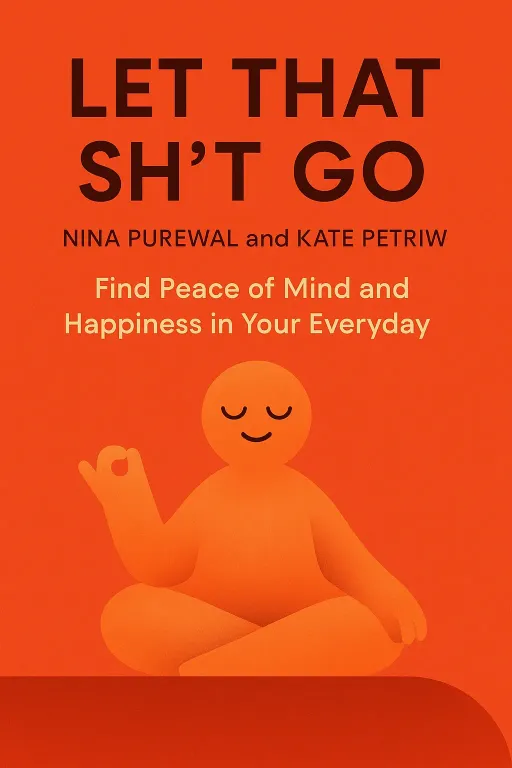
Nova: Exactly. We are living in a state of chronic, low-grade emergency. But today, we are looking at two very different ways to get off that treadmill. We are talking about Let That Sh*t Go by Nina Purewal and Kate Petriw, and Calm the Fuck Down by Sarah Knight.
Atlas: I love the title of that second one. It feels like the advice I give myself at 3:00 a. m. when I am spiraling about a presentation I gave three years ago.
Nova: It is a bit blunt, isn't it? But that is the beauty of this combination. Purewal and Petriw bring us the internal, emotional, mindfulness-based approach, while Sarah Knight brings us the tactical, cognitive-behavioral, get-your-life-together approach. It is the perfect one-two punch for anyone feeling like their brain is permanently stuck in high gear.
Atlas: I am curious about how these two worlds collide. Usually, when I hear mindfulness, I think of incense and silence. When I hear tactical management, I think of spreadsheets and to-do lists. How do they actually fit together?
Nova: That is the big question. We are going to explore how to use the first to regulate your emotions, and the second to manage your reality. Because, let’s be honest, you can be as mindful as a monk, but if your project schedule is a disaster, you are still going to be stressed. And you can be a productivity machine, but if you are an emotional wreck, you are going to burn out.
Atlas: So, it is about the internal state and the external environment. Let’s start with the internal. How do we even begin to calm down when everything feels like an emergency?
The Internal Shift: Micro-Mindfulness
SECTION
Nova: Purewal and Petriw argue that we are addicted to the cycle of overthinking. We think that if we worry about a problem long enough, we will solve it. But in reality, all we are doing is spiking our cortisol levels. They introduce this framework of micro-mindfulness.
Atlas: I have heard the term micro-mindfulness tossed around a lot. It sounds like a buzzword for people who don't have time to meditate for an hour. What does it actually mean in practice?
Nova: It is the opposite of the "all or nothing" mentality. You do not need a yoga mat or a silent room. It is about seizing 60 seconds in the middle of a chaotic day to break the cycle. Think about the last time you were in a meeting and someone made a comment that made your heart rate jump.
Atlas: Oh, that happens every week. I feel the heat rise in my neck, I start formulating a snappy comeback, and I lose track of what the meeting is actually about.
Nova: Right. That is the cortisol loop. Your brain perceives that comment as a threat—like a tiger jumping out of the bushes. But it is just a budget meeting. Purewal and Petriw suggest that in that exact moment, you pause. You acknowledge the physical sensation of the stress—the heat in your neck, the tightness in your chest—and you consciously choose to observe it rather than become it.
Atlas: So, instead of being the person who is angry, I become the person watching the anger happen?
Nova: Precisely. It is a subtle shift, but it is powerful. It creates a gap between the trigger—the comment in the meeting—and your response. Without that gap, you are just a reflex machine. With it, you are a strategist.
Atlas: I see the value there, but I have to play devil’s advocate. When I am in the thick of a crisis, the last thing I want to do is sit there and "observe my sensations." I want to fix the problem. Isn't that just delaying the inevitable?
Nova: Here is the thing. When you are operating from that high-cortisol, "fight or flight" state, your prefrontal cortex—the part of your brain responsible for logic, creativity, and problem-solving—actually goes offline. You are literally less intelligent when you are stressed.
Atlas: That is a terrifying thought. So, by taking that 60-second pause, I am not just calming down, I am actually recalibrating my brain to be more effective?
Nova: Exactly. You are giving your brain the oxygen and the space it needs to think clearly again. It is not about ignoring the problem; it is about making sure you are in the best possible state to tackle it. If you try to perform surgery while you are shaking, you are going to make a mistake. The surgery is the problem, but the steadiness of your hand is the prerequisite for success.
Atlas: Okay, that makes sense. It is like an athlete warming up before a race. You don't just sprint the moment you wake up. You need to prepare your muscles. In this case, you are preparing your mind.
Nova: That is a perfect analogy. And Purewal and Petriw point out that these micro-practices—taking a breath, noticing your feet on the floor, doing a quick body scan—are like reps in the gym. The more you do them, the stronger your "calm" muscle becomes.
Atlas: I like that. It moves mindfulness from a "special event" to a "daily utility." But let’s say I’ve done my 60 seconds of breathing. I’m calm. I’m present. Now I’m looking at the massive pile of work on my desk. The stress is still there, even if I am not panicking about it. How do we transition from the "feeling" to the "doing"?
The Tactical Shift: The No Worries Method
SECTION
Nova: That is the perfect bridge into Sarah Knight’s approach. If Purewal and Petriw are about managing your internal climate, Knight is about landscaping your external environment. She introduces the "No Worries Method," which is essentially a ruthless categorization system.
Atlas: I am a huge fan of categorization. I love a good system. How does she break it down?
Nova: She forces you to categorize your problems into two buckets: things you can control, and things you cannot. It sounds basic, but most of us spend 90 percent of our energy on the things in the second bucket.
Atlas: The "things I cannot control" bucket. That is where I live. I worry about the economy, I worry about my boss’s mood, I worry about what the client is going to say.
Nova: And that is exactly where the exhaustion comes from. Knight argues that we have a finite amount of mental energy. Every time you worry about something you cannot control, you are essentially pouring water into a bucket with a hole in it.
Atlas: So, what is the strategy? Do we just ignore the uncontrollable stuff?
Nova: We don't ignore it, we "allocate" our energy. Knight suggests a systematic audit. You write down the things causing you stress. Then, you draw a line. Everything above the line is within your direct control—your actions, your boundaries, your preparation, your responses. Everything below the line is outside your control—other people's opinions, the market, the weather, the past.
Atlas: And the goal is to stop spending energy below the line?
Nova: Right. If you cannot influence the outcome, you are not allowed to waste energy on the anxiety of it. You accept that it is happening, but you detach your emotional investment from it.
Atlas: This sounds incredibly logical, but I can imagine the pushback. People might say, "But if I don't worry about the market, I'm being irresponsible." Or "If I don't worry about my boss's mood, I'm being indifferent."
Nova: That is the common trap. We confuse "worry" with "preparation." Worrying about the market doesn't help you navigate it. Preparing a contingency plan for your finances does. Worrying about your boss's mood doesn't make them nicer. Setting clear boundaries and communicating effectively does. Knight’s point is that worry is the of productivity. It makes you feel like you are doing something, when in reality, you are just spinning your wheels.
Atlas: I feel like I have been called out. I definitely use worry as a proxy for "caring." If I am not worried, I feel like I am not working hard enough.
Nova: It is a badge of honor in our culture, isn't it? To be the most stressed person in the room is often equated with being the most dedicated. But Knight challenges that. She suggests that true efficiency is being calm enough to see what actually needs to be done.
Atlas: So, how do we combine these? If I use the micro-mindfulness from our first section to get into a neutral state, and then I use the No Worries Method to categorize my tasks, I feel like I would have a significant amount of extra energy.
Nova: You would. And that is the synthesis. You use the micro-mindfulness to stop the emotional spiraling, which clears the fog. Then, with that clear head, you apply the No Worries Method to identify what is actually worth your effort.
Atlas: It is a filtering process. Mindfulness clears the filter, and the No Worries Method sorts the contents.
Synthesis & Takeaways
SECTION
Nova: Precisely. And I think the most important thing to realize here is that this is a dynamic process. It is not a one-time fix. You are going to get stressed again. You are going to start worrying about things you cannot control again.
Atlas: Oh, absolutely. I’ll be back to worrying about my boss’s mood by tomorrow morning.
Nova: And that is fine. The goal is not to reach a state of permanent enlightenment where stress never touches you. The goal is to shorten the recovery time. When you find yourself in that loop, you pause for 60 seconds—that is the micro-mindfulness. You notice the tightness, you take a breath. And then, once you are back in the driver's seat, you look at your list and ask: "Is this in my control?" If it is, you take action. If it isn't, you let it go.
Atlas: I like the idea of framing it as "shortening the recovery time." It takes the pressure off being perfect. It makes it a skill you practice rather than a test you pass or fail.
Nova: Exactly. And for our listeners, here is a tiny, actionable step to start with today. The next time you feel that surge of overwhelm—maybe it is a deadline, or an email, or a difficult conversation—pause for 60 seconds. Do not do anything. Just breathe and acknowledge the feeling. Then, take a piece of paper and write down the problem. Draw a line. Put everything that is actually within your power to change above the line, and everything else below it.
Atlas: And then you just cross out the stuff below the line?
Nova: You can literally cross it out. It is a very satisfying physical act. You are telling your brain, "This is not my job."
Atlas: I love that. It turns a mental burden into a physical task you can complete. It is very practical.
Nova: That is the key. These books, while different in tone—one being more reflective and one being more punchy—share the same fundamental truth: you have more agency than you think, but only if you are willing to stop reacting and start choosing.
Atlas: It is about moving from being a victim of your circumstances to being an architect of your response.
Nova: Well said. And that is the path to navigating daily chaos without losing your mind. It is not about silencing the world; it is about finding your own signal in the noise.
Atlas: This has been a great conversation. I feel like I have a much clearer toolkit for my own Tuesday. And hopefully, our listeners do too.
Nova: I hope so. Remember, the next time you feel the panic rising, just take that minute. You have more control than you think.
Atlas: And for everything else? Just let it go.
Nova: Exactly. This is Aibrary. Congratulations on your growth!