

Balancing Everyday Zen with Cosmic Perspective
Golden Hook & Introduction
SECTION
Nova: You spend roughly ninety thousand hours of your life at work, yet your blood pressure likely spiked this morning over something as trivial as a lukewarm cup of coffee or a slightly delayed email response. That is the fundamental math error of modern existence. We are misallocating our emotional currency.
Atlas: That is a brutal way to start the morning, but you are absolutely right. I spent twenty minutes yesterday annoyed at a software update notification that kept popping up. I could have just clicked ignore, but instead, I carried that frustration into a meeting with my team. It is the classic case of letting a pebble in your shoe ruin a marathon.
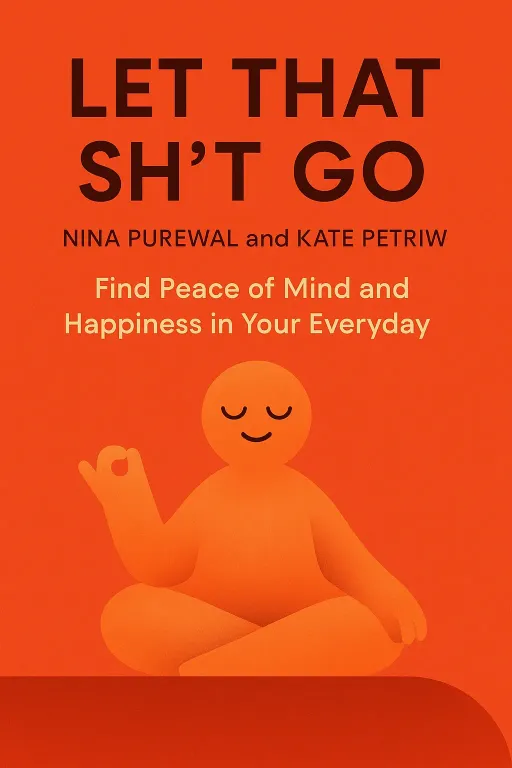
Nova: We have all been there. Today, we are attempting to fix that math error by colliding two very different worlds. We are diving into Let That Sh*t Go by Nina Purewal and Kate Petriw, which is essentially a masterclass in stripping away the complexity of mindfulness. And we are balancing that with Ken Wilber’s A Brief History of Everything, a dense, fascinating map of how personal consciousness evolves alongside the cosmos.
Atlas: Those two sound like they belong in different galaxies. One is about dealing with the annoyance of a slow internet connection, and the other is about the evolution of the universe. How do we make those two talk to each other without causing a mental overload?
Nova: By realizing that the only way to handle the small stuff is to understand the big stuff. Nina Purewal and Kate Petriw wrote their book with a very specific goal: to make mental clarity accessible. They realized that mindfulness had become this over-complicated, intimidating industry. Their work is a refreshing, blunt reminder that clarity is just an active choice to release micro-stressors.
Atlas: And Ken Wilber? I know he is a heavyweight in the integral theory world. His work is usually associated with deep, heady philosophy.
Nova: Exactly. Wilber’s book is an ambitious project that maps human development onto a cosmic scale. He argues that our individual consciousness is not an isolated event; it evolves in tandem with culture, nature, and the universe itself. It is the ultimate zoom-out lens. If Purewal and Petriw give us the tool to clean the lens, Wilber gives us the context for what we are actually looking at.
The Mechanics of Micro-Stressors
SECTION
Atlas: Okay, I am ready to zoom in. Let’s start with the micro-stressors. Everyone talks about mindfulness as this lofty, spiritual state you reach after years of meditation. But Purewal and Petriw seem to be suggesting something much more immediate. How do they define this active choice of releasing?
Nova: They frame it as an executive function. Think of your mind like a browser. Every micro-stressor—that rude comment from a colleague, the spilled water, the forgotten password—is an open tab. Most of us just leave those tabs open, running in the background, draining our battery. The authors argue that mindfulness is simply the act of closing the tab the moment you realize it is not serving you.
Atlas: That is an analogy I can actually use. So, it is not about reaching some Zen state where nothing bothers you. It is about closing the tab. But here is the problem: some tabs feel like they are frozen. You try to close them, but the stressor stays there. How do they suggest we actually force the quit?
Nova: They emphasize that the release is a physical and mental decision. It is about acknowledging the feeling, naming it as a micro-stressor, and then consciously deciding that the event is not worth your long-term energy. They use the concept of the internal thermostat. You decide what temperature your day is going to be. If an external event tries to push your temperature into the red zone, you recognize it as an external input, not an internal reality.
Atlas: I think the struggle for most people, especially those of us who are focused achievers, is that we view these micro-stressors as data points. We think, if I don't get annoyed at this mistake, I am not holding myself to high standards. We confuse stress with accountability.
Nova: That is a profound distinction. We wear our stress as a badge of competence. Purewal and Petriw challenge that by showing that the most effective people are the ones who can reset the fastest. When you hold onto a micro-stressor, you are carrying a weight that slows down your reaction time for the next big decision. It is an efficiency problem. By letting go, you are not being lazy; you are clearing your cache so your processor can run at top speed.
Atlas: I see that. It is like a professional athlete. If they miss a shot, they cannot stand there beating themselves up for the next five minutes, or they will miss the next three plays. They have to flush it. But how does this play out in a real-world scenario, say, a high-pressure office environment?
Nova: Imagine you are in a meeting, and someone dismisses your idea. The immediate reaction is to tighten your chest, start crafting a defensive response, and ruminate on why they are wrong. That is a micro-stressor. The Purewal and Petriw approach would be to notice the physical tightening, identify it as a stress response, and consciously decide to release the need to be right in that moment. You close the tab. You stay present for the rest of the meeting. You are more effective because you are not distracted by your own ego.
Atlas: That sounds simple, but it is incredibly difficult to execute in the heat of the moment. It requires a level of self-awareness that most of us just do not practice.
Nova: That is the key. They argue that this is a muscle. You do not go to the gym once and expect to be fit. You practice the release on the small things—the traffic jam, the cold coffee—so that when the bigger stressors come, you have the muscle memory to handle them. You are training for the big moments by mastering the mundane ones.
The Cosmic Context
SECTION
Atlas: Okay, I have the gym analogy for the micro-stressors. Now I want to bring in Wilber. Because, honestly, sometimes closing the tab feels impossible when the whole computer seems to be crashing. How does the cosmic perspective in A Brief History of Everything change how we view these stressors?
Nova: This is where the shift happens. Wilber provides a framework for understanding that our personal struggles are part of a much larger, unfolding process. He talks about the evolution of consciousness. When you look at your life through a cosmic lens, you realize that the vast majority of your daily stresses are localized, temporary phenomena. They are ripples on an ocean, not the ocean itself.
Atlas: That sounds like a perspective shift, but I have to be the skeptic here. If I am in a crisis, telling myself that the universe is vast and I am small can feel a bit dismissive. It can feel like spiritual bypassing. How does Wilber keep this grounded?
Nova: Wilber does not suggest you ignore your problems. He suggests you contextualize them. He maps out how the universe has moved from matter to life, to mind, and eventually to spirit. We are currently at a stage where our individual consciousness is struggling to keep up with the complexity of our culture. When you feel stressed, you are often feeling the friction of that evolution. You are a conscious being in a complex system.
Atlas: So, instead of thinking, why is this happening to me, I should be thinking, I am part of a larger process of development, and this stress is a friction point in that development?
Nova: Exactly. It turns the stressor from a personal failure into a data point about your growth. Wilber suggests that every level of development includes and transcends the level before it. You do not have to discard your daily life to have a cosmic perspective. You include your daily life within a larger understanding. It is like looking at a map of a city. When you are on the ground, you only see the traffic and the construction. When you look at the map, you see the city planning, the history, and the future development. You are still in the traffic, but you understand why the road is designed that way.
Atlas: That makes the stress feel less personal. If I am just a participant in a much larger, evolving system, my mistake or the annoyance of a colleague is not a reflection of my worth. It is just a detail in a much, much larger story.
Nova: Precisely. And that is where the two books merge. Purewal and Petriw give you the technique to handle the traffic, and Wilber gives you the map to see the city. When you combine them, you develop a "Zen-Cosmic Toggle." You can zoom in to handle the immediate, practical tasks of your day with clarity, and then zoom out to remember that these tasks are not the sum total of your existence.
Atlas: I like that. The "Zen-Cosmic Toggle." It implies that you need both. If you only have the cosmic perspective, you might become detached and ineffective. If you only have the micro-stressor management, you might become hyper-focused on trivialities.
Nova: That is a brilliant observation. You need the granular focus to function, and you need the wide perspective to maintain your sanity. Think about the most effective leaders you know. They are usually the ones who can handle a crisis with intense focus, but they never lose sight of the bigger mission. They are not sweating the small stuff because they know it is small.
Synthesis & Application
SECTION
Atlas: Let’s make this actionable for our listeners. If someone is listening to this and they are feeling overwhelmed by their current to-do list or a specific, persistent stressor, how do they start using this toggle today?
Nova: Start by identifying the stressor. Label it. Is this a micro-stressor, or is this a structural issue? If it is a micro-stressor—a rude email, a minor mistake, a scheduling conflict—use the Purewal and Petriw technique. Acknowledge it, name it, and choose to release it. Close the tab.
Atlas: And then?
Nova: And then, apply the Wilber lens. Ask yourself the deep question: When you look at this stressor through a cosmic lens, does it still have the same power over your peace of mind? Imagine yourself one hundred years from now. Will this specific email matter? Will this meeting matter? The answer is almost always no. That realization immediately strips the stressor of its power.
Atlas: It is essentially a reality check. We often overestimate the importance of the present moment because we are so deeply embedded in it. We need to intentionally pull ourselves out of that current to see the shoreline.
Nova: Exactly. It is about creating distance. You are creating a gap between the stimulus and the response. In that gap lies your freedom. The more you practice this, the easier it becomes. You start to see the absurdity of getting upset over things that have zero impact on your long-term evolution.
Atlas: I am thinking about the "pragmatic learner" profile we talk about. These are people who want results. They do not want to spend hours meditating. They want a tool they can use between meetings. This approach fits that perfectly. It is a mental shortcut.
Nova: It is the ultimate productivity hack. You are reclaiming the mental bandwidth that you were previously wasting on useless anxiety. Think of the energy you will have for the things that truly matter—your relationships, your creative projects, your health—when you are not constantly processing the noise of micro-stressors.
Atlas: This has been a really grounding conversation. I went in thinking we were talking about two disparate ideas, but it feels like they are two sides of the same coin.
Nova: They truly are. You cannot have a meaningful life if you are constantly distracted by the trivial, but you cannot have a happy life if you are constantly obsessed with the cosmic. You need the ability to balance both.
Atlas: If our listeners take one thing away from this, let it be the "Toggle." Zoom in to clear your desk, zoom out to clear your mind.
Nova: That is the perfect summary. It is about being fully present in the moment while simultaneously holding the perspective that this moment is just one of an infinite number of moments.
Atlas: I think I am going to try that the next time I get stuck in traffic. Instead of cursing the cars around me, I will remember the cosmic scale of human movement and then close the tab on my frustration.
Nova: And you will likely arrive at your destination with a lot more energy than you would have otherwise. It is a small change that leads to a massive difference in your daily quality of life.
Atlas: This is Aibrary. Congratulations on your growth!









