

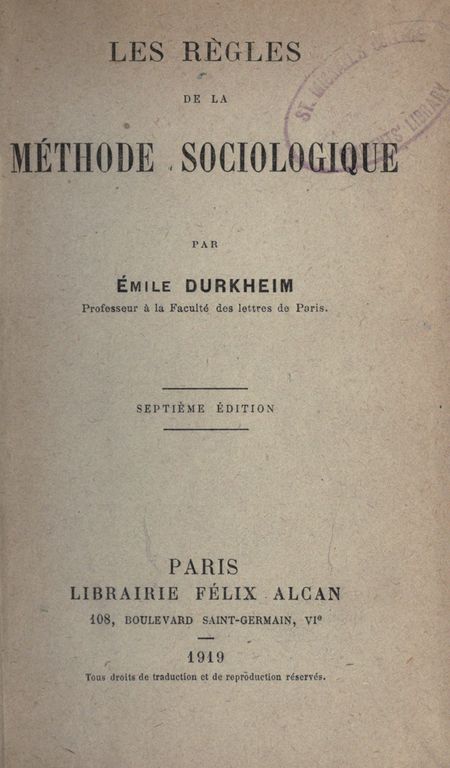
Les règles de la méthode sociologique
Introduction
Nova: Imagine for a second that you are not actually in control of your own life. I know, it sounds like the plot of a sci-fi movie, but in 1895, a French scholar named Emile Durkheim published a book that basically argued exactly that. He claimed that there are invisible forces, massive structures we cannot see, that dictate how we think, how we act, and even how we feel.
Nova: It is not fate, Leo. It is society. The book is called Les regles de la methode sociologique, or The Rules of Sociological Method. It is arguably one of the most important books ever written because it basically invented the modern science of sociology. Before this, people thought studying society was just a branch of philosophy or psychology. Durkheim said, no, society is its own thing, a unique entity that needs its own rules and its own scientific method.
Nova: Exactly. He wanted to move away from armchair philosophy where people just guessed why things happened. He wanted data, rigor, and most importantly, a clear definition of what a sociologist is actually looking at. He called these things social facts, and they are much weirder and more powerful than you might think.
Defining the Invisible Forces
The Discovery of the Social Fact
Nova: To understand Durkheim, we have to start with his most famous concept: the social fact. He defines a social fact as a way of acting, thinking, or feeling that is external to the individual and invested with a power of coercion.
Nova: It can be that literal, but usually it is much more subtle. Think about the language we are speaking right now. Did you invent English, Leo?
Nova: Right. It existed before you were born, and it will exist after you are gone. That is the external part. And if you decided right now to start speaking a language you just made up, nobody would understand you. You would be ignored or laughed at. That pressure to conform to the rules of English so you can communicate? That is the coercive part. Language is a social fact.
Nova: You choose the words, but the structure is given to you. Durkheim uses other examples like currency. You use dollars or euros because society agrees they have value. If you try to pay for your coffee with shiny rocks, the barista is going to call security. The monetary system is a social fact. It exists outside of you, but it dictates your possibilities.
Nova: That is a perfect analogy. And Durkheim argued that these facts are not just in our heads. They are real things. He famously said we should treat social facts as things. This was a direct shot at the psychologists of his time who thought everything could be explained by looking at the individual brain.
Nova: He meant that they have a reality that is independent of our will. You can't just wish a social fact away. If you try to walk through a wall, the physical reality of the wall stops you. If you try to violate a deep social taboo, the social reality of the collective reaction stops you. He wanted sociologists to study these reactions and structures with the same objectivity a biologist uses to study a cell.
Nova: You are hitting on his functionalist perspective already. He believed that because these social facts are so persistent, they must serve some kind of purpose. They hold the whole thing together.
Treating Ideas as Things
Sociology as a Hard Science
Nova: Now, once Durkheim established that social facts exist, he had to explain how to study them. This is where the rules part of the title comes in. His first rule was: All preconceptions must be eradicated.
Nova: That was exactly his point. He argued that we are all amateur sociologists, but our common sense is actually an obstacle to real science. We think we know why people get married or why they commit crimes, but Durkheim says those are just our personal biases.
Nova: Precisely. He would say that love is a psychological state, but marriage is a social institution with specific rules, legal requirements, and historical patterns. To understand marriage, you don't look at the couple's feelings; you look at the marriage rates, the laws, and the economic conditions of the society.
Nova: It can feel that way, but Durkheim believed it was the only way to be truly objective. He wanted to move from what he called the ideological stage to the scientific stage. In the ideological stage, we use ideas to explain things. In the scientific stage, we use facts to explain things.
Nova: You look for the external signs. You look at the laws being protested, the number of participants, the slogans used, and the historical frequency of such events. You look for things that can be measured and defined clearly. He insisted that a scientist must define their subject matter by its external characteristics.
Nova: Exactly. By defining it that way, you can compare it to other protests in different countries or different centuries. You are looking for the underlying laws of social behavior, not the individual drama of the people involved.
Nova: That is a great way to put it. He believed that if you look at enough data, you will see patterns that are invisible to the people living through them. Individual actions might seem random, but social facts are remarkably stable.
Normal vs Pathological
The Function of Crime
Nova: This brings us to one of the most controversial parts of the book. Durkheim introduces a distinction between the normal and the pathological. In biology, a healthy heart is normal, and a diseased heart is pathological. He wanted to apply this to society.
Nova: You would think so, but Durkheim's definition of normal was actually based on statistics. He said that if a social fact is found in the majority of societies of a certain type, it is normal. And here is the kicker: he argued that crime is normal.
Nova: This is where Durkheim's genius, or his madness, depending on who you ask, really shines. He argued that crime is present in every single society. There has never been a society without it. Therefore, according to his rule, it must be normal.
Nova: True, but Durkheim went a step further. He said crime is not just normal; it is necessary. It serves a function. Think about it: how do we know what our values are? We know because someone breaks them and we all react with outrage.
Nova: In a way, yes. When a crime is committed, the collective consciousness of the community is offended. The punishment of the criminal is a ritual that brings the rest of society together and reaffirms their shared values. It draws a line in the sand and says, this is who we are, and that is what we do not do.
Nova: Exactly. He even suggested that in a society of saints, where no one ever committed a major crime, the smallest little faults would become huge scandals. People would find something to be outraged about just to maintain those social boundaries. The amount of crime might change, but the function of it remains the same.
Nova: That is exactly the analogy he used. Now, he did say that if the crime rate suddenly spikes or drops drastically, that could be pathological. But a steady level of crime is just part of the machinery of a functioning society. It also allows for social change. Yesterday's criminal is often tomorrow's hero. Think about people who broke laws to fight for civil rights. Their crime was the catalyst for society to evolve its moral code.
How to Prove a Social Cause
The Comparative Method
Nova: So, we have social facts, we have the rule of objectivity, and we have the distinction between normal and pathological. The final big piece of the puzzle is how to explain why things happen. Durkheim's rule here was simple but strict: The determining cause of a social fact must be sought among antecedent social facts.
Nova: It means you cannot explain a social phenomenon by looking at something that isn't social. You can't explain the rise of a religion by saying people were feeling lonely. Loneliness is a psychological state. You have to look at other social facts, like changes in the economy, the structure of the family, or the political climate.
Nova: Exactly. If you want to understand why the divorce rate is going up, you don't look at whether people are getting more selfish. You look at changes in labor laws, the education of women, or the shift in religious influence. You look for the social shifts that forced the change.
Nova: You are right, you can't. So Durkheim proposed the comparative method. He called it the indirect experiment. Since you can't create a society in a test tube, you look for societies that are similar in most ways but different in one key area. If the social fact you are studying changes along with that one variable, you might have found your cause.
Nova: Precisely. He was a huge fan of statistics for this reason. He believed that by comparing rates of things like suicide, marriage, or crime across different groups, you could isolate the social forces at work. His later work on suicide is the classic example of this. He showed that suicide rates weren't just about individual depression; they were tied to how integrated a person was into their community.
Nova: It really is. And he insisted that we should only look for one cause for one effect. He didn't like the idea that many different things could cause the same social fact. He believed in a very tight, logical connection between the cause and the consequence.
Nova: That was his goal. He wanted to give sociology the same prestige and certainty as the natural sciences. He wanted to move away from the vague storytelling of history and the abstract theorizing of philosophy to something that could be proven with evidence.
Conclusion
Nova: As we wrap up our look at The Rules of Sociological Method, it is worth reflecting on just how much this one book changed the way we see the world. Before Durkheim, the idea that society was a real, objective thing that could be studied scientifically was radical. Today, we take it for granted.
Nova: It is humbling, but it is also empowering. Durkheim believed that by understanding these rules, we could actually improve society. If we know how the machine works, we can fix it when it breaks. He wasn't just interested in theory; he wanted to help the French society of his time navigate the massive changes of the industrial revolution.
Nova: Exactly. He showed us that we are not just isolated individuals floating in a vacuum. We are part of something much larger, a collective consciousness that binds us together. Whether it is the language we speak or the laws we follow, we are always participating in the life of the group.
Nova: That is the spirit. Durkheim would be proud. We have explored the definition of social facts, the importance of objectivity, the surprising function of crime, and the rigor of the comparative method. It is a foundational text for a reason.
Nova: My pleasure, Leo. And to everyone listening, remember that the world around you is full of hidden structures waiting to be discovered. Keep asking questions, keep looking for the data, and keep exploring the invisible forces that make us who we are. This is Aibrary. Congratulations on your growth!