

The Science of Constructive Optimism
Golden Hook & Introduction
SECTION
Nova: Your brain is lying to you about why you failed today, and that lie is actively making you physically weaker.
Atlas: That is a brutal way to start the morning, Nova. But honestly, I think a lot of people listening can relate to that feeling of a setback just draining their physical energy.
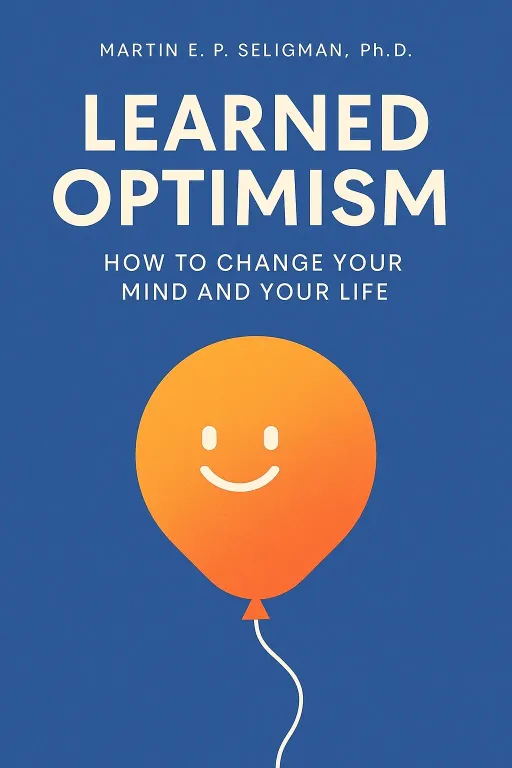
Nova: It is a documented physiological response. The way we talk to ourselves in the quiet aftermath of a defeat directly dictates our immune system, our cardiovascular health, and our career longevity. Today we are diving into the science behind this with two foundational books by Martin Seligman, the father of positive psychology. We are looking at Learned Optimism and its companion guide for the next generation, The Optimistic Child.
Atlas: Oh, I have heard of Seligman. He is a massive figure in psychology. Didn't he lead the entire American Psychological Association at one point?
Nova: Yes, he was elected president of the APA by the largest vote in its history. He used that historic mandate to completely shift the field of psychology. For decades, the focus was almost entirely on treating mental illness and pathology. Seligman stood up and said we need to study what makes life worth living, how we build resilience, and how we foster human strength.
Atlas: That makes so much sense. We spend so much time studying how things break, but we rarely study how they stay strong under pressure. So where does this journey actually begin? Because I know his early work was actually quite dark.
Nova: It was. It started in the late 1960s with a series of highly controversial experiments on what he called learned helplessness. He discovered that when animals, and later humans, are subjected to mild, unavoidable unpleasantness, they eventually stop trying to escape. They learn that their actions have no impact on the outcome. Even when the situation changes and escape becomes incredibly easy, they just lie down and accept the discomfort. They have learned to be helpless.
Atlas: Wow, that is heavy. It sounds exactly like what happens when someone experiences a string of bad luck in their career or personal life. They just throw their hands up and say, why even try?
Nova: Exactly. But Seligman noticed something else. During these experiments, about one-third of the subjects never became helpless. No matter how many setbacks they faced, they kept looking for a way out. They kept trying. This discovery obsessed him. Why do some people break under pressure, while others find a way to thrive? The answer, he found, lies in our explanatory style.
The Anatomy of Explanatory Styles
SECTION
Nova: Let's break down what an explanatory style actually is. It is the habitual way we explain bad events to ourselves. It is the internal monologue that runs when we make a mistake, lose a client, or fail a test. Seligman broke this down into three core dimensions, which we can call the three P's: permanence, pervasiveness, and personalization.
Atlas: That sounds like a powerful framework. Let's start with permanence. How does that play out in our minds?
Nova: Permanence is all about time. When a setback occurs, a pessimist believes the cause is permanent. They say, I always mess up, or this industry is dead forever. An optimist, on the other hand, views the setback as temporary. They say, that was a rough quarter, or I was exhausted today. They see the cause as a passing storm, not a permanent climate change.
Atlas: Oh, I see. It is the difference between saying I am terrible at public speaking and saying I did not prepare enough for this specific presentation. One feels like a life sentence, and the other is just a scheduling issue.
Nova: You nailed it. And that leads directly to the second dimension, which is pervasiveness. This is about space and scope. A pervasive explanatory style means you let a failure in one specific area of your life bleed into every other area. If a project fails at work, a pessimist thinks, my entire career is over, and I am probably a terrible partner and friend too. An optimist compartmentalizes. They say, this project failed, but my team still trusts me, and my home life is solid. They keep the damage contained.
Atlas: That is a massive distinction. I imagine anyone managing high-pressure teams struggles with this. It is so easy to let a single bad meeting ruin your entire week and color every decision you make.
Nova: It really is. The third dimension is personalization, which is about ownership. When things go wrong, do you look inward or outward? A pessimist immediately internalizes the blame. They say, I am stupid, or I don't have what it takes. An optimist looks at the external factors. They say, the market conditions were terrible, or the instructions were unclear.
Atlas: Hold on a second, Nova. This is where I want to push back a bit. If we are always blaming external factors, don't we risk becoming completely unaccountable? It sounds like we are just making excuses for our own failures.
Nova: That is a very common objection, and it is a crucial point. Seligman is very clear that optimism is not about lying to yourself or avoiding responsibility. It is about cognitive accuracy. If you actually made a mistake, you need to acknowledge it. But pessimists take 100% of the blame for things that were largely out of their control. They ignore the weather, the market, the team dynamics, and focus solely on their personal flaws. Optimists look at the data objectively. They take responsibility for their specific actions, but they do not take on the burden of factors they could not control.
Atlas: That makes sense. It is about separating your identity from the event. You are not a failure; you just experienced a failure.
Nova: Exactly. And the real-world impact of this is staggering. Seligman conducted a famous study with the giant insurance company MetLife. At the time, MetLife was spending millions of dollars hiring and training sales agents, only for half of them to quit within the first year because selling insurance involves facing constant rejection. Seligman suggested testing the applicants' explanatory styles.
Atlas: Oh, that is a brilliant real-world laboratory. What happened?
Nova: The results were mind-blowing. The agents who scored high in optimism sold 37% more insurance than their pessimistic peers. Even more incredible, the agents in the top ten percent for optimism sold 88% more than those in the bottom ten percent. On top of that, the pessimists quit at twice the rate of the optimists. MetLife actually changed their entire hiring strategy based on this research, hiring people who had high optimism scores even if they failed the traditional industry aptitude tests.
Atlas: That is an unbelievable statistic. It shows that resilience is a highly valuable business asset. It is literally a line item on a balance sheet.
Nova: It absolutely is. And it shows that talent and intelligence are only part of the equation. If your explanatory style makes you give up after the tenth rejection, your talent never even gets a chance to shine.
Fostering Resilience and Actionable Reframing
SECTION
Atlas: That brings up a really interesting question. Where does this style come from? Are we just born as optimists or pessimists, or is this something we pick up along the way?
Nova: We learn it, largely during childhood. In his book The Optimistic Child, Seligman explains that children develop their basic explanatory style by around the age of eight. They learn it by listening to the adults around them, particularly their parents and teachers. They pay close attention to how we explain our own failures, and how we criticize them.
Atlas: That sounds like a heavy responsibility for parents. I imagine the way we give feedback to a child can shape their entire adult mindset.
Nova: It absolutely does. Seligman warns against two major traps here. The first is the pessimistic criticism trap, where we tell a child they did poorly because of a permanent, personal flaw. For example, saying you are just bad at math instead of saying you did not study enough for this fractions test. The second trap, which might surprise people, is the empty praise trap.
Atlas: Oh, I am intrigued. What is the empty praise trap?
Nova: During the self-esteem movement of the eighties and nineties, parents were told to constantly praise their children to make them feel good about themselves, regardless of actual performance. Seligman argues this backfired completely. Self-esteem is a natural byproduct of doing well, of overcoming obstacles and mastering skills. When we give kids unearned praise, they see right through it. They learn that praise is meaningless, and they never develop the actual coping mechanisms required to handle real failure.
Atlas: That is a powerful point. It is like trying to build a house by painting the walls before you have even poured the foundation. You are giving them the feeling of success without the tools to actually achieve it.
Nova: That is a perfect analogy. We need to teach children, and ourselves, how to engage with the world effectively. Seligman developed a framework based on cognitive behavioral therapy called the ABCDE model. It stands for Adversity, Belief, Consequence, Disputation, and Energization.
Atlas: Okay, let's walk through that. How does that work in practice?
Nova: Let's say you face an Adversity. You present a proposal at work, and your boss rejects it. Your immediate Belief might be, I am terrible at my job, and I am going to get fired. The Consequence of that belief is that you feel miserable, you lose your energy, and you avoid talking to your boss for the rest of the week.
Atlas: Right, that is the classic downward spiral. So how do we break it?
Nova: That is where Disputation comes in. This is the core skill of learned optimism. You actively dispute your own belief with evidence. You look at it like a lawyer defending a client. You say, wait, is it really true that I am terrible at my job? I just received a great performance review last month. My boss did not say the proposal was terrible; she just said we do not have the budget for it this quarter.
Atlas: Oh, I love that. You are essentially cross-examining your own negative thoughts. You are demanding proof.
Nova: Exactly. And when you do that, you reach the final step, which is Energization. By disputing the irrational belief, you feel a surge of relief and renewed energy. You realize the situation is temporary and specific, which allows you to take constructive action. You can schedule a follow-up meeting to discuss how to adjust the proposal for the next budget cycle.
Atlas: That makes so much sense. It takes the emotional sting out of the setback and turns it into a practical puzzle to be solved. But how do we make this a daily habit? Because when you are in the middle of a high-stress day, it is incredibly hard to stop and run through a five-step cognitive model.
Nova: This is where we can apply the tiny step takeaway from Seligman's work. The next time you face a professional setback, no matter how small, commit to writing down three temporary and specific causes for the failure.
Atlas: That sounds incredibly simple, but I can see how it would be highly effective. Why three causes specifically?
Nova: Writing down three specific causes forces your brain to shift from emotional panic to analytical thinking. It activates your prefrontal cortex. By forcing yourself to find temporary and specific reasons, you are actively dismantling the permanence and pervasiveness traps. You are training your brain to see the setback as a localized, solvable problem.
Atlas: Let's play this out with a real-world example. Imagine a product launch that completely flops. A team leader is sitting at their desk, feeling that heavy weight of failure. What do they write down?
Nova: Instead of writing, our team is incompetent, which is permanent and personal, they would write down three specific things. First, we launched during a holiday weekend when user attention was incredibly low. Second, the marketing campaign focused too heavily on technical specs rather than user benefits. Third, we had a critical server bug in the first hour that prevented sign-ups.
Atlas: Those are all incredibly specific and, most importantly, they are all fixable. You can launch at a better time next time, you can rewrite the marketing copy, and you can patch the bug. It gives you a roadmap for action.
Nova: It does. It shifts you from a state of learned helplessness to a state of constructive optimism. You realize that you have agency, that your actions can change the outcome next time. That is the essence of resilience.
Synthesis & Takeaways
SECTION
Atlas: This is such a refreshing perspective. It makes me realize that optimism is not about wearing rose-colored glasses or ignoring reality. It is a disciplined cognitive skill.
Nova: It really is. It is about accuracy and performance. Seligman's work shows us that our explanatory style is a habit of mind that we can actively choose to change. By practicing this daily, we build the mental stamina required to sustain our energy through demanding growth phases and lead our teams through high-pressure situations.
Atlas: That is a perfect place to wrap things up. If you are listening to this and want to put this into practice today, take that tiny step. The next time something goes wrong, grab a piece of paper and write down three temporary, specific reasons for it. Train your brain to see the path forward.
Nova: This is Aibrary. Congratulations on your growth!









