

The Optimistic Mindset Engine
Golden Hook & Introduction
SECTION
Nova: Your brain is running a highly sophisticated, round-the-clock marketing campaign, and unfortunately, it is frequently advertising absolute nonsense to you. We are talking about those immediate, automatic thoughts that tell you a single mistake has entirely ruined your career, or that one difficult meeting means you are completely incompetent.
Atlas: Oh, I know that feeling all too well. It is like having a tiny, highly dramatic news anchor living inside your head, constantly broadcasting breaking news about your personal and professional doom. And the worst part is, we usually believe the broadcast without asking for a single piece of evidence.
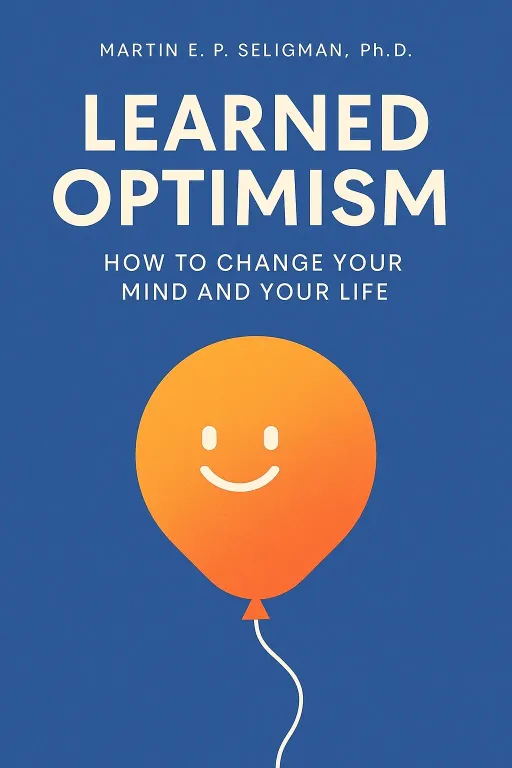
Nova: We absolutely do. Today, we are going to look at how to fire that dramatic news anchor and replace them with a rigorous, objective investigative journalist. We are diving deep into the mechanics of cognitive resilience, drawing from two massive pillars of modern psychology. First, we have Martin Seligman, the legendary researcher widely considered the father of positive psychology, and his classic work, Learned Optimism. Seligman actually spent years studying learned helplessness before realizing that optimism is not just a genetic trait, it is a cognitive skill that can be systematically learned.
Atlas: Right, and then we are pairing that with the clinical powerhouse David Burns and his highly acclaimed book, Feeling Great. Burns is a pioneer of cognitive behavioral therapy, and his TEAM framework has completely revolutionized how fast people can expose and dismantle their own cognitive distortions.
Nova: The beauty of these two approaches is that they do not ask you to engage in toxic positivity or repeat empty affirmations in the mirror. Instead, they give you a practical, high-performance toolkit to audit your own thoughts, especially when you are dealing with professional setbacks and high-pressure environments.
Atlas: That sounds exactly like what our listeners need. If you are juggling a massive workload and trying to maintain your momentum, you do not have time for vague advice. You need to know how to clean up your mental dashboard quickly so you can get back to making real progress. Where do we start?
Nova: We start with Seligman and the fundamental way we explain the world to ourselves. He calls this our explanatory style. When something goes wrong, your brain automatically writes a story about why it happened. Seligman discovered that pessimists and optimists write completely different stories, and those stories dictate whether we bounce back or completely freeze up.
Rewriting the Internal Script
SECTION
Atlas: Okay, let's unpack that. When you say explanatory style, what does that actually look like in real life? Because to me, it sounds like some people are just naturally glass-half-full and others are glass-half-empty.
Nova: It feels that way, but Seligman proves it is actually a learned habit. He breaks it down into three dimensions, which we can call the three Ps: permanence, pervasiveness, and personalization. Let us focus on permanence first. When a setback occurs, a pessimistic explanatory style views the trouble as permanent. They think, this project failed because I am bad at managing people, and I will always be bad at it. An optimistic style views the setback as temporary. They think, this project failed because we had a communication breakdown this week, and we can fix that next time.
Atlas: Wow, that is a massive difference. The first version makes you feel like you are trapped in a permanent state of failure, whereas the second version suggests it is just a temporary bump in the road.
Nova: Exactly. And then you have pervasiveness. This is about whether you let a setback in one area of your life bleed into everything else. A pessimistic mind takes a bad presentation at work and concludes, my entire career is in jeopardy, and honestly, I am probably a terrible partner and friend too. They let the dark cloud cover the entire sky. An optimistic mind localizes the storm. They say, okay, that presentation did not go well, but my core skills are still solid, and the rest of my day is completely unaffected.
Atlas: I think a lot of high-achievers struggle with that exact pattern. We take one slipping metric or one critical email and suddenly the entire day feels like a write-off. It is incredibly exhausting because you are constantly defending your entire identity against minor setbacks.
Nova: It is incredibly draining, and that brings us to the third P, which is personalization. This is about where you place the blame. Now, this is a subtle one. It is not about avoiding responsibility. It is about whether you attribute failures to internal, unchangeable flaws, or to external, specific factors that you can actually influence. A pessimistic style says, I lost the client because I am terrible at sales. An optimistic style says, I lost the client because the competitor offered a lower price point and our current packaging was not a great fit for their budget.
Atlas: That makes perfect sense. The optimistic view gives you a solvable problem, while the pessimistic view just gives you a character flaw to worry about. So, how do we actually change this habit? If my brain is automatically running the pessimistic script, how do I rewrite it?
Nova: Seligman developed a brilliant, step-by-step system for this called the ABCDE model. It is a structured way to dispute your own automatic thoughts in real time. Let us walk through a concrete scenario to see how it works. Imagine you are a team lead, and your team just missed a critical project deadline.
Atlas: Let us run with that. That is a classic high-stress scenario. The deadline is missed, the client is unhappy, and the pressure is on. What is the A in this model?
Nova: The A stands for Adversity. This is the objective fact of what happened. In this case, the adversity is simply: the project was not delivered by five p. m. on Friday. No judgment, just the raw data.
Atlas: Got it. Just the facts. But then comes the B, right?
Nova: Yes, B is for Belief. This is where your brain starts writing the story. If you have a pessimistic style, your automatic belief might be: I am a terrible leader, my team does not respect me, we are going to lose this client, and I am probably going to get fired.
Atlas: That escalated quickly, but honestly, that is exactly how the brain works under stress. It jumps straight to the worst-case scenario.
Nova: Every single time. And that leads directly to C, the Consequences. Because you believe you are a terrible leader who is about to get fired, you feel anxious, defeated, and completely paralyzed. Instead of taking constructive action to fix the project, you spend the weekend hiding from your emails and feeling miserable. The consequence of your belief is inaction and despair.
Atlas: This is the loop that traps so many people. The belief creates the feeling, and the feeling drives the behavior, which usually makes the adversity even worse.
Nova: You have hit the nail on the head. And this is where most people stop. They assume their automatic belief is the absolute truth. But Seligman says this is precisely where you must introduce the secret weapon: D, which stands for Disputation. This is where you actively argue against your own belief. You do not just say, oh, everything will be fine. That is wishful thinking, and your brain will not buy it. You have to use cold, hard evidence. You act like a defense attorney cross-examining your own thoughts.
Atlas: I love that image. So, how does the defense attorney handle the belief that I am a terrible leader who is going to get fired?
Nova: You look at the facts. You say to yourself, wait a minute. Is it true that I am a terrible leader? No. Last month, we successfully launched two major initiatives, and my team gave me excellent feedback in our annual review. Is it true that I am going to get fired? Extremely unlikely. My manager told me last week that I am a key asset to the department. The delay happened because two team members were out sick, and our client changed the project requirements at the last minute.
Atlas: That is incredibly grounding. It shifts the conversation from an emotional crisis to a logistical puzzle.
Nova: Exactly. It strips away the drama. And that leads to the final step: E, which is Energization. Once you have successfully disputed the catastrophic belief, you feel a shift in your energy. You realize you are not helpless. You feel motivated to send a professional email to the client explaining the new timeline, and you schedule a brief team meeting for Monday morning to adjust the workload. You have reclaimed your agency.
Atlas: That is an incredibly powerful sequence. It takes you from paralyzed to proactive in a matter of minutes. But I can already hear the skeptics asking, does this really work when the stakes are incredibly high? What if the adversity is not just a missed deadline, but a genuine career crisis?
Nova: That is actually when it is most critical. Seligman’s research showed that people who use this disputation process are far more resilient, less prone to burnout, and consistently outperform those who let their automatic pessimistic beliefs run wild. It is essentially cognitive armor.
Dismantling Cognitive Distortions
SECTION
Atlas: That cognitive armor sounds fantastic, but what about those moments when the negative thoughts feel so heavy and so true that we cannot even begin to dispute them? Sometimes you are so deep in the pit that arguing with yourself feels impossible.
Nova: That is the perfect transition to David Burns and his TEAM framework. Where Seligman gives us a model for reshaping our daily explanatory style, Burns provides a rapid-response system for those moments when we are completely gripped by intense anxiety or self-doubt. He specializes in exposing what he calls cognitive distortions, which are essentially systematic errors in our thinking.
Atlas: I find the concept of cognitive distortions fascinating because they are so incredibly sneaky. They masquerade as logical, realistic thoughts, but they are actually just psychological optical illusions.
Nova: They really are. And Burns argues that before we can even use methods to change our thoughts, we have to deal with our own internal resistance. This is what makes his TEAM framework so revolutionary. The T stands for Testing, which is simply measuring how you feel. But the magic really happens in the E and the A, which stand for Empathy and Agenda Setting.
Atlas: Let us talk about Agenda Setting, because that sounds like a step most people completely skip. Usually, when we feel bad, we just want to jump straight to fixing it. Why do we need to set an agenda first?
Nova: Because deep down, part of us often wants to hold onto our negative thoughts. Burns realized that our negative feelings are often deeply connected to our core values. For example, if you are a high-achiever who is constantly worrying about making a mistake, that worry is tied to your high standards and your desire to do excellent work. If we just try to force you to stop worrying, your subconscious resists because it thinks, if I stop worrying, it means I do not care about quality anymore.
Atlas: Wow. That is a profound insight. The worry is wearing a mask of professional dedication. So, if we try to just positive-think it away, we feel like we are abandoning our standards.
Nova: Exactly. So in Agenda Setting, you look at the negative thought and ask, what does this thought say about me that is actually positive and beautiful? If you are feeling overwhelmed by a setback, that feeling shows you have a deep sense of responsibility and a passion for your work. Once you honor and validate that, the resistance melts away. You can say, okay, I want to keep my high standards, but I want to lose this paralyzing self-criticism. Now, we are ready for M, which stands for Methods.
Atlas: And the methods are where we actually dismantle the distortions. What are some of the classic distortions that high-performing professionals fall into?
Nova: The absolute classic is all-or-nothing thinking. This is where you see everything in black-and-white categories. If your performance is not absolute perfection, you view yourself as a total failure. There is no middle ground.
Atlas: I see that constantly. It is the mindset of, if I do not get an A on this project, it is an F. There is no room for a solid, highly functional B-plus. It makes every single task feel like a high-wire act without a safety net.
Nova: It is incredibly punishing. Another major one is mental filtering. This is where you dwell exclusively on a single negative detail and filter out all the positive aspects of your reality. It is like having a drop of ink fall into a glass of clear water, and suddenly you believe the whole glass is toxic. You could receive ten glowing pieces of feedback on a project, but if one person asks a critical question, you spend the entire week obsessing over that one question.
Atlas: That is such a vivid image. The drop of ink in the water. We completely ignore the clear water because we are so hyper-focused on the dark speck. Why does our brain do that?
Nova: It is an evolutionary survival mechanism. Our ancestors had to pay far more attention to the rustle in the bushes that might be a predator than to the beautiful sunset. But in a modern professional setting, that survival mechanism becomes a massive liability. It causes us to make terrible decisions based on incomplete, biased data.
Atlas: So, how do we use Burns' methods to clean the water, so to speak? How do we challenge these distortions when we catch ourselves doing them?
Nova: One of the most effective methods is the double-standard technique. When you are beating yourself up over a mistake, you ask yourself, would I say these exact things to a close friend or a colleague who made the same mistake?
Atlas: Oh, absolutely not. If a colleague came to me and said, I missed a deadline, I am a complete fraud and my career is over, I would tell them they are being ridiculous. I would point out all their past successes and help them draft a quick plan to get back on track.
Nova: But when it is ourselves, we use a completely different, highly abusive standard. The double-standard technique forces you to extend the same objective, compassionate logic to yourself that you naturally offer to others. It is not about letting yourself off the hook, it is about being fair and realistic.
Atlas: It is about applying the same quality of logic to your own life that you apply to everyone else's. I really like that because it appeals to our sense of fairness and accuracy. It is not soft, it is just correct.
Nova: Exactly. Another brilliant method is the examine-the-evidence technique. Instead of accepting the distortion as a fact, you demand proof. If your brain says, everyone thinks I am doing a terrible job, you write that down as a hypothesis. Then, you look for concrete, verifiable evidence to support or refute it. You ask, has anyone actually told me this? What did my last performance review say? What are the actual project metrics? When you force your brain to produce real evidence, the distortion usually crumbles because it has absolutely nothing to stand on.
Synthesis & Takeaways
SECTION
Atlas: That is incredibly liberating. It feels like we are taking the emotional charge out of the situation and turning it into a straightforward data-auditing process.
Nova: That is the ultimate goal. When you combine Seligman’s ABCDE model with Burns’ cognitive restructuring, you get an incredibly robust system for maintaining your mental momentum. You stop being a passive victim of your automatic thoughts and start actively managing your cognitive engine.
Atlas: What I find so compelling about this is how it serves the high-achiever who is short on time. This is not about spending hours in self-reflection. It is about a rapid, highly efficient mental intervention that you can do on the back of a napkin during a five-minute break.
Nova: It is entirely about efficiency and impact. And that brings us to our tiny step for today, which is a practical way to build this cognitive muscle starting right now. The very next time you face a professional setback, big or small, do not just let the thoughts swirl around in your head. Grab a piece of paper or open a blank document and do three quick things.
Atlas: Walk us through them. What are the three steps?
Nova: First, write down your immediate belief about the setback. Get the raw, unfiltered dramatic news broadcast out of your head and onto the page. Second, look at that belief and identify the cognitive distortion at play. Is it all-or-nothing thinking? Are you filtering out the positive? Are you treating a temporary setback as a permanent failure?
Atlas: And the third step?
Nova: Actively dispute that belief with three objective, unarguable facts. Not vague hopes, but real data points from your life that prove the catastrophic belief is incorrect.
Atlas: That is incredibly practical. It takes less than five minutes, but it completely breaks the cycle of catastrophic thinking before it can derail your day. It is like a quick software patch for your brain.
Nova: It really is. By doing this regularly, you are training your brain to automatically look for objective reality rather than falling into default pessimistic traps. You are building a mind that is not just optimistic, but resilient, agile, and primed for continuous growth.
Atlas: That feels like the ultimate competitive advantage in a fast-paced world. It is about keeping your head clear so you can keep moving forward, regardless of the obstacles thrown your way.
Nova: It is the foundation of true cognitive mastery. We hope you take this tiny step and apply it the very next time you feel that mental news anchor starting to panic.
Atlas: This is Aibrary. Congratulations on your growth!









