

The Discipline of the Process
Golden Hook & Introduction
SECTION
Nova: We've all heard the mantra, "focus on your goals, visualize success, chase that outcome." It's ingrained in our culture. But what if that relentless pursuit of the finish line is secretly sabotaging your performance, stealing your joy, and actually creating a constant hum of stress?
Atlas: Ooh, now that's a bold claim, Nova. It sounds almost… heretical to the entire self-help industry. I mean, aren't goals what propel us forward, especially for those of us trying to make an impact or navigate complex new landscapes?
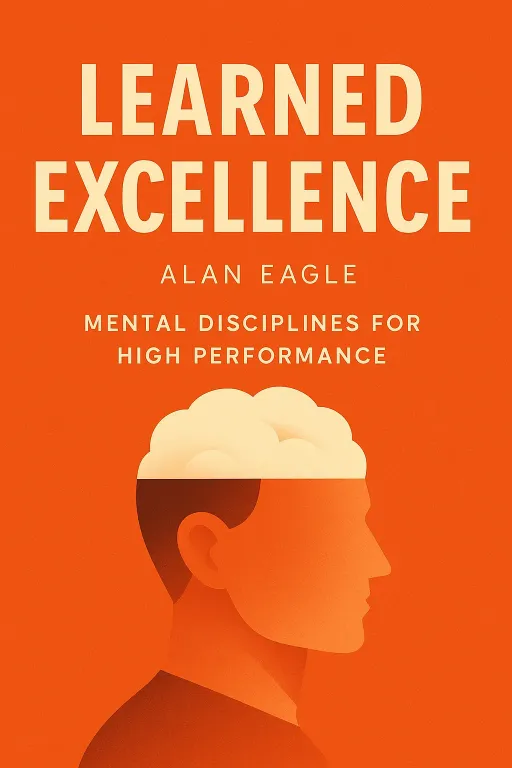
Nova: Absolutely, Atlas, and it’s a valid question that many curious strategists grapple with. But today, we're flipping that script entirely, exploring a profound shift in perspective that promises not just higher proficiency, but genuine peace. We're diving into "The Discipline of the Process," drawing insights from two incredible works: "Learned Excellence" by Alan Eagle and "The Practicing Mind" by Thomas M. Sterner.
Atlas: Oh, I like that. Two different lenses, same powerful core idea. Tell us a bit about the minds behind these.
Nova: Well, Alan Eagle, for instance, co-authored "Learned Excellence" after years within the high-performance culture of Google, observing firsthand what truly drives elite teams and individuals. He brought that lens to studying Navy SEALs and Olympians. Then there’s Thomas M. Sterner, a renowned mindfulness coach who penned "The Practicing Mind" from his deep experience guiding artists, athletes, and even everyday individuals in cultivating presence.
Atlas: So we have insights from tech, elite forces, and mindfulness. That’s a powerful triangulation. It makes me curious, what’s the central tension they both address?
The Counterintuitive Power of Process Over Outcome
SECTION
Nova: The central tension, Atlas, is our obsessive focus on the versus the often-overlooked power of the. Sterner, in particular, emphasizes shifting our focus from the end goal to the present process to eliminate stress and dramatically increase proficiency.
Atlas: Hold on, that sounds great in theory, but how do you just… the goal? For many of our listeners, myself included, goals are the North Star. They're what drive us to learn new tech, to communicate better, to achieve impact. Without them, don't we just drift?
Nova: That’s a really insightful question because it touches on a deep-seated belief. We’re taught to visualize success, to aim for the summit. But Sterner argues that the stress we feel often comes from the between where we are now and that distant, often intimidating outcome. By fixating on the destination, we inadvertently create anxiety and even paralysis.
Atlas: So the stress isn’t the work itself, but the constant comparison to an imagined future? That makes me wonder, what happens when we shift that focus?
Nova: What emerges is a profound sense of liberation. When you focus solely on the of the task – the actual doing – you enter a state of flow. The anxiety about "will I succeed?" or "what if I fail?" melts away, because those questions are outcome-oriented. Instead, you're absorbed in the present moment, refining the action itself.
Atlas: That’s actually really inspiring. I imagine a lot of our listeners, especially those diving into complex new technologies, feel that pressure. The sheer scope of learning a new programming language or a sophisticated AI tool can be overwhelming.
Nova: Exactly. And this is where the actionable takeaway from our content comes in: 'Process-Oriented Sprinting.' Imagine setting a timer for 20 minutes to work on a tech skill. But here's the crucial part: during those 20 minutes, you focus solely on the of the task, rather than the final result.
Atlas: So you’re saying, if I'm learning a new coding language, I wouldn't be thinking, "I need to build this entire app by the end of the week." Instead, for those 20 minutes, I'd be thinking, "How cleanly can I write this single function? How precisely can I debug this one line?"
Nova: Precisely! You're not worrying about the full application, or even if this specific function will be perfect for the final product. You're immersing yourself in the of the syntax, the logical steps of debugging, the elegance of the code structure. It’s like a musician practicing scales, not thinking about the concert, but about the purity of each note.
Atlas: That’s a great analogy. It’s like the gardener who isn’t just looking at the finished garden, but enjoying the act of turning the soil, planting each seed, watering with care. The beauty of the garden is a byproduct of the care in the process.
Nova: What's even more interesting is how this approach impacts proficiency. When you're not distracted by the outcome, your brain is fully engaged in learning and adapting in the present. This leads to deeper learning, more robust skill acquisition, and paradoxically, faster progress towards those very goals you temporarily ignored. You're building muscle memory for excellence.
Atlas: So the stress comes from the between where you are and the outcome, and the proficiency comes from closing that gap with focused, present-moment effort, rather than stressing about it. That fundamentally reframes how I think about learning something new.
Cultivating Intentional Habits & Mental Models for Mastery
SECTION
Nova: And this focus on the present process is precisely what Alan Eagle explores in "Learned Excellence" when he dissects the practices of high performers like Navy SEALs and Olympians. He argues that their extraordinary achievements are a direct result of intentional habits and sophisticated mental models.
Atlas: That sounds incredibly disciplined. I mean, Navy SEALs and Olympians operate at the absolute peak of human performance. How do "intentional habits" and "mental models" translate for someone trying to navigate new tech or master communication for impact, outside of such extreme environments?
Nova: That’s a brilliant connection, Atlas, because the principles are universal. Think about a Navy SEAL training. It's not about "win the war." It’s about the meticulous, repetitive practice of every single movement: how to clear a room, how to load a weapon, how to communicate non-verbally. Each action is an "intentional habit" refined to perfection. The mental model comes in anticipating scenarios, running through "if-then" loops in their minds before they even step into a situation.
Atlas: So, it's not just doing the thing, it's doing the thing and?
Nova: Exactly. Take an Olympian, a diver for example. They're not just thinking "win the gold medal." They're focused on the entry angle of their fingertips, the precise rotation of their body, the tension in their core. They have a detailed mental model of the perfect dive, playing it out repeatedly in their minds, visualizing every sensory detail, every muscle engagement, long before they ever hit the water.
Atlas: Wow, that’s such a powerful way to look at it. So for someone mastering new tech, an intentional habit might be dedicating 20 minutes every morning to deep-dive into a specific API documentation, not to solve a problem, but just to understand its architecture. And the mental model might be a framework for debugging, or anticipating how different components of a system will interact.
Nova: You've nailed it. For communication, an intentional habit could be dedicating 10 minutes daily to actively listening without interruption, or practicing framing complex ideas into single, clear sentences. The mental model would be understanding your audience’s perspective, anticipating their questions, and structuring your message for maximum clarity and impact, much like a strategist plans a campaign.
Atlas: So, it’s about constructing an internal architecture for excellence. It’s not just about the external action, but the internal framework that guides it. That makes me wonder, how do we actually these intentional habits and mental models in our daily lives without the extreme pressure of a SEAL or an Olympian?
Nova: It starts small, with that 'Process-Oriented Sprint.' It's about consistency, not intensity. It's about creating feedback loops for yourself. After your 20-minute tech sprint, you might reflect: "What did I as I typed that code? Where did my focus wander? How can I refine the next time?" It’s a continuous, mindful refinement of you do things. The mental models emerge from this reflection and repeated exposure. You start to see patterns, anticipate challenges, and develop internal strategies.
Atlas: That’s the reflective learner in me resonating deeply. It’s about truly understanding the of growth, rather than just hoping for it. It's about grounding our actions in core beliefs about how mastery is built.
Synthesis & Takeaways
SECTION
Nova: Absolutely. The beauty of these two perspectives is how they converge. Sterner gives us the 'why' – reduced stress, increased proficiency through present-moment focus. Eagle gives us the 'how' – building that focus through intentional habits and mental models, perfected by the world’s elite.
Atlas: It’s not just about doing; it’s about you do. And that 'how' is deeply rooted in being present and intentional, even when the finish line seems miles away. The idea that ignoring the outcome can actually lead to better outcomes, and less stress, is genuinely transformative.
Nova: And for our listeners, the curious strategists, empathetic innovators, and reflective learners, the takeaway is profoundly practical. Whether you're navigating new tech, mastering communication, or developing a personal philosophy, the path to sustained growth and impact lies in embracing the journey itself.
Atlas: So, the challenge then, is to try that 'Process-Oriented Sprint.' Set a timer for 20 minutes. Pick that tech skill, that communication exercise, or even a moment of reflection for your personal philosophy. And for those 20 minutes, focus solely on the mechanics, the, the present moment, letting go of the pressure of the final result.
Nova: It's an invitation to rediscover the joy in the work, to build mastery through presence, and to unlock a level of performance that outcome-fixation could never achieve. It’s about building a foundation of excellence, one mindful sprint at a time. What small, process-focused sprint can you commit to today?
Atlas: That's a powerful question to leave our listeners with. A small, intentional step can lead to profound transformation.
Nova: This is Aibrary. Congratulations on your growth!









